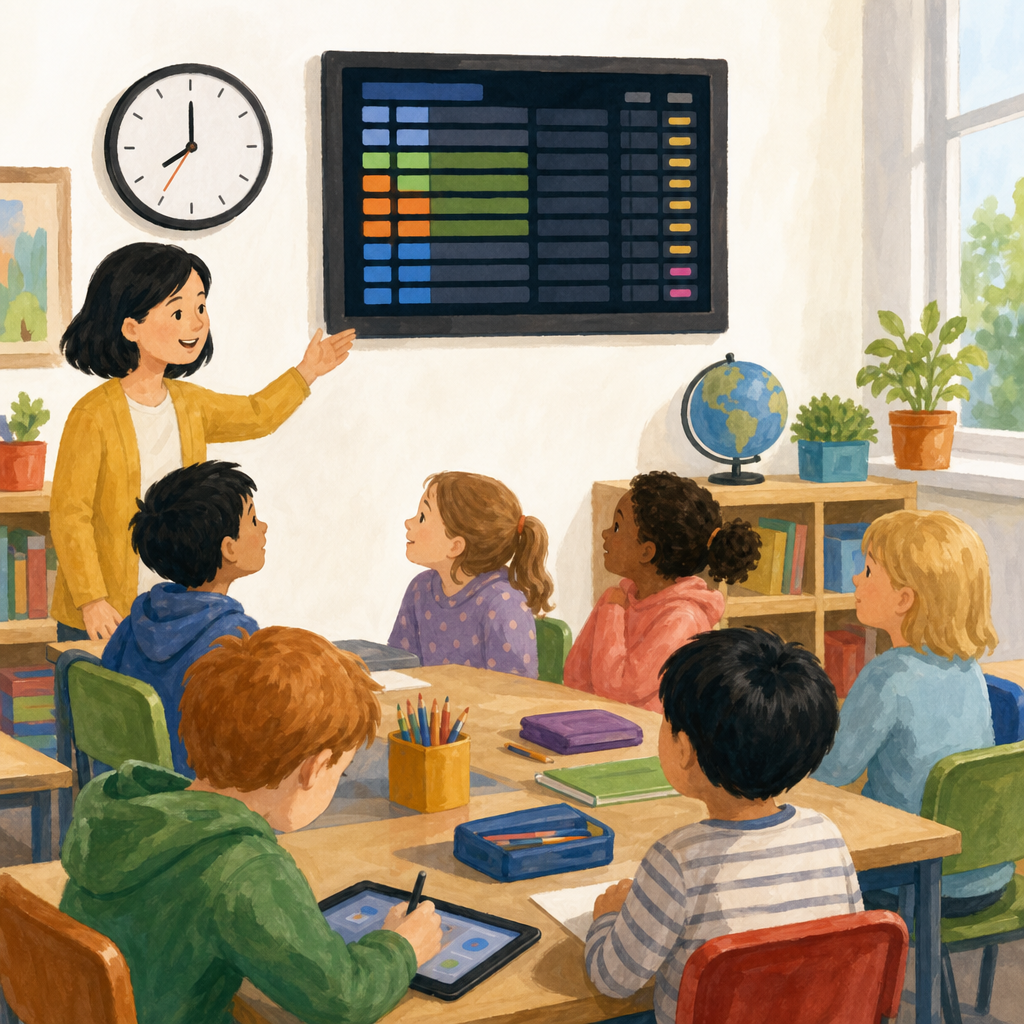
 What time is it right now? Say it in English. Now look at a train timetable: the same moment might be written as 14:30, not half past two. Today you learn French time phrases you can say aloud, and you will notice how French timetables often use the 24-hour clock.
What you'll learn
- Ask what time it is and answer with Il est…
- Say o'clock, half past, quarter past and quarter to using today's phrases
- Notice 24-hour times on a French-style board with your teacher
Listen, repeat, then flip to check the French. English is on the front: hear the model first, say it with the class, then flip to see the spelling. Watch how we build full times on the board, for example Il est deux heures et demie.
Click each French time phrase, then its English meaning. Whisper the full French time (start with Il est… when you can) as you click each one so the sound sticks with the match.
Open your copy. Write three full French time sentences using the models on the board. Choose times from today's list only.
Models (copy the pattern, change the time if you like):
- Il est deux heures. (It is two o'clock.)
- Il est cinq heures et demie. (It is half past five.)
- Il est midi. (It is midday.)
Other building blocks you may use: huit heures, dix heures, et quart, moins le quart.
Listen for each full French time phrase and cross it off if it is on your card. When every phrase on your card is crossed off, call Bingo! Keep your ears open for half past and quarter to; they sound close when they fly past quickly.
Unlock the full learning experience
You're previewing this lesson. Get full access to this lesson and hundreds more — each one ready to teach, with interactive activities, printable resources and pupil progress tracking built in.
This lesson is copyright of Coding Ireland 2017 - 2025. Unauthorised use, copying or distribution is not allowed.