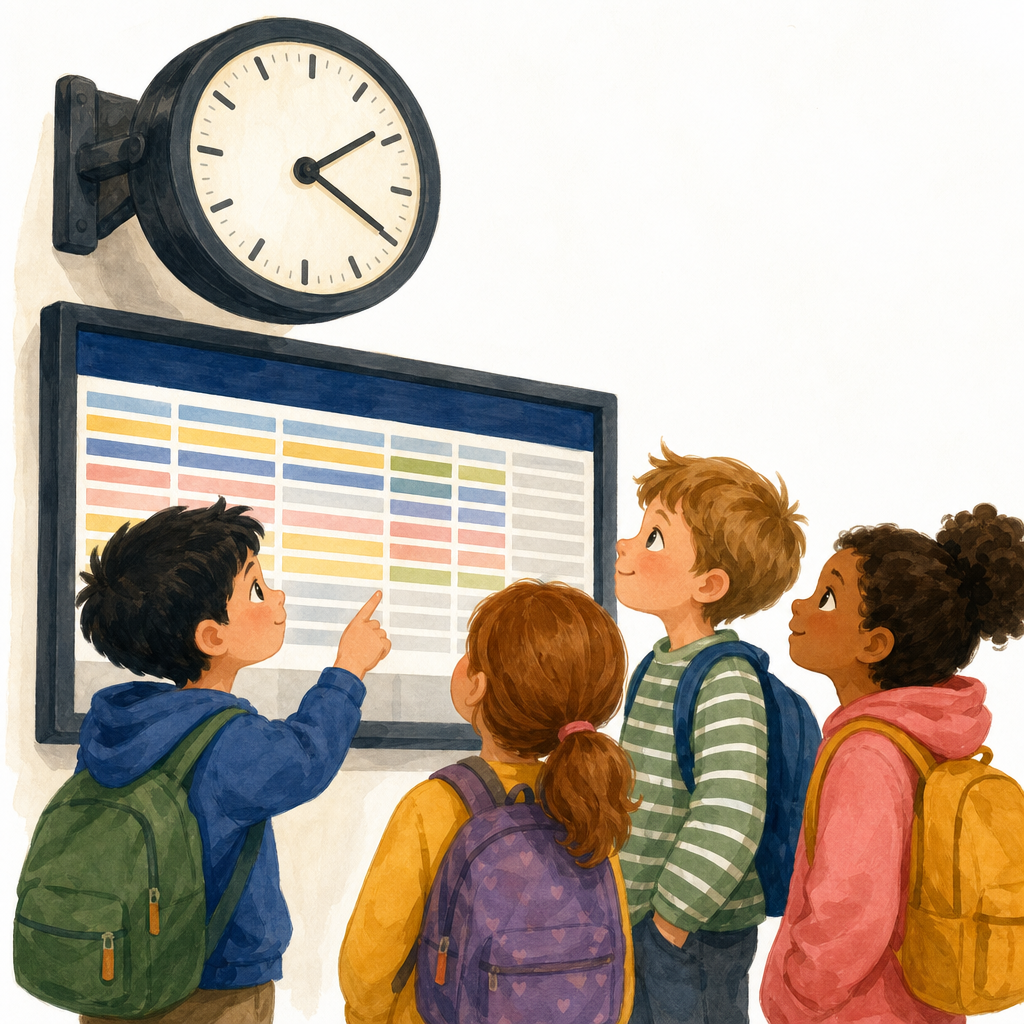
 What time is it right now? Say it in English first. Now imagine you are reading a Spanish train timetable. Would the number look the same?
By the end of this lesson, you will be able to:
- Answer the time in Spanish using today's phrases (half past, quarter past, quarter to, on the hour)
- Match a 24-hour timetable time to how you would say it face to face
- Write three times from your day with the model stems on the board
These are phrases you would hear under the clock — el reloj — in a big station like Atocha, or on a school corridor clock in Valencia.
For each card: listen to the audio, repeat twice with the class, then flip to check the English.
Hours: 1 una · 2 dos · 3 tres · 4 cuatro · 5 cinco · 6 seis · 7 siete · 8 ocho · 9 nueve · 10 diez · 11 once · 12 doce
Match as if you are helping a friend read a Cercanías board in Madrid. Click each Spanish time phrase, then its English meaning. Whisper the Spanish each time a word is picked.
Read the three model sentences aloud with the class first. Then open your copy and write your own times by swapping in your hour (and optional y media, y cuarto, menos cuarto or en punto).
Models (say them together):
Me levanto a las siete en punto. (I get up at seven o'clock exactly.)
El colegio empieza a las nueve. (School starts at nine.)
Me acuesto a las diez y media. (I go to bed at half past ten.)
Your turn — copy the frame, change the time:
Me levanto a las ______.
El colegio empieza a las ______.
Me acuesto a las ______.
Optional stretch: invent one Spanish day line from a timetable (e.g. a train at 16:45) and write the face-to-face form underneath using today's phrases: Las cinco menos cuarto.
First your teacher gives everyone a bingo card (printed ticket-style cards). The cards show school-bell and station times. Listen carefully to each time phrase and mark it on your card. When every time on your card is crossed off, call Bingo, and read your times back like a station announcer!
Unlock the full learning experience
You're previewing this lesson. Get full access to this lesson and hundreds more — each one ready to teach, with interactive activities, printable resources and pupil progress tracking built in.
This lesson is copyright of Coding Ireland 2017 - 2025. Unauthorised use, copying or distribution is not allowed.