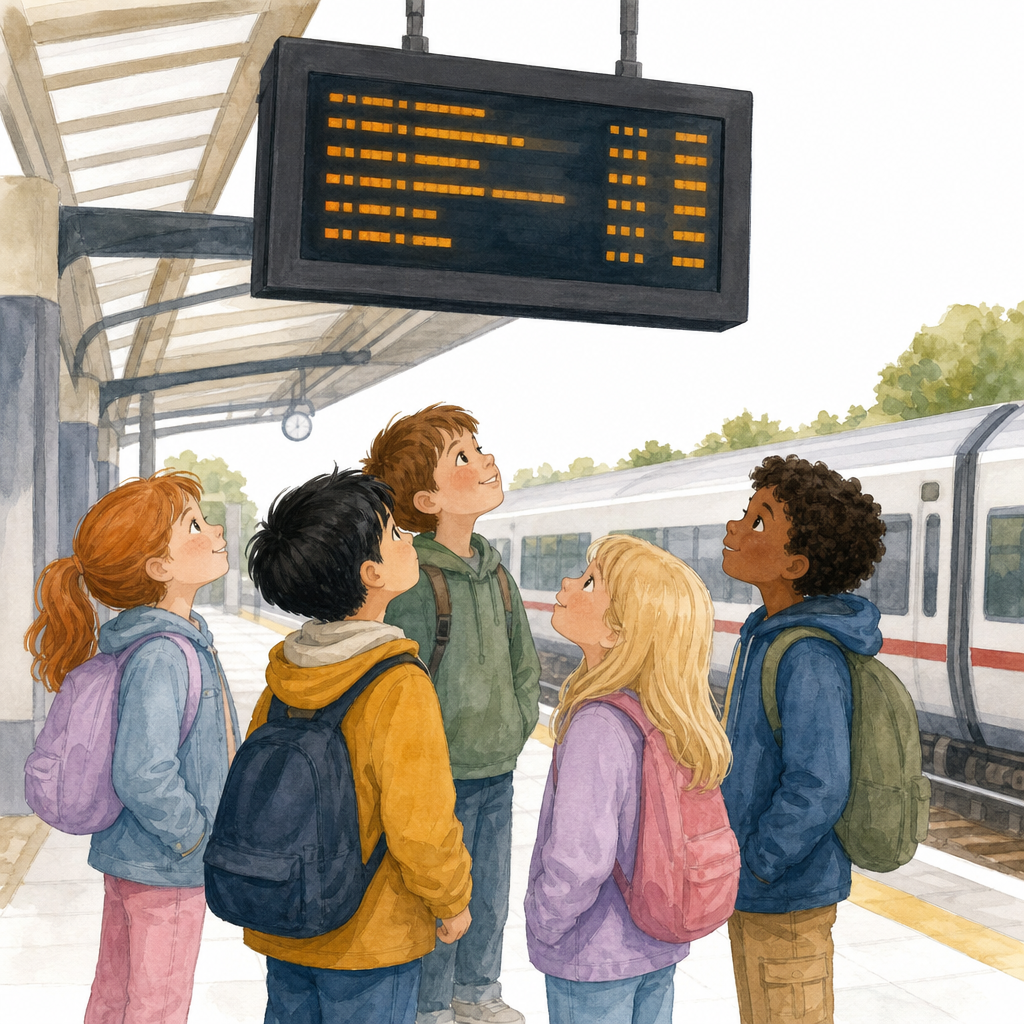
 What time is it right now? Easy enough in English. Now picture yourself on a German railway platform reading a departure board. The times look familiar, but the phrases sound different. Today you will ask for the time and answer with o'clock, half and quarter phrases you can really use.
By the end of this lesson, you will be able to:
- Ask what the time is and answer with German o'clock phrases
- Use halb, Viertel nach and Viertel vor with a clock face
- Spot why German halb names the hour still coming
Listen to each time phrase on the cards first, then repeat it together. On a second pass, try from memory before the card flips.
First pass: o'clock times, midday and the half-past chunk.
Second pass: the two quarter phrases.
The exchange you are building
Wie spät ist es? (What time is it?)
Answer with a full line from a card: an o'clock time, a half-past line, or a quarter line.
Half-past tip (clock faces): the German half-past word names the hour it is going towards, not the hour just gone.
- Halfway to 2 = half past one in English
- halb acht = half past seven (halfway to 8)
You are reading a German departure board. Click each German time phrase, then its English meaning. Say the German quietly as you click each one.
Then, pair mic (2 minutes): Partner A asks Wie spät ist es? Partner B answers from one of the four answer cards on the board, then swap.
In German, complete three lines in your copy using today's stems. The stems stay on the board the whole time, so look up at them whenever you need to.
Copy and complete
- Es ist ______ Uhr.
- Es ist Viertel nach ______.
- Es ist halb ______.
Word bank: acht · drei · fünf · elf · zwei (for halb zwei = half past one)
Optional fourth line if you finish: Es ist Mittag.
- acht Uhr — eight o'clock
- drei Uhr — three o'clock
- fünf Uhr — five o'clock
- elf Uhr — eleven o'clock
- halb — half (as in half past)
- Viertel nach — quarter past
- Viertel vor — quarter to
- Mittag — midday / noon
Listen like passengers on the platform. When the announcer calls a time phrase that is on your card, mark it. When every phrase on your card is marked, call Bingo!
Unlock the full learning experience
You're previewing this lesson. Get full access to this lesson and hundreds more — each one ready to teach, with interactive activities, printable resources and pupil progress tracking built in.
This lesson is copyright of Coding Ireland 2017 - 2025. Unauthorised use, copying or distribution is not allowed.