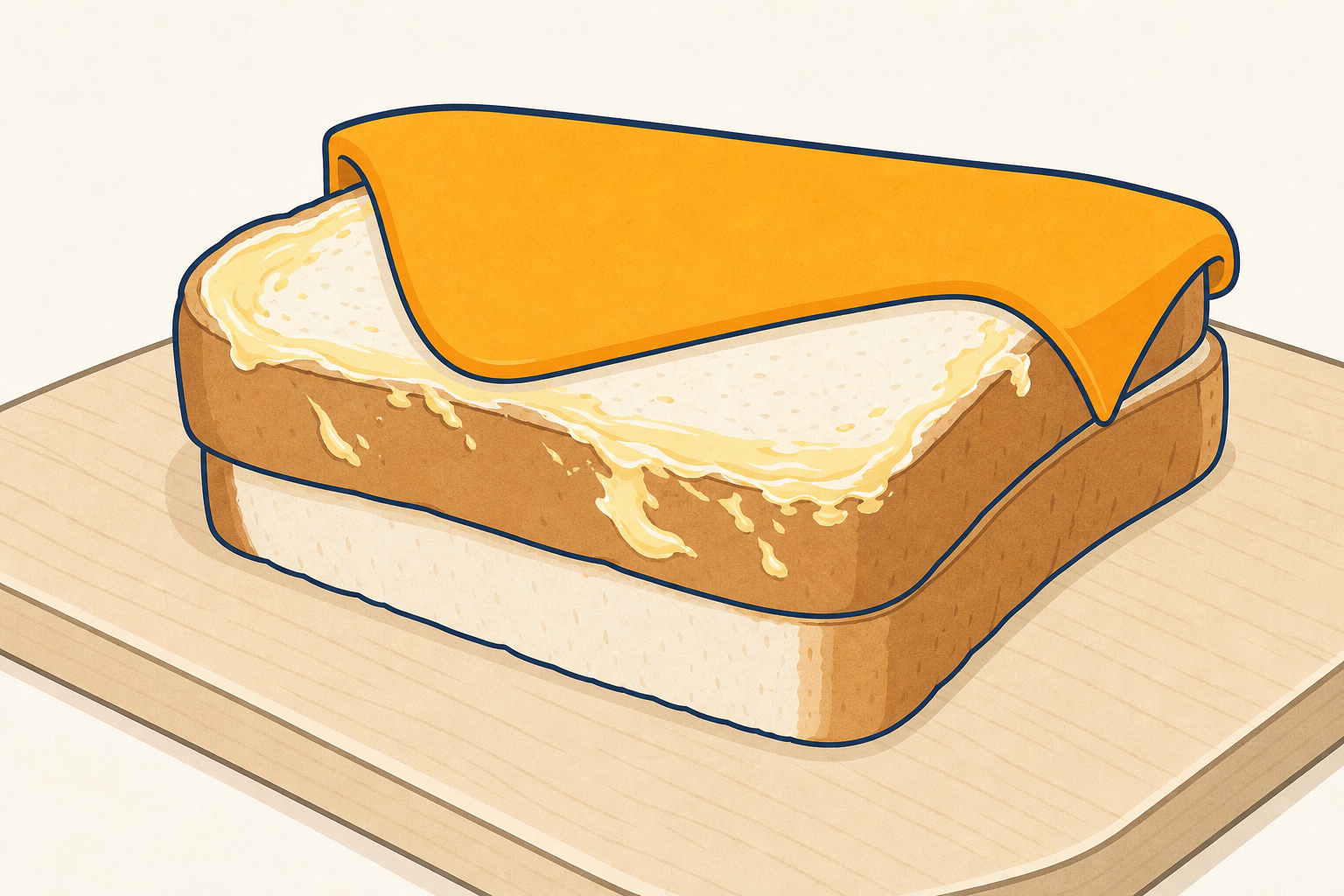
Watch this silly sandwich. Butter on the outside, bread last… oh no! Why did that go wrong?
What do you think we need to get right when we do steps?
Mime a quick, funny wrong-order sandwich with empty hands only: pretend to add filling with no bread, then grab the bread last. Keep it light and short. No props to make.
Ask: What went wrong? What should I have done first? Take two or three ideas. Do not name algorithm yet.
Have the sandwich picture cards face down nearby for the next steps, but do not lay out the full set yet.
Today's word: algorithm. That means a set of steps in the right order that tell you how to do something.
Say it with me: an algorithm is steps in the right order.
Say the word slowly: algorithm — AL-guh-rith-um. Children only need the friendly meaning: a set of steps in the right order that tell you how to do something. One short chant of the sentence together is enough here. You will chant it again after the card model and at the exit check so the label sticks. Save chef and builder examples for the later talk step so the new word is not buried.
| Concept | Why it matters | Example |
|---|---|---|
| Algorithm — a set of steps in the right order that tell you how to do something | If the steps are jumbled, the job does not work (like butter on the outside of the sandwich) | Four sandwich steps done first to last so you get a real sandwich |
| Order — which step comes first, next and last | The same steps in a new order make a different (or silly) result | Shoes on before you run outside for PE |
| Exact steps — do each step the way it was said, without skipping or swapping | Robots and helpers only do what the steps say, so clear steps matter | When you play robot, you only move when your friend says the next step |
Misconception to head off: children may think any list of actions is fine in any order. Use the silly sandwich to show order is the point.
Look at the four sandwich picture cards. Which one should come first?
Watch how we put them in order, then say the steps with me.
Use the illustrated sandwich set only — the same picture-first printable the groups will use next. Hold the four cards so the class can see the pictures. Cards are largely text-free: one simple picture per step with at most a single short label (Bread, Butter, Filling, Together). You read the full step aloud; children do not need to decode sentences.
I wonder which card comes first… I think we need the bread before the butter… I try laying them: bread, butter, filling, put together… I notice that order makes a real sandwich… I think an algorithm is steps in that right order.
Then deliberately swap two cards (e.g. filling before bread) and ask what would go wrong. Put them right again. Class choruses the four steps in order once.
Stick the label: end this step with one more class chant: An algorithm is steps in the right order. Point at the ordered cards as you say it so the word sits on the sequence they can see.
Success look-fors: children point to bread first; they notice a jumbled order is silly; they join the algorithm chant.
First we get ready, then we order.
Every group gets the sandwich picture cards. Put the pictures in the right order. Say the steps out loud together.
Do not start robot play yet. Groups finish ordering and saying the steps before the next step begins.
Differentiation: offer only three cards (drop put-together) for groups who need a shorter sequence. Confident groups can shuffle on purpose, then fix the bug.
Safety: gentle moves; stay in your floor space while cards are laid out.
Now play robot with your ordered cards.
One child talks: say one step. One child is the robot: pretend only that step. Then swap jobs. No real food.
Cards stay in the agreed order on the floor. Do not re-order during this burst unless fixing a clear mistake.
Then swap jobs so roles change.
Minimum participation: every child must be the robot at least once and the talker at least once. If time is tight, keep sequences short (two or three steps) so swaps still happen.
Fold the watchers in: when one pair acts, ask the others did the robot follow exactly? what should come next?
Safety: mime and pretend only; no real food; gentle moves; stay in your group’s space.
Optional extension if time (not the main path): a second set of illustrated PE getting-ready cards can be offered to a confident group. Tell them: this is a sensible order we use in our class (shoes off, runners on, PE top on, line up). Still mime only — no real shoes off.
You're previewing this lesson. Get full access to this lesson and hundreds more — each one ready to teach, with interactive activities, printable resources and pupil progress tracking built in.