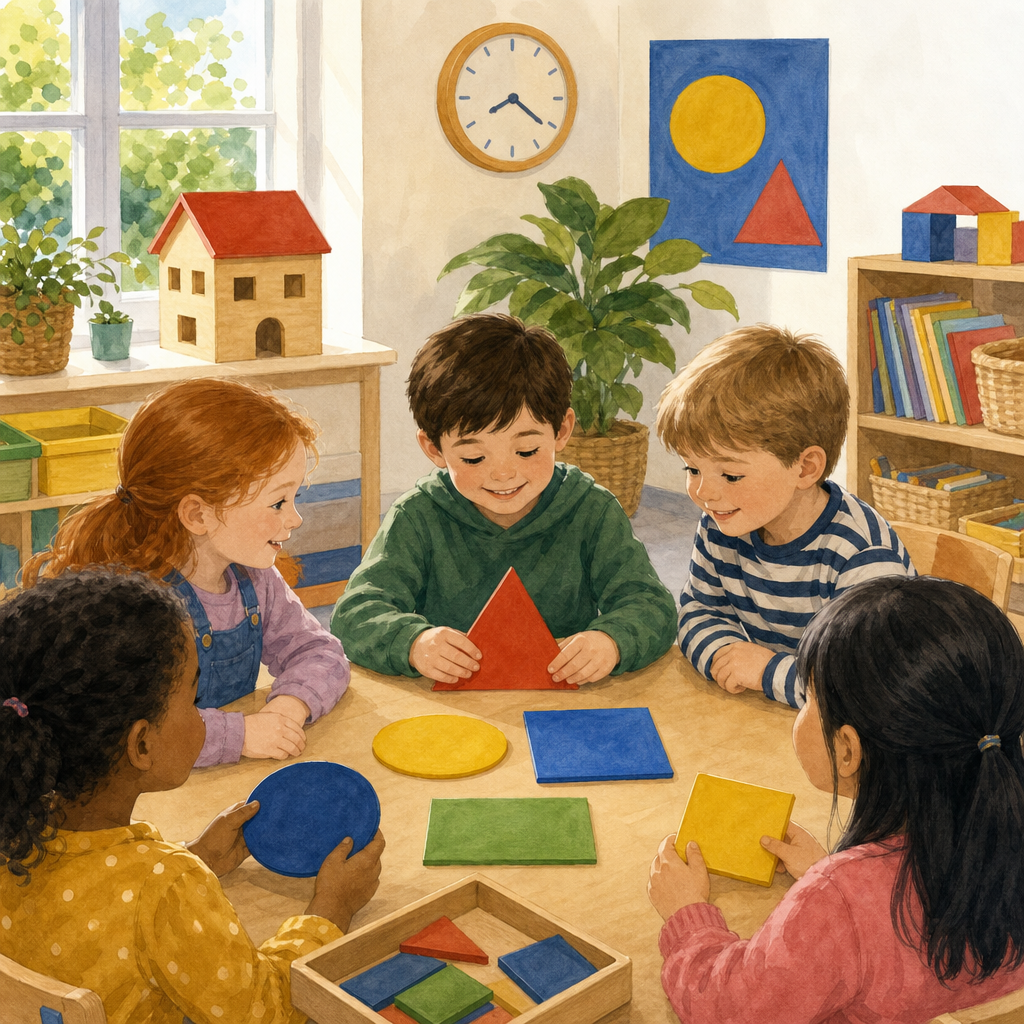
You have ten seconds. Find a circle, a square and a triangle somewhere in this room. Ready? Go!
Give the class a genuine ten-second hunt, then take three or four answers. Do not teach the German yet; the flashcards in the next step will reveal the words. Point out that German nouns always start with a capital letter, so every shape word they meet today will look like a proper name on the page.
Here are today's eight shapes. Look at each picture, listen to the German with its article, then say it with the class. Flip to see the written word only after you have heard and repeated it.
Chunk the set so eight new forms do not land at once. Start with five core shapes: der Kreis, das Quadrat, das Dreieck, der Stern, das Herz. For each card: show the image, play the audio (or model yourself), class repeats chorally twice with the article, then flip to the written form. Only after those five feel secure, add the remaining three: das Rechteck, die Raute, das Oval, same hear–say–see order.
Guides: der Kreis (dair KRYSS), das Quadrat (dahs kvah-DRAHT), das Dreieck (dahs DRY-eck), das Rechteck (dahs REKH-teck), der Stern (dair SHTAIRN), das Herz (dahs HAIRTS), die Raute (dee ROW-tuh), das Oval (dahs oh-VAHL). Cheer every full phrase with its article, never bare nouns. Herz ends with a buzzing /ts/: show teeth and tap it together, HAIRTS. After a cognate such as Quadrat or Oval, ask briefly "does this look like any English maths word?" Do not run a guess-before-flip challenge on non-cognates.
Quick German anchor: show a photo of a German Spielplatz or Ampel crossing and point out der Kreis on a signal light and das Dreieck on a warning triangle, so the words sit in a real street scene. Flag that German nouns are always capitalised.
First, a quick whole-class warm-up: teacher says a German shape, you point to it on the board. Then the wheel lands on a shape picture. Say the German word out loud with its article. The word list stays visible if you need a glance, and a classmate may whisper-help.
Before the first spin, run a short "teacher says / class points" round on the board images so every pupil hears and maps all eight again without cold production. Keep a reference strip of the eight full forms (with articles) visible at the side of the IWB for the whole activity.
Spin on the board; the wheel should show the shape image, not English alone. Invite a volunteer each time and insist on the full form with the article: das Dreieck, not bare Dreieck. Lean cold-call production toward the core five; for trickier items (die Raute, das Rechteck, der Kreis) allow a classmate whisper-help or a quick audio replay, then have the whole class echo. Big round of applause when a volunteer lands das Rechteck with the article first time. Keep the pace brisk so most pupils get a turn.
Open your copy. The eight labelled shapes stay on the board while you write. Choose four, draw each one, and write the full German word underneath with der, die or das. Watch those capital letters!
Pause the interactive and leave a single reference slide or flashcard grid showing all eight targets with articles (der Kreis, das Quadrat, das Dreieck, das Rechteck, der Stern, das Herz, die Raute, das Oval) visible on the IWB for the whole three minutes. Do not reduce this to one card: pupils need the full bank so spellings such as Quadrat, Rechteck, Dreieck and Raute are copyable, not guessed.
Everyone writes: this is the only three minutes where every pupil's pen is moving. Walk the room and check that each label carries its article and a capital letter on the noun. Praise any pupil who self-corrects a missing capital or a forgotten article. Do not collect these.
You each have a printed bingo card with shape pictures. When you hear the German name, put a counter on that picture. First full line stands and calls Bingo! then reads their shapes back in German with the articles.
How to Play Bingo:
Option 1: Students on Devices (Digital Version)
Option 2: Print Out the Bingo Cards
You're previewing this lesson. Get full access to this lesson and hundreds more — each one ready to teach, with interactive activities, printable resources and pupil progress tracking built in.