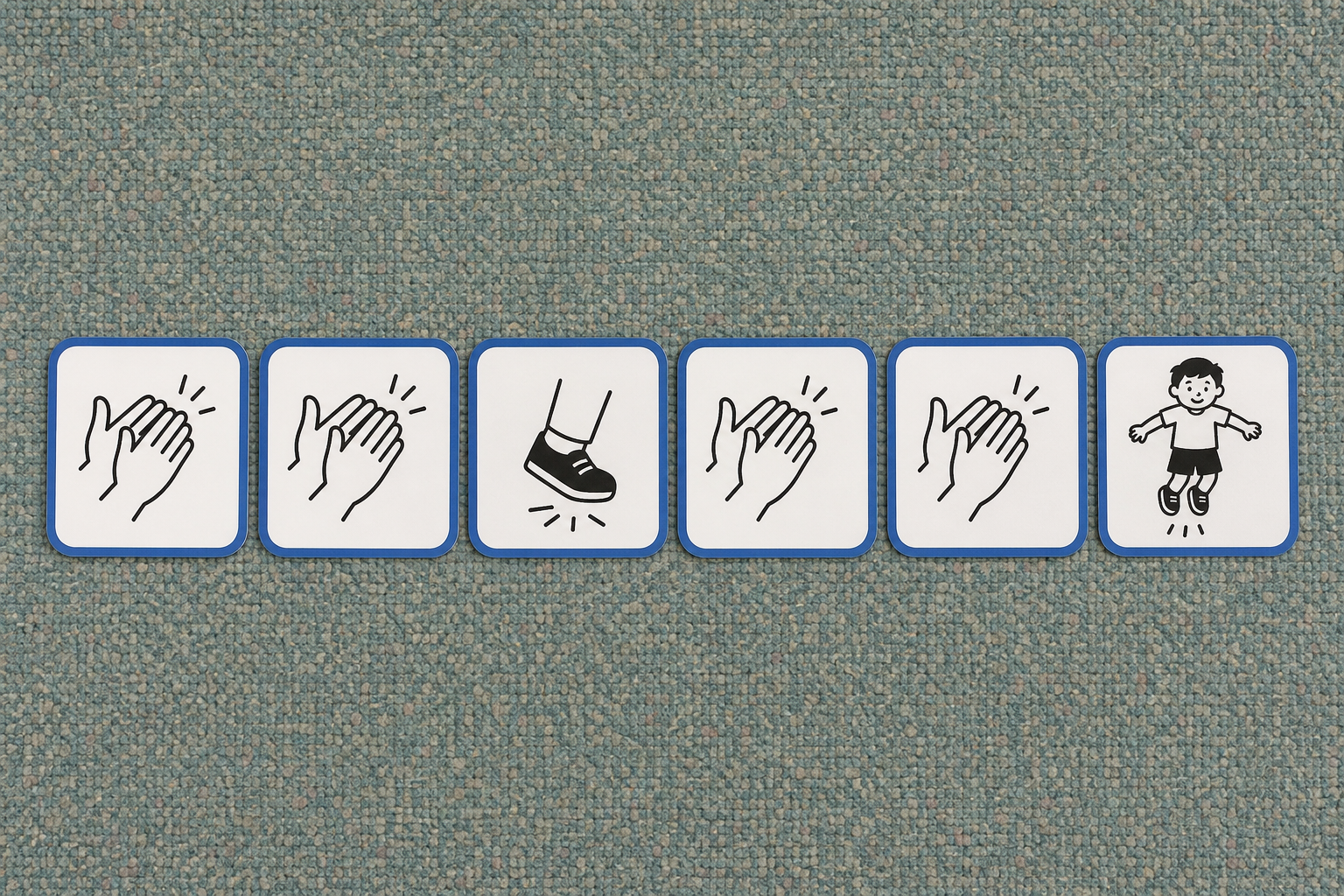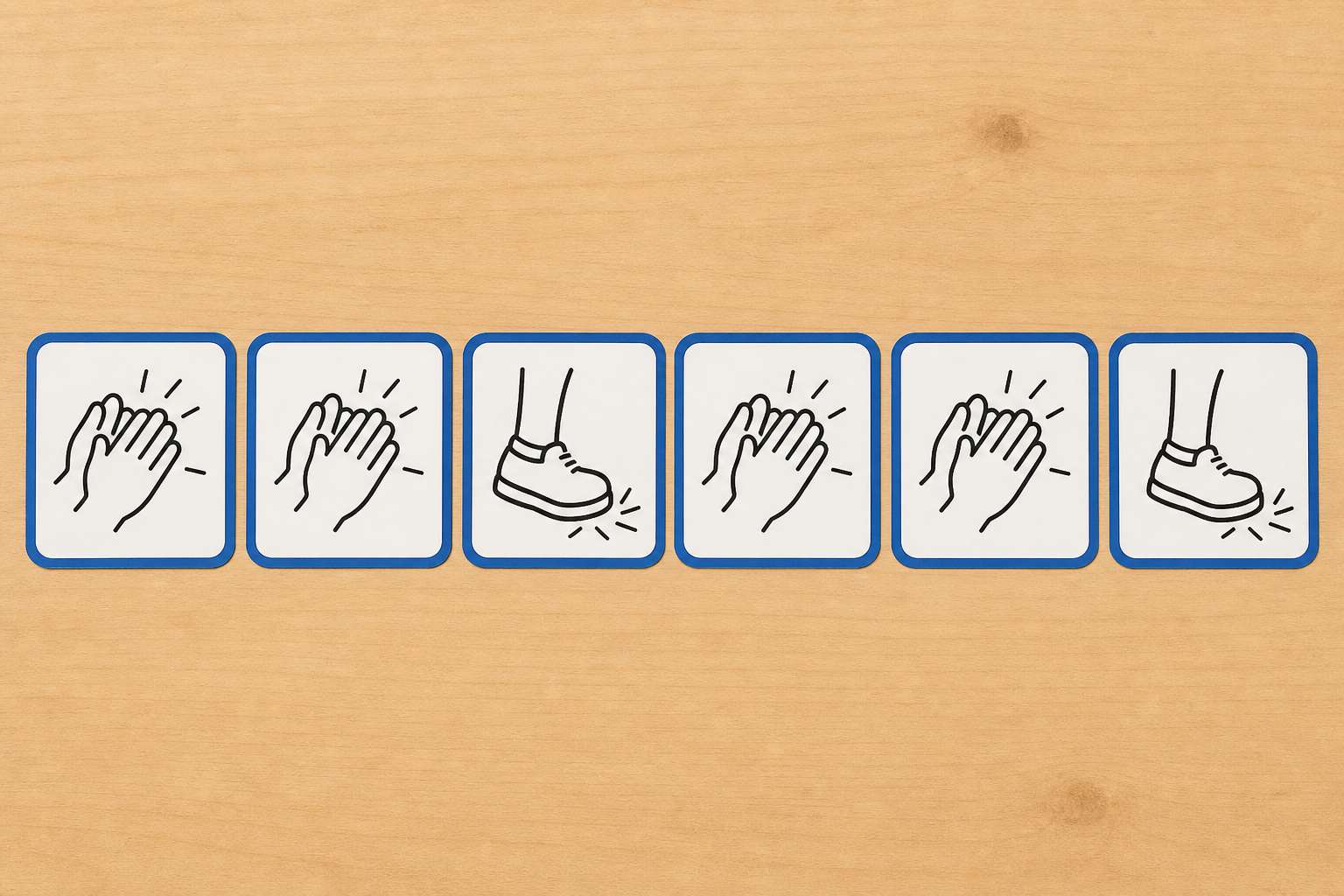
Watch and listen carefully. Clap, clap, stamp… clap, clap, stamp… What part keeps coming back again and again?
Hands up when you can say the repeating bit out loud.
Stand where everyone can see you. Do the sequence clap, clap, stamp twice without naming it. Pause and ask what keeps coming back. Accept answers such as "clap clap stamp" or "the same three moves".
Keep the hook light: do not hand out cards or name the words repeat and bug yet — those come next. This beat is only curiosity.
Look-fors: children joining in quietly; someone pointing to the clap-clap part; someone saying "it happens again".
Today's word: repeat. That means the bit that happens again, like clap, clap, stamp.
In clap, clap, stamp… clap, clap, stamp… which bit is the repeat?
Another word: bug. A bug is a wrong step that makes the pattern go wrong. We can change that step so it works again.
Write repeat on the board first and say the short line with the clap-clap-stamp example. Keep the board light; the table below is for you.
| Concept | Why it matters | Example |
|---|---|---|
| Repeat — a step, or a short group of steps, that happens more than once in a sequence | Spotting a repeat helps us give shorter, clearer instructions — we can say "do this bit again" instead of listing every move | In clap, clap, stamp, clap, clap, stamp, the clap-clap-stamp chunk is the repeat |
| Bug — a wrong or missing step that stops the sequence working the way we wanted | When something goes wrong, looking for the bug is how we get better at giving and following instructions. Once we find it, we change that step so the sequence works again | If the card says stamp where it should say clap, the pattern breaks — that wrong card is the bug; swap it for a clap and the pattern runs cleanly |
How to reveal the two board lines: show only the repeat line first. After children name the clap-clap-stamp repeat, do the quick check below. Only then write bug and reveal the second board line. Keep fix as a spoken teacher word glued to the action ("we change the wrong step") — do not add it as a third board definition.
Misconception to head off: children may think a bug means the whole sequence is "broken forever". A bug is just one wrong step we can change. Also, a prediction that turns out wrong is not a bug — a bug is a wrong instruction, not a wrong guess.
Quick check: say clap, clap, wave, clap, clap, wave. Ask which bit repeats. Then swap the second wave for a stamp and ask where the bug is. Invite one child to say what they would change so it works again — that change is the fix, said in the moment.
Look at the robot on the board. Watch the path we build together. Which move is used more than once?
Open the algorithm-sequencer interactive on the IWB in explore mode. Commands on the palette are forward, turn left and turn right. The goal is to reach the star without going off the grid. The robot starts at the left of the middle row facing the star on the right, so a straight line of forwards reaches it.
I wonder / I predict (about 1 minute): which step will we use more than once? We will need forward more than once in a row.
I test (about 2 minutes): build a short working path together: forward, forward, forward, forward. Run it so the robot reaches the star. Point to the four forwards: that is our repeat.
I observed / I think (about 1 minute): forward was used four times — that is the repeat. A repeat is the part we do again.
Bug beat (about 2 minutes): only after the working path has run, say: now watch — one step will be wrong. Change one of the middle forwards to turn left (or turn right). Run it so the robot misses the star. Ask: where is the bug? Invite hands up for a fix, drag the correct forward block back, and run once so the class sees the fix work. Use the second on-screen prompt only at this point.
Pacing cut if you are slipping: skip a second full re-run after the fix — one clean fix run is enough. Do not open a long discussion; take two hands and move on so the floor activity keeps its minutes.
Fold the watchers in: when one child suggests a block, ask the class "do you agree? what would you try?" Watching is real participation.
If the interactive is unavailable: lay large arrow cards on the floor mat in the same order and walk the path yourself as the "robot".
Part A: Lay out your ready cards. Act the pattern twice. Point to the bit that comes back again and again.
Part B: Your teacher gives you the line with one wrong card. Find the wrong card and swap it so the pattern works again.
Floor space should already be clear from before-lesson prep — do not use these 13 minutes to move furniture. Have each group's card set ready to hand (see counts below).
Print the provided action cards. Each group set needs multiples of the same action so ready patterns can use a card more than once. Per group, print at least:
Plus a small spare pile (about two extra of each) for planting wrong cards and fixes. Low-cost option: write the action words on sticky notes with the same counts.
Part A — spot the repeat (about 6 minutes). Give each group a ready pattern already in order, for example: clap, clap, stamp, clap, clap, stamp. Groups stand and act it twice. Ask them to point to the chunk that repeats (finger-point on the floor cards is enough). Take one or two groups to show the class. Revoice: the repeat is the part that comes back.
Part B — find the bug (about 7 minutes). Hand each group the same pattern but with one deliberate wrong card swapped in (for example the second stamp becomes a wave: clap, clap, stamp, clap, clap, wave). Groups act it, notice it feels wrong, find the wrong card, swap it for the right one from their spare cards, and act the fixed pattern. One group shows their bug and their fix on the floor at the front.
Pacing lever: if time is slipping, use one showcase only (not two). While that group shows, fold the rest of the class in with a single whole-class question: "Where was their bug? What did they change?" Watching is participation — do not set a parallel desk task. Cut Part A showcase first if you need to protect the journal minutes next.
Suggested ready patterns (use one or two across the class):
Safety: gentle moves only; space between bodies; no running spins across the room.
Differentiation: support groups with a three-card pattern (clap, stamp, clap, stamp). Stretch groups invent their own four-card pattern with one clear repeat, then plant their own bug for a partner group to find.
Key questions while you circulate: Which bit happens more than once? Which card is the odd one out? What will you change to fix it?
On your Investigation Journal page, record the repeat your group found and the bug you fixed. Draw or write the steps in order if that helps you remember. You do not need full sentences — clear labels are enough.
Pupils record on the paper Investigation Journal page in class (protect these minutes — do not send the journal home as homework). Prompt them to capture two things only: the repeat they spotted, and the bug they fixed (and what they changed it to). Circulate and scribe a word or two for anyone who needs support.
What "good" looks like at this age: a simple drawing of clap-clap-stamp with a ring round the repeating chunk; a crossed-out wrong card and the correct card beside it; or short labels such as "repeat = clap clap stamp" and "bug = wave → fixed to stamp".
Do not describe page layout or invent named boxes — the journal page is generated for you. Just keep pointing pupils back to those two ideas.
Fast finishers can add one more pattern from the board robot path (which step repeated on the IWB).
You're previewing this lesson. Get full access to this lesson and hundreds more — each one ready to teach, with interactive activities, printable resources and pupil progress tracking built in.