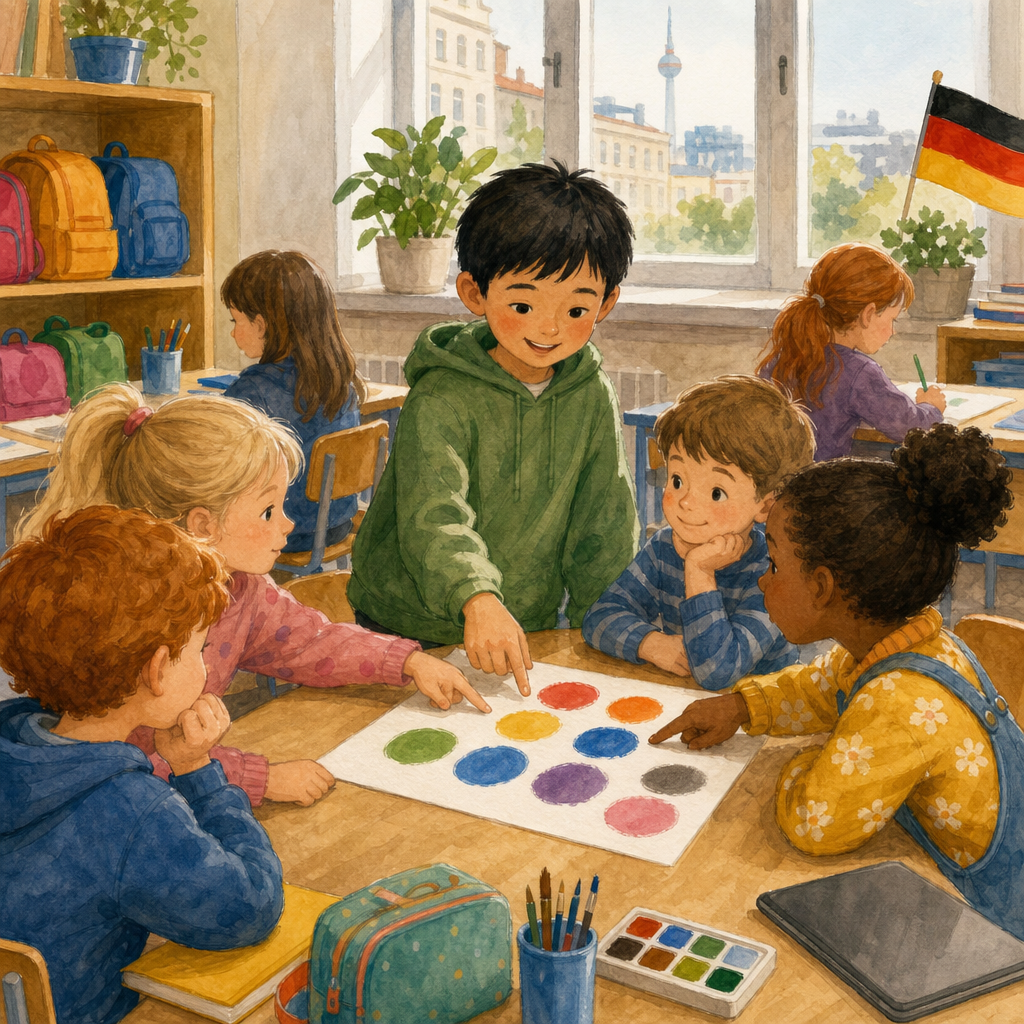
Imagine stepping into a classroom in Berlin: blue bags on the desks, a red book open on the table, a green plant on the windowsill, and maybe a scarf in black, red and gold hanging by the door. Everything has a colour. Today you will learn eight colour words in German so you can name what you see, here and there.
Optional title line if a pupil asks: the lesson title is English only. If you want the German phrase for "the colours", it is die Farben (dee FAR-ben). No objects to gather beforehand: point at coloured things already in the room (a blue bag, a red book, a green plant, the black board). Ask the class to name each colour in English first, then tell them they will hear the German in the next step. Keep the Berlin classroom picture light and quick: the point is to get eyes scanning for colour and to plant a German-speaking place in their minds, not to teach yet. Smile as you look around: "This room is already full of German colours waiting for us."
Here are today's eight colours. We will learn them in two short passes. First the ones that sound almost like English. Then the trickier ones. Tap each word, listen, and say it back together.
Run the word-table in two passes so the harder words are not lost in a long list.
Pass 1 (cognates, about 4 minutes): blau (blau), braun (brown), orange (o-RAHN-zhuh), rot (roht). Tap each one; class repeats twice (all together, then by table). Celebrate the first full-class rot: a big cheer if the whole room lands it together.
Quick recap: Point back through those four without audio and have the class call them chorally once.
Pass 2 (trickier, about 5 minutes): grün (groon), gelb (gelp), schwarz (shvarts), Weiß (vice). Sound anchors: grün: lips forward like a tiny whistle, groon; Weiß: like English "vice", with a sharp ss at the end; schwarz: start with sh, then a v: sh-varts. Make schwarz deliberately over-the-top once so it sticks. Pause on the umlaut in grün. Confirm any colours from the hook here. End pass 2 with one fast run of all eight in order.
Watch the board. When a card flips, whisper the German colour together. Volunteers come up to turn two cards at a time and find each German colour with its English meaning. Everyone whispers on every turn, even from your seat.
Whole-class IWB play only: pupils at desks have no cards. Model two pairs first so everyone sees the move. On every flip, the whole class whispers the German word before the volunteer chooses the match. If a pair is missed twice, stop and say the German word together before moving on. Listen for schwarz (shvarts) and Weiß (vice), which are the ones pupils most often soften. Warm line when a tricky pair is found: "Yes — that was proper schwarz!" Keep energy high; swap volunteers often so many voices are heard at the front too.
Keep the word list on the board. Open your copy and write all eight German colour words carefully from the screen. Then choose four colours and, beside each, write one thing you would spot in a Berlin classroom (or something near you now) that is that colour. Take special care with the umlaut on grün .
Pause the board on the word-table so every spelling is visible: pupils copy from the screen, not from memory. Everyone writes all eight colour words, then adds a classroom (or Berlin-classroom) object for only four colours of their choice. Walk the room and check the umlaut on grün and the capital W on Weiß. If a pupil cannot find something orange, a nearby jumper or pencil case from a neighbour is fine. Do not collect these. If time is short, finish the object column orally while pointing: "Tell your partner one object for blau." Praise neat umlauts out loud when you see them.
First, a quick stand-up: when you hear a German colour, silently point to something in the room that colour. Then watch the board. When an object appears, whisper the German colour together. A volunteer clicks the correct colour label. Everyone whispers first, every time, even from your seat.
Stand-up warm-up (about 2–3 minutes): Clear desks slightly so arms can point. Call a German colour from today's eight; every pupil silently points to something that colour in the room. Do five or six colours, mixing easy cognates with trickier ones (schwarz, Weiß, gelb). Then swap once or twice: point at a real object and the whole class calls the German colour chorally. This is the production beat that matches the objective: every pupil points and every pupil says.
Board game (about 5 minutes): Whole-class IWB only. On every image, the whole class whispers the German colour before a volunteer clicks the label. No silent watching from the back. Swap volunteers often. If the class softens schwarz or Weiß, stop and remodel once, then continue. Warm line when someone nails a hard one without peeking: "Brilliant schwarz!"
You're previewing this lesson. Get full access to this lesson and hundreds more — each one ready to teach, with interactive activities, printable resources and pupil progress tracking built in.