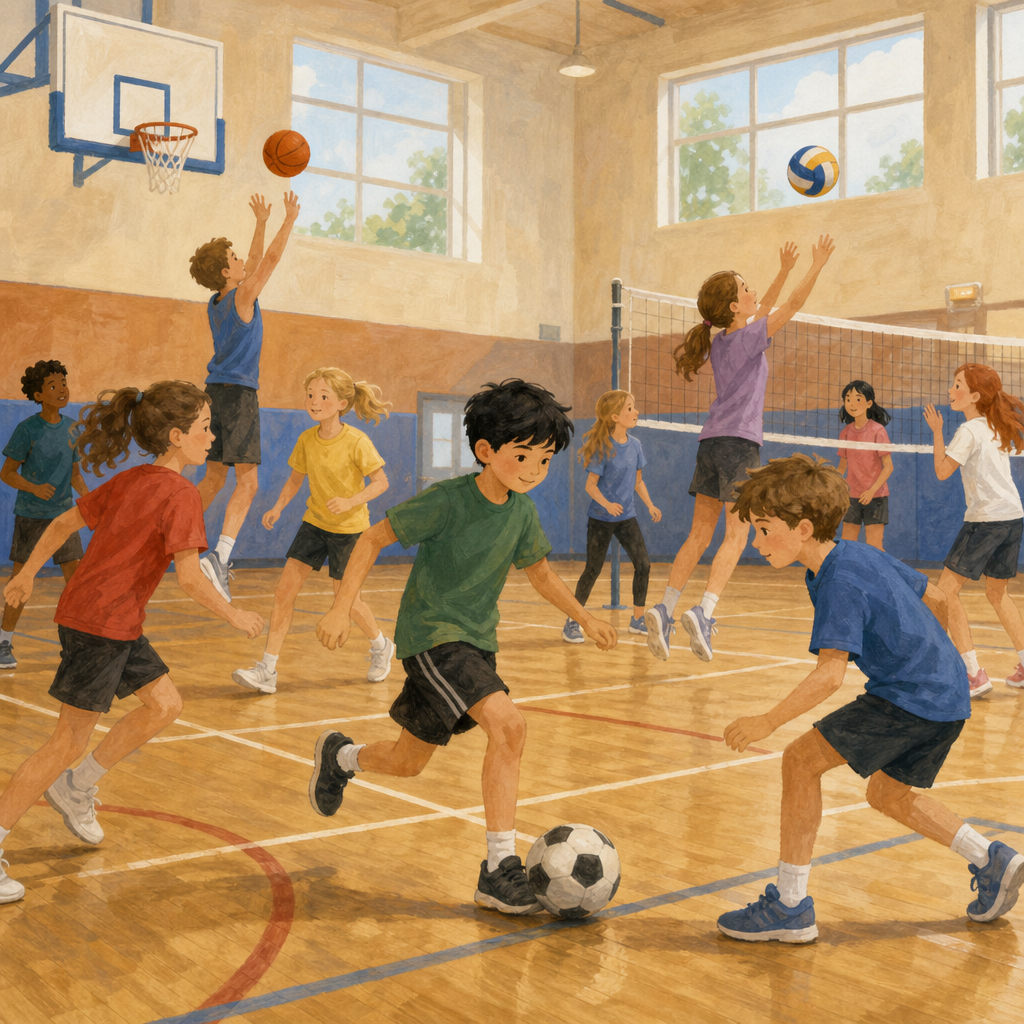
Which sport does this class play most? Say it in English first, then try a French guess if you have one. We will settle the match in French by the end!
Today you will name sports in French and say when you play them, using a day of the week.
Take a quick show of hands for the class favourite sport. Accept English answers first, then invite one or two brave French guesses without correcting yet. The word-table in the next step will settle the forms. Keep the tone light and competitive in a friendly way: the class is picking a winner, then learning how to say it properly in French.
Remind pupils that days of the week are words they already met earlier this year. Those days come back when they build full sentences later.
Here are today's eight sports. Listen as each one is played on the board, then say the full phrase back together with le or la.
First we learn the sport names. Then we add a day: ball sports use jouer au, for example Je joue au football le samedi (I play football on Saturday). Swimming, cycling and running use faire de or faire du, for example Je fais de la natation le mardi and Je fais du cyclisme le vendredi.
You control the board. Tap each word; the class listens, then repeats. Do not ask pupils to tap from their seats.
Order and load: Cluster the five clear cognates first with extra choral rounds: le football, le tennis, le basketball, le baseball, le volleyball. Then add the three harder items with gesture or image dwell time and two extra choral rounds each: la natation (swim mime), le cyclisme (pedal mime), la course (running on the spot). Point at the article every time so pupils hear the full phrase, not a bare noun.
Only after two solid choral rounds of all eight nouns, introduce the sentence frames. Ball sports: Je joue au football le samedi (zhuh zhoo oh foot-BAL luh sam-DEE). Faire sports: Je fais de la natation le mardi (zhuh fay duh lah na-ta-SYOHN luh mar-DEE), Je fais du cyclisme le vendredi (zhuh fay dü see-KLEES-muh luh von-druh-DEE), Je fais de la course le lundi (zhuh fay duh lah koors luh LUN-dee).
Put one pupil-friendly pattern line under the models (no metalanguage lecture): jouer au + le-sport (au = à + le) · faire de la + la-sport · faire du + le-sport.
Keep a small days strip visible for the rest of the lesson: lundi (LUN-dee), mardi (mar-DEE), mercredi (mair-kruh-DEE), jeudi (zhuh-DEE), vendredi (von-druh-DEE), samedi (sam-DEE), dimanche (dee-MAHNSH). Two model days on the board are enough if space is tight.
France aside (30 seconds): volleyball is common in French school PE (EPS); le cyclisme links to big road races pupils may have seen on TV. Save deeper culture for the pétanque talk later.
Later in this unit pupils meet jouer with musical instruments (jouer du / de la). The sports pattern here is jouer au / faire de. Different prepositions: flag the contrast when instruments appear so pupils do not overgeneralise jouer au.
A busy French collège gym (EPS) is on the board. Volunteers drag one French label at a time onto the right sport or piece of equipment.
Everyone else: whisper-say the full phrase with le or la before the label is dropped, then thumbs-up if the article sounds right.
Run this as whole-class turn-taking on the IWB in a French school-gym setting, not a generic hall. Invite volunteers one at a time. Seat job for the rest of the class: point or whisper the full phrase (la natation, not bare natation), then thumbs-up or thumbs-down on the article before the label sticks.
If a label lands in the wrong place, ask the class to say the correct French together before the next turn. This is recognition after first contact, so keep the pace brisk and the mood light.
First, say it. Look at the models. The class will complete a few sport-and-day sentences out loud together, then you say one sentence to the person beside you.
Je joue au baseball le samedi. (I play baseball on Saturday.)
Je fais de la natation le mardi. (I go swimming on Tuesday.)
Je fais du cyclisme le vendredi. (I go cycling on Friday.)
Days you can use: lundi · mardi · mercredi · jeudi · vendredi · samedi · dimanche
Then write. Open your copy and write two sentences saying which sport you play and on which day. Take care with accents and with le or la. Two full sentences with the right article and a day: that is a win; tick them in your head.
Oral beat first (about 3 minutes), pencils down. Keep both model sentences and the days strip visible. Point at a sport image (or word) plus a day cue; the class chorally completes 4–5 prompts, mixing patterns, for example: Je joue au rugby is out of scope now, so use Je joue au volleyball le jeudi, Je joue au tennis le samedi, Je fais de la course le lundi, Je fais de la natation le mercredi, Je fais du cyclisme le dimanche. Then pairs: one pupil says one sport-and-day sentence, partner repeats. Invite two or three volunteers to say one sentence to the class before writing starts. Celebrate clear articles and a full sentence rather than a perfect accent.
Write (about 4 minutes). Pause other board clutter but keep the word-table, the three models, and the days strip up. Task: write two sentences, sport plus day. Walk the room and check each sentence has a sport and a day. Weaker writers may copy-adapt a model and change the sport or the day. Do not collect the copies.
Pattern reminder on the board if needed: ball sports → jouer au; natation, course → faire de la; cyclisme → faire du.
You will hear a short scene near a French park path (think of a voie verte or a path by the square). Your teacher will play the clip twice on the class speakers.
Before the first play, read the question stems on the board so you know what to listen for. Then answer the questions about what you heard.
Show 2–3 simple question stems on the board before any audio (who / which sport / which day, matching whatever the scenario offers). Play the full clip once for the whole class on the speakers with books closed. Play it a second time, then let pupils answer. Go through the answers together and replay any line that caused trouble.
You do not need to be fluent: trust the audio model. Frame the setting briefly as a path by a French park or square, not a nameless field. After the answers, ask one stretch question orally: which sport from today's list might also happen on a park path or greenway? Accept any sensible answer. Quick win praise: a class thumbs-up if most people caught the sport or the day.
You're previewing this lesson. Get full access to this lesson and hundreds more — each one ready to teach, with interactive activities, printable resources and pupil progress tracking built in.