1 - Start ~4 mins
 When you build a media project, the pictures and sounds have to come from somewhere. Today the question is: where does that material come from, and are you actually allowed to use it?
You will sort real-looking sourcing situations into free or not free, then start gathering images and sounds from libraries that permit reuse and log every file you take.
2 - Examine and Discuss ~5 mins
 Finding something on the internet is not the same as having permission to use it. A licence is the written permission that says what you may do with a file and whether you must credit the creator.
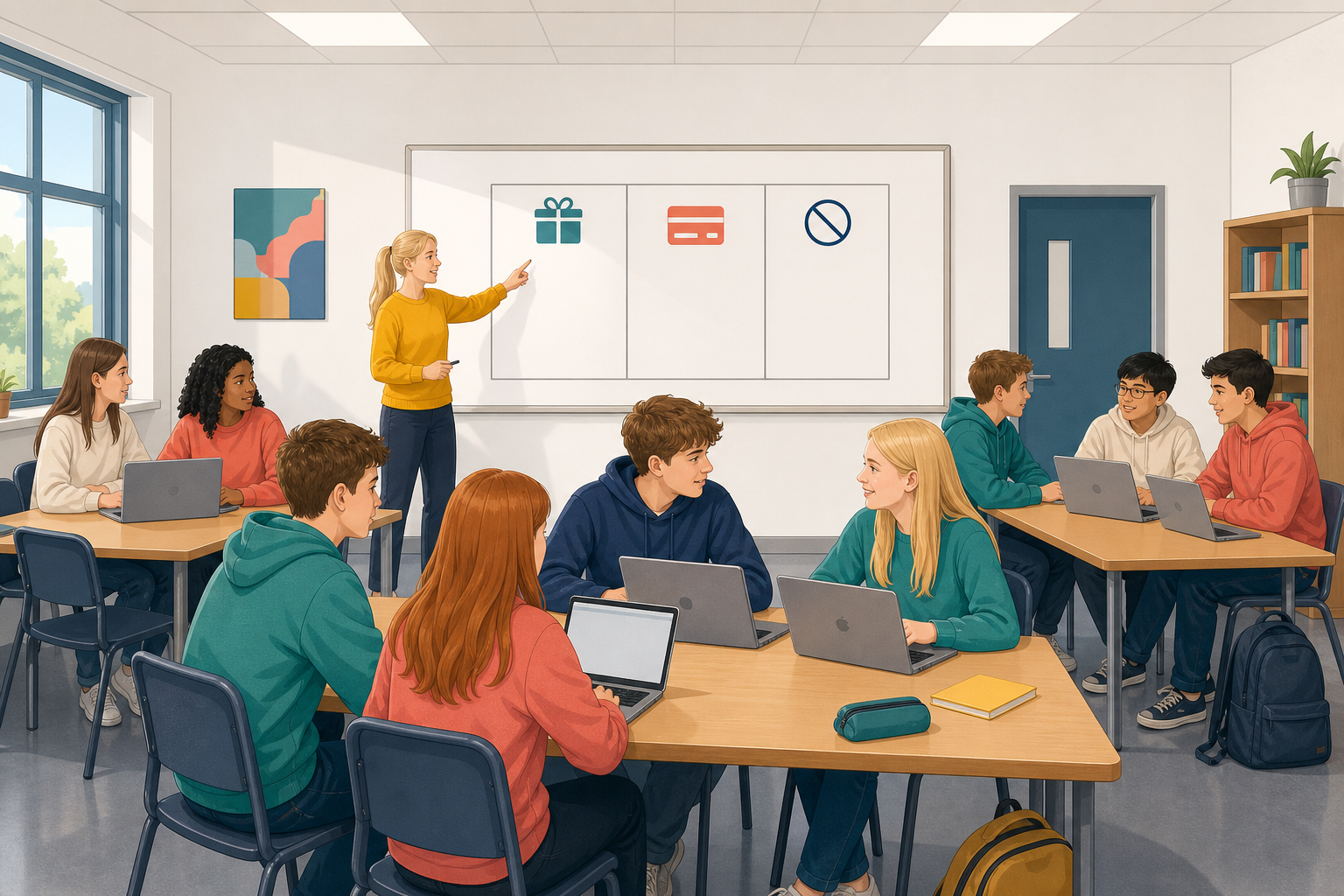
Three buckets matter today: free without credit, free with credit, and not free. Key line: found on the internet is not a licence.
Two libraries many schools use are Pixabay (images, clips and some audio) and Freesound (sound effects). You will also see Creative Commons labels: CC0 means public domain, no credit needed; CC BY means free to use if you name the creator.
3 - Hands-on: Free to Reuse or Not? ~12 mins
Work as a class on the interactive activity. Drag each invented sourcing situation into the bucket that fits, and be ready to say why.
Before each drag: take 20 seconds of pair talk on which bucket and why. Your teacher picks a pair to drag and defend. A different pair takes each card.
Quick gloss (keep this in view): Creative Commons (CC) = a free licence with rules; CC BY = free if you name the creator; CC0 / public domain = free with no credit; attribution = giving credit / naming the creator.
The three buckets are:
- Free to reuse without credit: the licence clearly allows use with no attribution
- Free to reuse with credit: you may use it if you name the creator as asked
- Not free to reuse: no clear licence, personal or commercial content, or a preview you have not paid for
After each placement, be ready to defend it. If the class disagrees, change the card and say what evidence would settle it.
Free to reuse or not?
4 - Your Turn: Gather and Log ~12 mins
Watch one worked example on the board first (about 2 minutes): your teacher finds one image on Pixabay, reads the licence aloud, and writes one full log line. Then you do the same for your own two files (about 10 minutes).
Start gathering material you might later use in a short media piece on an interest of yours. The default path is Pixabay for images and, where available, Pixabay audio. Do not grab random search results. Use Freesound only if your teacher has set this up (for example board download or bookmark-only).
Done today: two files logged fully beats three files half-logged. Two images is fine if sound is awkward today.
Before you finish, check:
- You have chosen a rough theme for the material (for example sport, music, local place, hobby).
- You have downloaded or bookmarked at least two files you are allowed to reuse (two images is the reliable default; add a sound only if your teacher has made that path available).
- For every file, your source log names: file name, where it came from, what the licence allows, and whether credit is needed (and the creator's name if it is).
- You have saved the log the class way so it is there next session.
Where to read the licence: on Pixabay, open the image and read the licence line under the Download button (often Free for commercial use, no attribution required). On a sound page, read the licence label beside the file before you bookmark or download.
Example log lines (match this shape for every file):
- sunset_pitch.jpg | Pixabay | Free for commercial use, no attribution required | Credit needed: no
- crowd_cheer.mp3 | Pixabay | Free for commercial use, no attribution required | Credit needed: no
- Optional, only if your teacher has set up Freesound: rain_on_glass (bookmarked) | Freesound page | CC BY | Credit needed: yes, Creator: Jane Murphy
If a file has no clear licence, leave it. Find another. Early finishers may add a third file as stretch.
5 - Make Sense ~3 mins
Pull the class back together. What made a file clearly free, and what made one a hard no?
Name the principle in plain words: found on the internet is not a licence. Free-to-reuse libraries help, but you still read what each file permits and you still write it down. A source log is not extra homework; it is how you prove later that any media piece you assemble respects other people's work.
Unlock the full learning experience
You're previewing this lesson. Get full access to this lesson and hundreds more — each one ready to teach, with interactive activities, printable resources and pupil progress tracking built in.
This lesson is copyright of Coding Ireland 2017 - 2025. Unauthorised use, copying or distribution is not allowed.