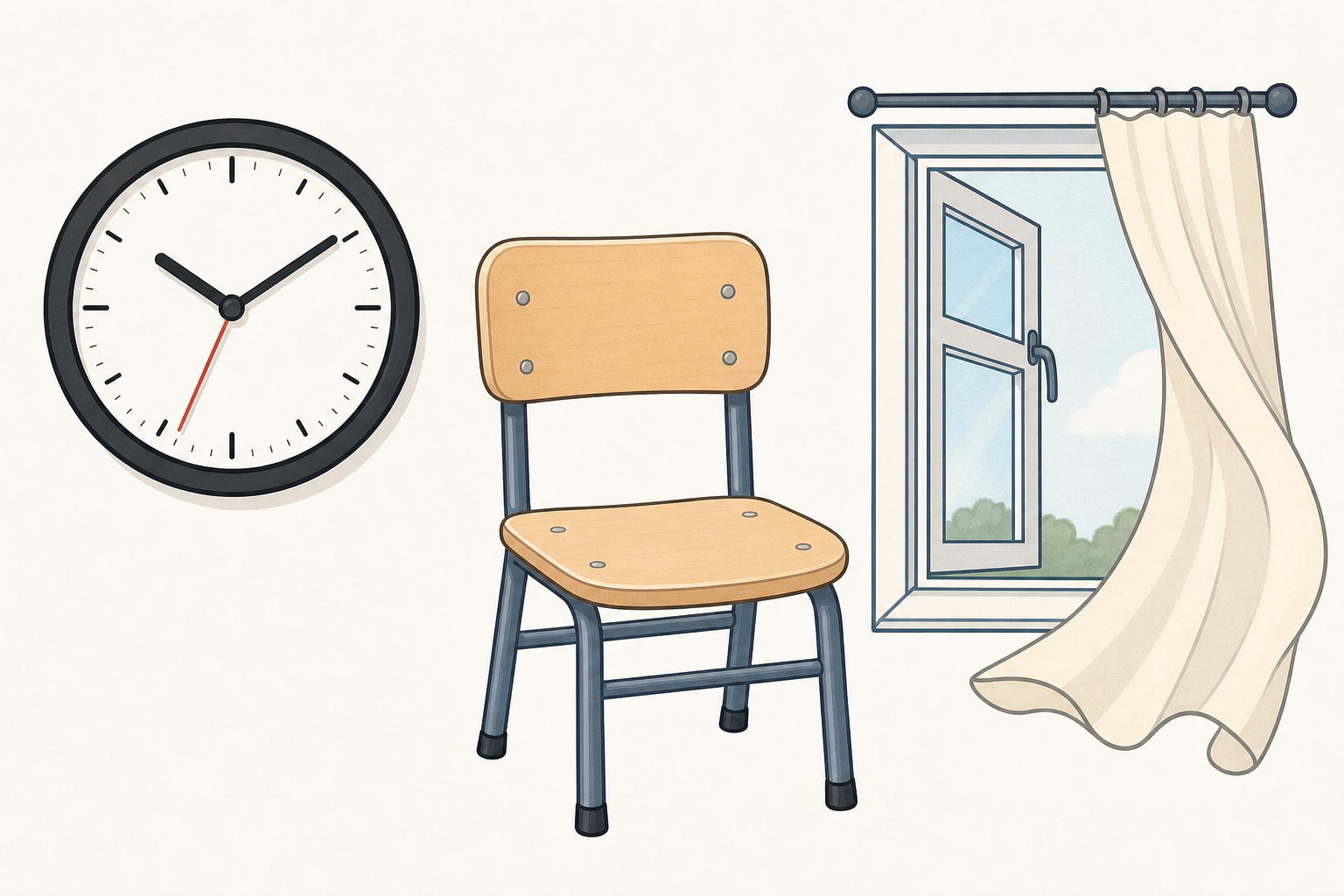
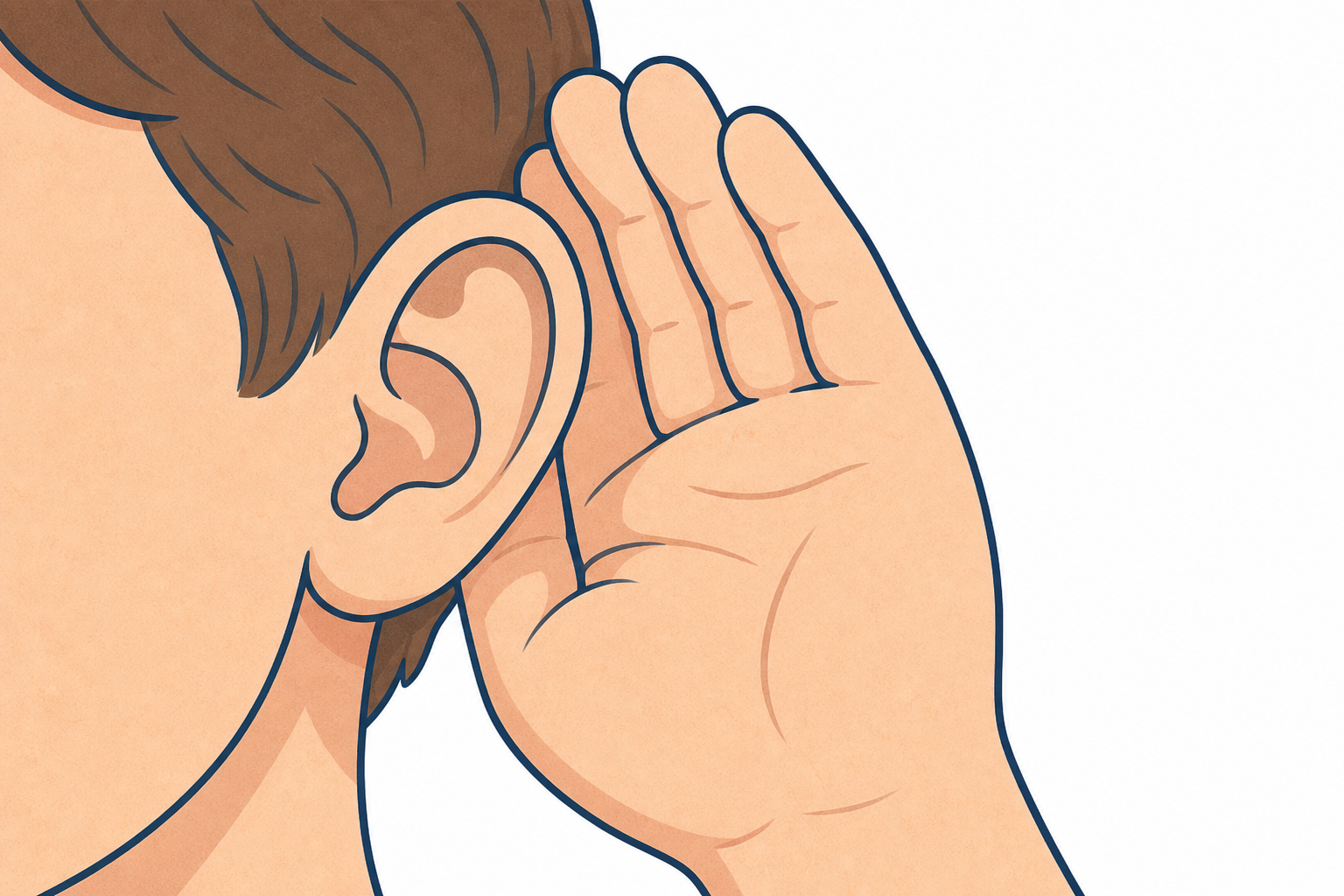
Close your eyes for ten quiet seconds. What can you hear right now in our classroom?
Hands up when you can name one sound and where you think it came from.
Keep this beat light. Do not hand out clipboards or start the outdoor walk yet. The only job is curiosity: the room is already full of sound sources if we stop and listen. Today we are using our listening ears (our STEM ears) to notice sounds like scientists.
Key questions: What did you hear? Who or what made it? Was it near you or further away?
What to expect: pupils name voices, chairs, the radiator, footsteps in the corridor, rain on the window, a bird outside. Revoice their ideas: every sound comes from somewhere.
Differentiation: invite a quieter pupil by asking them to point toward the place the sound came from if they prefer not to speak yet.
Capture two or three named sounds on the board (e.g. chair, clock, bird). You will reuse them in the next step when you introduce today's words.
We just heard real sounds in our room. We will use three ideas to talk about sounds like scientists.
Listen with me to one sound we named. Sound source means who or what made it. Point to where you think it came from.
Is that sound loud or quiet? Loud means it seems big in our ears. Quiet means soft and gentle. Show me with your hands: big hands for loud, small hands for quiet.
Is it near or far? Near means close to us. Far means a long way off. Point close to you for near, or stretch your arm out for far.
No interactive. Use live classroom sounds from step 1 so the words match the hunt. Pace one kid idea at a time against one real room sound the class already named. Every pupil has a job each time: point to the source, show loud or quiet with hands, then show near or far with a point or stretch. Do not leave row 3 only holding three definitions.
| Concept | Why it matters | Example |
|---|---|---|
| Sound source — the person, animal or thing a sound comes from | If we can name the source, we can talk about sound like scientists, not just say "I heard a noise" | A robin in the school hedge, a chair scraping, or a car beyond the yard wall |
| Loud and quiet — whether a sound seems big in our ears or soft and gentle | Sorting loud and quiet helps us notice differences in the same place | The school bell is loud; a whisper beside you is quiet |
| Near and far — how close the sound source is to us | Two sounds can both be quiet for different reasons: one is soft, one is a long way off | A pencil tap on your desk is near; traffic past the wall is far |
Worked listen (model the noticing cycle aloud with one real room sound, then invite the class actions above):
Repeat quickly with a second sound a pupil named (e.g. footsteps in the corridor: quieter, further away), again with point and hand signals so all pupils act, not only the speaker.
Misconception to head off: pupils often say "a noise" with no source. Coach them back to a person, animal or object. Keep today's words only to sound source, loud or quiet, and near or far. Do not introduce higher or lower pitch or vibration today; those come in a later sound lesson.
STEM eyes: our classroom is already a science lab once we use our listening ears (STEM ears).
We are going on a sound hunt. First we will listen quietly in our classroom. Then we will listen outside in our school grounds.
What do you think we will hear indoors? What about outdoors? Tell your partner one sound you think we will hear and why.
Keep ideas short and spoken. What pupils think they will hear is never wrong; it is the start of the science. Take three or four ideas for the board (e.g. chairs, voices, a bird, wind, a car) without turning this into a long list. Avoid the word prediction on the board; use "what do you think we will hear".
Focus question: What sounds will we hear indoors and outdoors, and where will they come from?
Prompts: Will outdoor sounds be louder or quieter than classroom sounds? Which sounds might be near us? Which might be far away?
Before you leave the room: agree the quiet signal, the walking route, and the boundary (e.g. the yard edge or garden path). Leave clipboards, pencils and Investigation Journal pages stacked by the door inside. Pupils do not carry writing kit on the hunt; they pick them up only when you return for recording.
First we sit very still indoors. Cup one hand behind your ear. Whisper to your partner each sound you hear and what you think made it.
Then we walk quietly outside. Stop when the teacher raises a hand. Listen again. Find sounds that are loud or quiet, and sounds that are near or far.
Lights low or eyes closed if the class can manage it. No clipboards yet. You model first: I can hear the clock. I think the clock is the sound source. It is quiet and near. Pupils whisper findings to a partner; you harvest a few aloud. A quick mental list or a whispered word is enough until you return.
Keep the route short. Walk calmly to the agreed spot (or wet-day spot by the door). Stop as a class. Same pattern: silent listen, then whisper the sound and the source. Push for variety: birds, wind in leaves, distant traffic, a door closing, feet on tarmac, rain if it is an Irish wet day. Build in transition slack for coats and lining up so Steps 5 and 6 are not squeezed. Return indoors together, then hand out clipboards and journals at the door for recording.
Key questions while you circulate: What is the sound source? Is it loud or quiet? Is it near or far? How can you tell?
Common sticking point: pupils say "a noise" with no source. Coach them back to a person, animal or object.
Safety: stay together; no running during the quiet listen; clear boundaries; return indoors together.
Differentiation: some pupils point to the source instead of naming it; a partner can help put the word to it. Confident listeners can try to find one far-away sound and one near sound.
STEM eyes: our own school grounds are the lab today. Everyday places are full of sound sources once we use our listening ears.
Look at my example on the board first. I wrote and drew one sound I heard.
On your Investigation Journal page, write or draw what you heard. Who or what made it? Was it loud or quiet? Near or far if you can.
Aim for at least two sounds from our hunt.
This beat is in-class and non-negotiable. Do not set it as homework. The sort in the next step and the success look-fors need today's hunt evidence on the page. If time is short, protect this full beat by shortening the outdoor stop, not by cutting recording.
Hand out clipboards, pencils and Investigation Journal pages now, on return from the hunt (they stayed stacked inside during step 4).
Before pupils write, model one completed example on the IWB or board using a simple frame:
Keep the same spoken sentence frame: I heard… It came from… It was loud/quiet… It was near/far…
Pupils draw or write on the paper Investigation Journal page; they do not type into the platform.
What good recording looks like at this age: at least two sounds, each with a source (not just "noise"), and a loud or quiet judgement. Near or far is a welcome stretch.
Support: sentence starters said aloud. Scribes for pupils who need a partner or adult to help with a word. A simple word bank on the board (loud, quiet, near, far, bird, car, chair, footsteps).
Fast finishers: add one more outdoor sound, or draw the place the far-away sound came from. Not an on-device task.
You're previewing this lesson. Get full access to this lesson and hundreds more — each one ready to teach, with interactive activities, printable resources and pupil progress tracking built in.