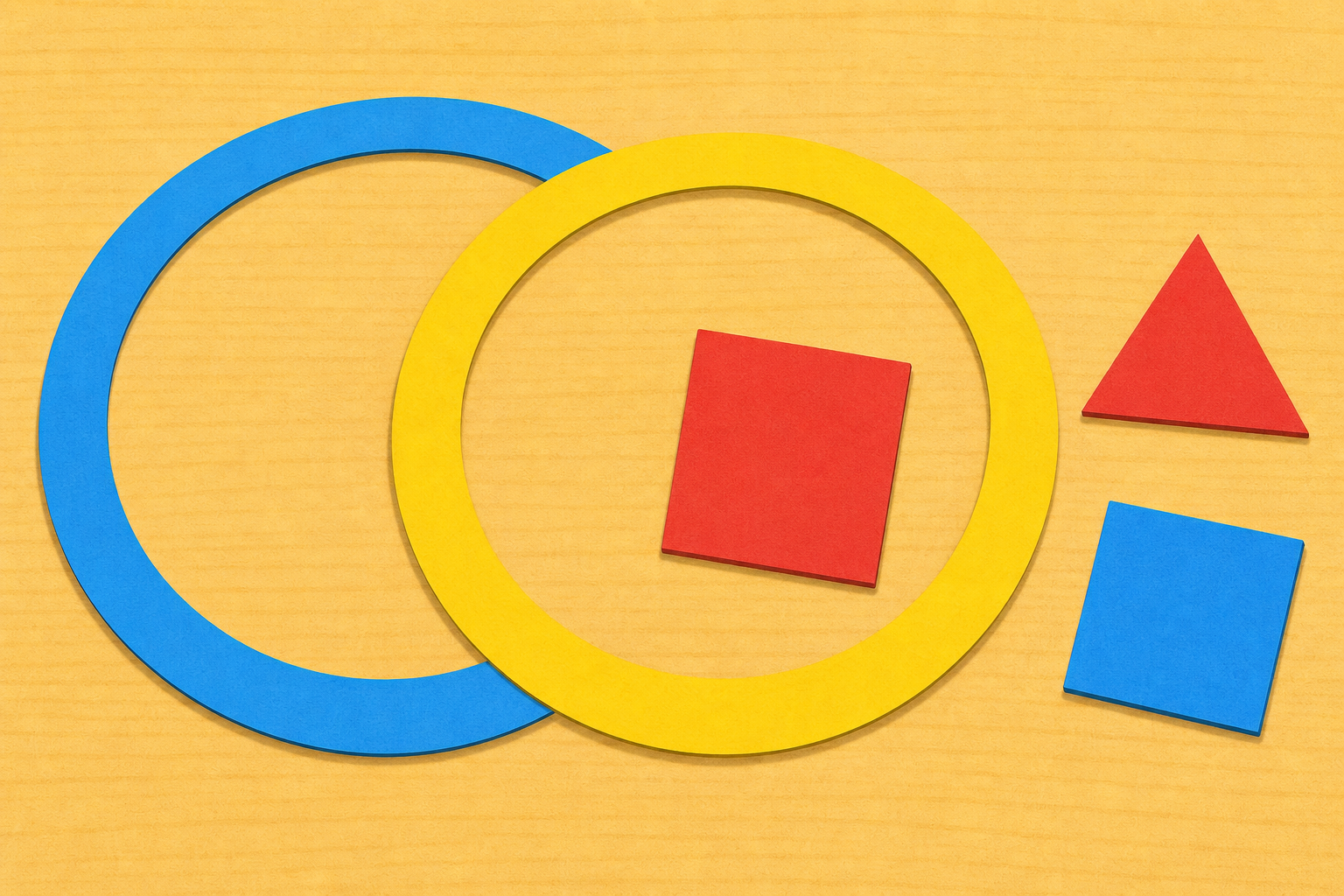
Here is a hoop labelled has four sides and a second hoop labelled is red. Where would a red triangle go? And where would a red square go?
Take two or three hands-up answers, not open call-outs. Hold out for the tricky one: a red square is both red and four-sided, so a single hoop can't hold it — this is the puzzle that leads into the overlap.
Watch the board with me. You might be asked to say a region out loud, so keep your eyes on where each card lands.
First a single hoop for one rule: test the rule, and the card is either in or out.
Now two circles that cross. The little space where the two circles cross is called the overlap. A card only goes in the overlap when both rules are true for it.
This last one has two rules again. Watch for a card that follows neither rule — where do you think it goes?
Work each one live on the board.
Our two rules today are has straight sides and is shaded.
We sort these five cards together: a shaded square, a plain circle, a shaded hexagon, a plain triangle, and a shaded circle. For each card we test both rules, then decide if it goes in one circle, in the overlap, or outside both.
Talk this one through together — pupils take turns at the board and the class agrees or corrects out loud.
For each card ask both rules in order: does it have straight sides? is it shaded? The shaded circle is the trap — shaded but no straight sides, so it belongs in the shaded circle only. Revoice a strong answer: so this card is in the overlap because BOTH tests came back yes.
In your maths copy, draw two overlapping circles. Label one circle with a rule and the other circle with a second rule. Then write three of the sorted items into the right regions, including one item in the overlap where the circles cross.
Walk the room glancing at whether the overlap card genuinely follows both labelled rules — this is whole-class copybook practice, not marking.
We work through four sorts together on the board, each one harder than the last:
This is the practice round — pupils take turns at the board, check each answer, and the class confirms before moving on. Keep the board work brisk rather than over-explaining.
Watch for pupils dropping a two-rule card into just one circle when it belongs in the overlap. Before each check, ask the class to predict which region the last card goes to.
You're previewing this lesson. Get full access to this lesson and hundreds more — each one ready to teach, with interactive activities, printable resources and pupil progress tracking built in.