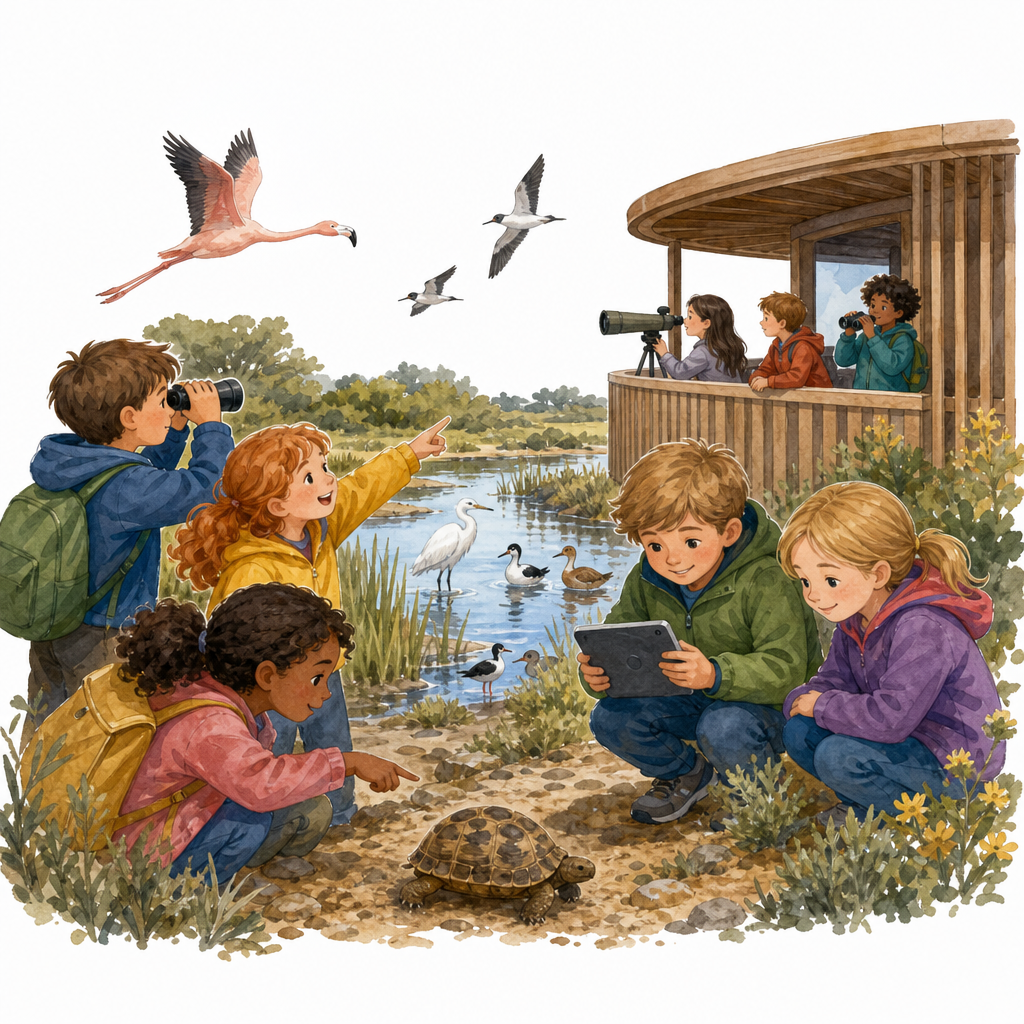
You are visiting a wildlife centre near Doñana National Park in Spain. Name one animal you might see in water, one in the air, and one on the ground.
You already know more animal words in Spanish than you might think. Today we pull pets, wild animals and birds into one set. Some animal words go with el (like el perro), some with la (like la vaca). Today we sort them into two groups.
Open with the Doñana wildlife-centre hook so the set feels like a real Spanish place, not a random word list. Take three or four quick habitat answers in English first. Then invite any Spanish animal words pupils already remember from earlier in the year (pets, wild animals, birds). Do not correct article choice yet; the flashcards and the sorting game will do that work. On the board, stick to the concrete line: some words go with el, some with la. Save the terms masculine and feminine for your own notes, or introduce them only after two clear examples. Keep the hook brisk so the class reaches the word set while energy is high.
Look at each picture and the English word. Listen to the Spanish with el or la, repeat with the class, then volunteers try the full phrase.
Run this as a whole-class flip on the board. For each card: show the image and English first, play the audio (or model the full phrase yourself once), then the class repeats chorally with the article. Only after that choral pass do you invite a volunteer to say it again before a second flip or check. Never ask for first production from memory alone on a year-wide recall set. Insist on the article every time: bare perro is not the answer, el perro (el PEH-rroh) is. Point out that many words ending in -o take el and many ending in -a take la, but stress that learners still need to learn each pair. Replay audio on any word the class hesitates over.
We sort each animal into the el column or the la column on the board. Say the full phrase with the class before it drops. Watch for green or red.
Whole-class IWB only: you or a volunteer drags; the class chorally agrees. Model the first drag yourself: say the full phrase aloud with the article, for example la vaca (lah BAH-kah), then drop it into the la column. Before every drop, the class says the full el/la phrase together. When a drop is wrong, pause and say the correct pair together twice. Ask what endings pupils notice, but keep the focus on learning each noun with its article rather than inventing a perfect rule. The la column will be shorter (two animals); that is fine. Celebrate both columns equally so the feminine pairs stay memorable for the copy task.
Keep the eight animals on the board while you write. Copy four full phrases into two columns headed el… and la…. Choose any four so both columns have at least one animal.
Run this only after Spin and say so pupils have heard and said each phrase several times. Leave or restore the sorted el / la columns on the IWB (or a static two-column model) so every spelling stays visible while pens move. Pupils copy from the board; they do not write from memory. Each entry must include the article. Because only two nouns take la, most pupils will copy both la vaca and la oveja plus two from the el column. Walk the room quietly; this is the only three minutes when every pen should be moving. Do not collect the copies.
Teacher reference list (display or keep beside you):
Spin the wheel. When it lands on an animal, say the full Spanish word with el or la out loud before the next spin.
Frame the wheel as trail signs at the Doñana wildlife centre: each spin is a sign the class reads aloud with the article. Spin on the board and name a pupil for each landing, or let tables take turns. The answer must include the article: el león (el leh-OHN), not bare león. If someone freezes, give a three-second wait. Then invite a neighbour whisper. After that, the class says it together. Aim for several full spins so every animal is heard more than once. This is lively production practice after the sorting work, so keep the pace brisk rather than testing. When you finish, leave or restore a clear two-column el / la model on the IWB for the copy moment that follows.
You're previewing this lesson. Get full access to this lesson and hundreds more — each one ready to teach, with interactive activities, printable resources and pupil progress tracking built in.