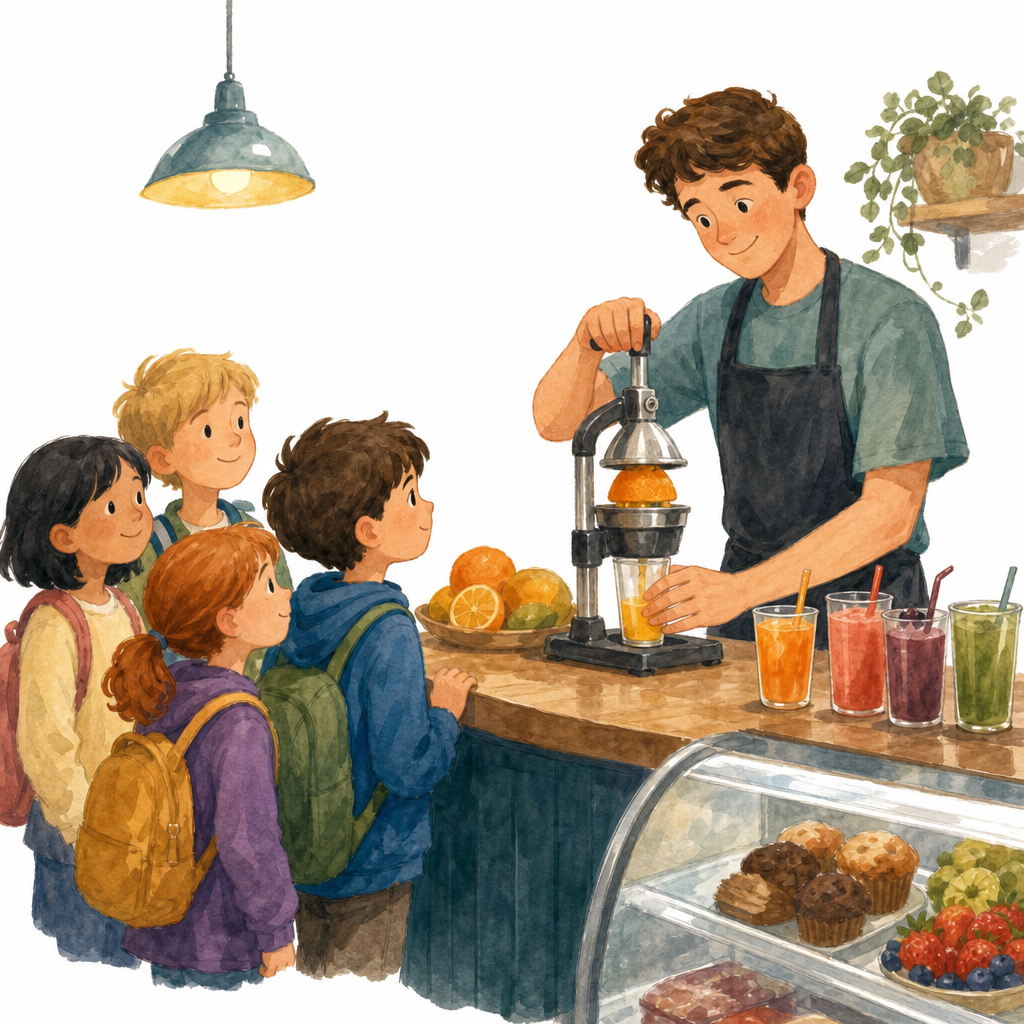
 You can already greet someone, ask for something, say thank you, and say goodbye in Spanish. Today those four moves become one full café order, from the door to the counter and back out again.
By the end of this lesson, you will be able to:
- Name eight drinks in Spanish
- Order a drink in a full café exchange
- Say what you could really do if you landed somewhere Spanish-speaking tomorrow
The cards on this step flip over: the English is on the front and the Spanish is on the back. Every Spanish drink comes with a little word in front of it, el or la, which is the Spanish for "the" and tells you whether the word counts as masculine or feminine. Say the Spanish aloud with that word included before you flip, and listen for the stress on café and batido.
Café exchange to copy later:
Hola. (OH-lah) Hello.
Un zumo, por favor. (oon SOO-moh por fah-BOR) A juice, please.
Gracias. (GRAH-thyahs) Thank you.
Adiós. (ah-DYOS) Goodbye.
When you order, use un or una (a/an), not el or la:
- un: un zumo, un café, un té, un refresco, un batido, un agua
- una: una leche, una limonada
Click each Spanish drink, then its English meaning. Say the Spanish quietly as you click each one.
Open your copy and write the whole café exchange: greeting, order, thank you, goodbye. Choose any drink from today's list for the order line. Use un or una to match your drink (not el or la), and keep every accent.
Order-line models (pick the pattern that matches your drink):
Un café, por favor. (masculine drinks: zumo, café, té, refresco, batido, agua)
Una limonada, por favor. (feminine drinks: leche, limonada)
When you finish writing, whisper-read your four lines with a partner.
- el agua — Water
- el zumo — Juice
- la leche — Milk
- el café — Coffee
- el té — Tea
- el refresco — Soft drink
- la limonada — Lemonade
- el batido — Milkshake
Listen for each drink word and mark it on your card. When every drink on your card is marked, call Bingo! Say the word back quietly when you mark it so your ear and your eye work together.
Unlock the full learning experience
You're previewing this lesson. Get full access to this lesson and hundreds more — each one ready to teach, with interactive activities, printable resources and pupil progress tracking built in.
This lesson is copyright of Coding Ireland 2017 - 2025. Unauthorised use, copying or distribution is not allowed.