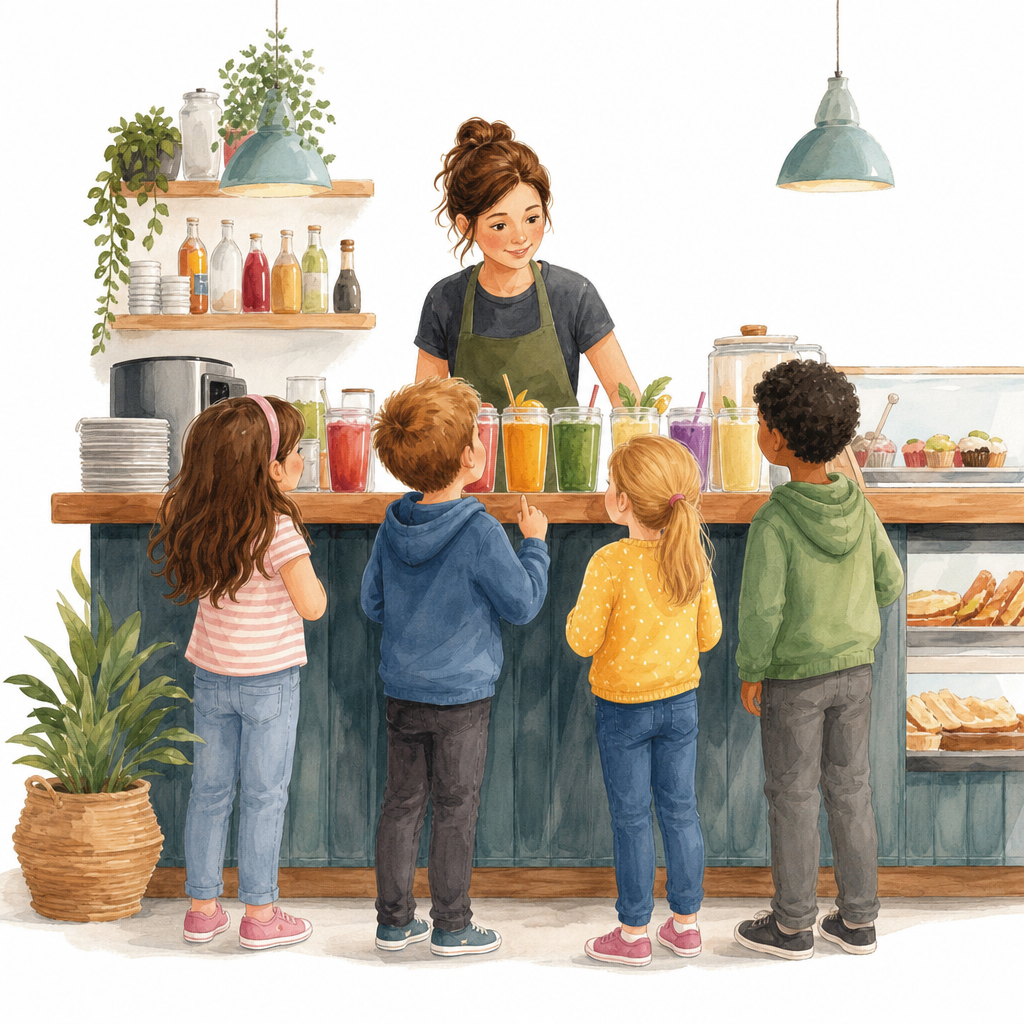
 Today you learn four short café moves in German, then you add drink words so you can put a full order together.
Listen to each move, then say it back:
- Guten Tag (GOO-ten tahg) — hello
- Ich hätte gerne …, bitte (ikh HET-tuh GAIR-nuh … BIT-tuh) — I would like …, please
- Danke (DAHN-kuh) — thank you
- Auf Wiedersehen (owf VEE-der-zay-en) — goodbye
Those four moves open, order, thank and close. The drinks come next.
By the end of this lesson, you will be able to:
- Name eight drinks in German
- Open, order, thank and close in a short café exchange
- Say honestly what two years of German now let you do
English on the front, German on the back. Say the German aloud before you flip, article included: der Kaffee, die Limonade, das Wasser and the rest as they come up.
Then try an order frame with any drink you meet. The little word before the drink changes:
- Ich hätte gerne einen Tee, bitte (I would like a tea, please)
- Ich hätte gerne eine Limonade, bitte (I would like a lemonade, please)
- Ich hätte gerne ein Wasser, bitte (I would like a water, please)
Use einen, eine or ein to match the drink. Keep Guten Tag, Danke and Auf Wiedersehen around the order.
Click each German drink, then its English meaning. Say the German quietly as you click each one, article and all.
Open your copy and write the whole café exchange: greeting, order, thank you, goodbye. Use one of today's drinks in your order, with its article.
- das Wasser — water
- der Saft — juice
- die Milch — milk
- der Tee — tea
- der Kaffee — coffee
- die Limonade — lemonade
- der Apfelsaft — apple juice
- die Brause — fizzy drink
Listen for each drink word and mark it if it is on your card. When every drink on your card is marked, call Bingo!
Unlock the full learning experience
You're previewing this lesson. Get full access to this lesson and hundreds more — each one ready to teach, with interactive activities, printable resources and pupil progress tracking built in.
This lesson is copyright of Coding Ireland 2017 - 2025. Unauthorised use, copying or distribution is not allowed.