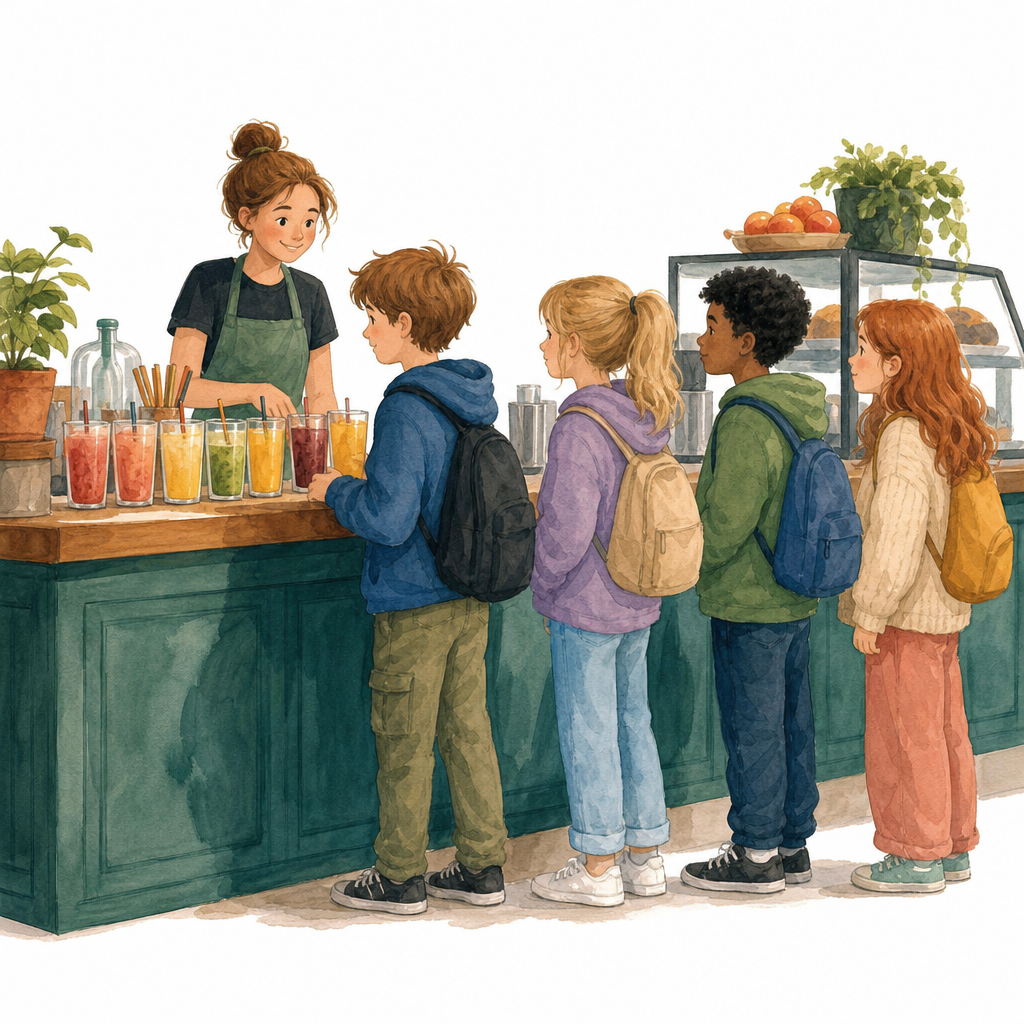
 What do you usually ask for in a café at home? Think of two or three drinks you would order without looking at a menu.
Today you will learn eight Spanish drink words, then practise asking for one out loud, just as you would at a café counter.
By the end of this lesson, you will be able to:
- Name eight drinks in Spanish with el or la
- Ask for a drink in a short spoken phrase
- Notice one café custom that is different from home
Here are today's eight drinks. Watch and listen first: you will see the English and the picture, then hear the Spanish with el or la. Repeat each one twice with the class. Notice the pattern: most take el, and two take la.
Listen carefully. When you hear a drink you know, mark it on the paper bingo card on your desk. When every drink on your card is marked, shout Bingo! then read your drinks in Spanish with el or la.
Open your copy. Copy the eight drinks with their articles from the list on the board, then circle the two you would order.
- el agua — water
- el zumo — juice
- la leche — milk
- el café — coffee
- el té — tea
- el refresco — soft drink
- la limonada — lemonade
- el batido — milkshake
When you name a drink you use el or la. When you order one at the counter you switch to un or una.
Part A — Practise the order phrase first (whole class, before any spin):
Repeat each model twice with the class:
Un zumo, por favor. (oon THOO-moh, por fah-VOR): A juice, please.
Una limonada, por favor. (OO-nah lee-moh-NAH-dah, por fah-VOR): A lemonade, please.
Un agua, por favor. (oon AH-gwah, por fah-VOR): A water, please. (Still un, even though agua is feminine.)
Rule: Un with el-drinks, Una with la-drinks. Exception: el agua becomes Un agua.
Quick guide while you order:
- Un + drink: zumo, café, té, refresco, batido, agua
- Una + drink: leche, limonada
Part B — Spin the wheel
When the wheel lands on a drink, order it aloud using the phrase from Part A: Un or Una + the drink + por favor.
Unlock the full learning experience
You're previewing this lesson. Get full access to this lesson and hundreds more — each one ready to teach, with interactive activities, printable resources and pupil progress tracking built in.
This lesson is copyright of Coding Ireland 2017 - 2025. Unauthorised use, copying or distribution is not allowed.