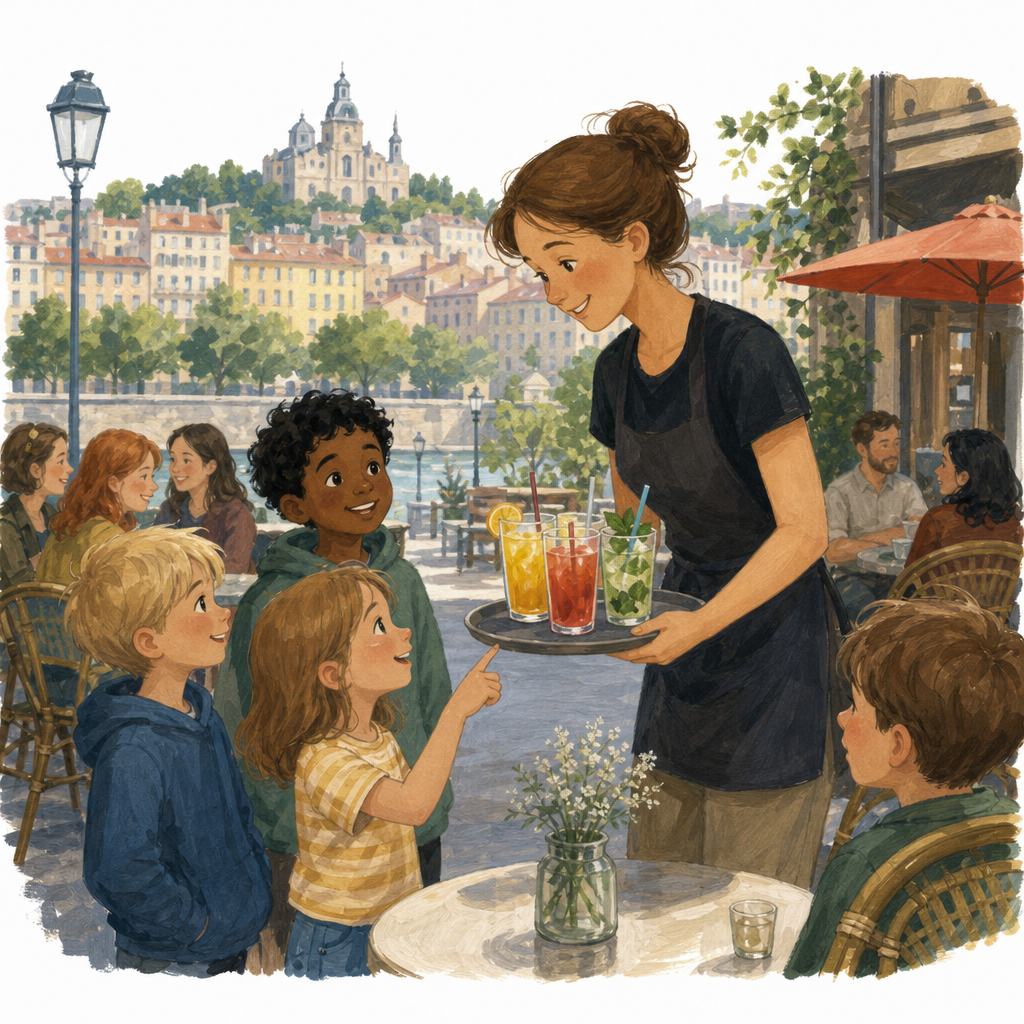
 Picture a sunny terrasse outside a café in Lyon: clink of glasses, menu on the table, people chatting. What would you order at home? Call out a few favourites. By the end of today you will name eight drinks in French and ask for one out loud.
By the end of this lesson, you will be able to:
- Name eight drinks in French with le, la or l'
- Spot drink words when you hear them
- Ask for a drink using a simple French phrase
We will see English first on the board, then hear the French. Listen carefully, repeat the French out loud with the article, then we flip to check the spelling. Listen for the soft zh sound in jus.
Your card shows drink pictures (or English labels). Listen for the French name and cross off each drink as you hear it. Cards are all different, so not everyone has every drink. When every drink on your card is crossed off, call Bingo!
Copy the eight drinks from the board with le, la or l', then circle the two you would order on the Lyon terrasse.
- l'eau — Water
- le jus d'orange — Orange juice
- le lait — Milk
- le thé — Tea
- le café — Coffee
- le chocolat chaud — Hot chocolate
- la limonade — Lemonade
- le jus de pomme — Apple juice
Back on the Lyon terrasse. First we learn the café order together. Listen, then say it with the class:
You: Je voudrais un chocolat chaud, s'il vous plaît.
(I would like a hot chocolate, please.)
The wheel shows each drink with le or la. When we order we switch to un, une or de l'. The wheel lands on a drink; that pupil orders it aloud with the whole sentence, not just the word the wheel asks for.
Unlock the full learning experience
You're previewing this lesson. Get full access to this lesson and hundreds more — each one ready to teach, with interactive activities, printable resources and pupil progress tracking built in.
This lesson is copyright of Coding Ireland 2017 - 2025. Unauthorised use, copying or distribution is not allowed.