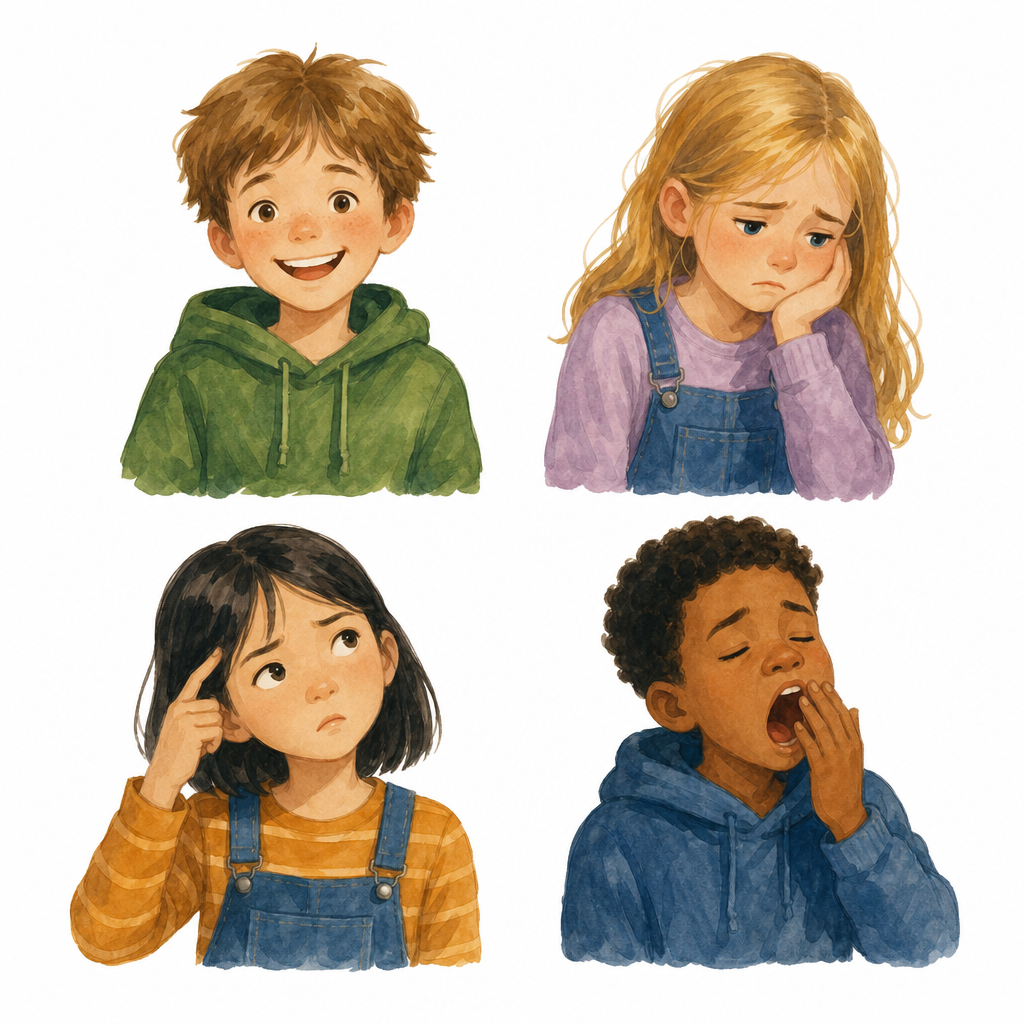
Show me happy without saying anything. Now sad. Now confused. Faces and shoulders do a lot of the work before any word arrives.
Take the three faces quickly. Happy and sad land at once; confused usually gets a frown or a tilted head. Do not name the Spanish words yet. The point is that feeling comes first and the word follows, which is exactly how the rest of the lesson works. All three faces map to words they will meet in the next step.
Here are today's eight emotion words, in two groups of four. Tap each one, listen, then say it back together. Notice how many end in -ado or -oso.
English cousins: two words sound almost like English already. Nervioso is a close cousin of nervous, and emocionado shares a root with emotion (it means excited).
After each group, we build the short sentence: Estoy … (eh-STOY, I am …).
Chunk 1 (first four): Tap feliz, triste, enfadado, cansado. Class repeats each twice (once together, once by table). Pronunciation: feliz (feh-LEES), triste (TREES-teh), enfadado (en-fah-DAH-doh), cansado (kahn-SAH-doh). Model the frame: Estoy feliz (eh-STOY feh-LEES). You say an English feeling from this group; class answers chorally Estoy … for all four. Quick show-me: pupils mime the face while saying the Spanish.
Chunk 2 (second four): Same pattern for asustado (ah-soos-TAH-doh), confundido (kon-foon-DEE-doh), nervioso (ner-BYOH-soh), emocionado (eh-moh-syoh-NAH-doh). Before the choral repeats, pause on the cognate hook on the board: ask "Which English words do nervioso and emocionado remind you of?" Accept nervous / emotion / emotional / excited, then confirm: nervioso ≈ nervous, emocionado shares a root with emotion and means excited. Choral Estoy … for each.
Full set once: Run through all eight words quickly, then four mixed English prompts with full-class Estoy + emotion answers. Stress the middle syllable on enfadado, asustado, confundido and emocionado.
Note in passing: words ending -ado / -oso can end -ada / -osa when talking about a girl or woman (enfadada, cansada, asustada, confundida, nerviosa, emocionada); feliz and triste stay the same. Both forms are correct.
It is the last five minutes of a big football match in Madrid: fans look emocionado, nervioso, enfadado… Volunteers flip two cards on the board. When a match is found, everyone says the Spanish word together.
Whole class on the IWB with volunteers taking turns to flip. The rest of the class must say the Spanish aloud on every successful match (not just watch). If a pair is missed twice, stop and say the Spanish word together before moving on. Listen especially for the stress on the middle syllable of enfadado, asustado, confundido and emocionado.
Cheer a clean match — one ¡Muy bien! from you keeps energy up. After the board is cleared, do a 60-second oral beat: you say an English feeling, class answers chorally Estoy + emotion for four or five examples. That locks the frame before copies open.
We have just said the frame together. Now open your copy and write:
Estoy ______ (eh-STOY, I am ______)
Pick one emotion from the list on screen that matches how you feel right now. Example on the board: Estoy feliz.
Pause the board. Keep the word-table on screen so pupils can see the spelling. The sentence frame is already on the IWB: Estoy … (eh-STOY, I am). A pupil who is happy writes Estoy feliz; a pupil who is tired writes Estoy cansado or Estoy cansada.
Point out clearly that enfadado / cansado / asustado / confundido / nervioso / emocionado become enfadada / cansada / asustada / confundida / nerviosa / emocionada when talking about a girl or woman — both are correct; pick the one that fits you. Feliz and triste stay the same.
Walk the room and check the full sentence is there, not just the single word. Do not collect these.
You each have a bingo card. Cross off each Spanish emotion as you hear it. First full line stands and reads their winning words aloud in Spanish.
How to Play Bingo:
Option 1: Students on Devices (Digital Version)
Option 2: Print Out the Bingo Cards
You're previewing this lesson. Get full access to this lesson and hundreds more — each one ready to teach, with interactive activities, printable resources and pupil progress tracking built in.