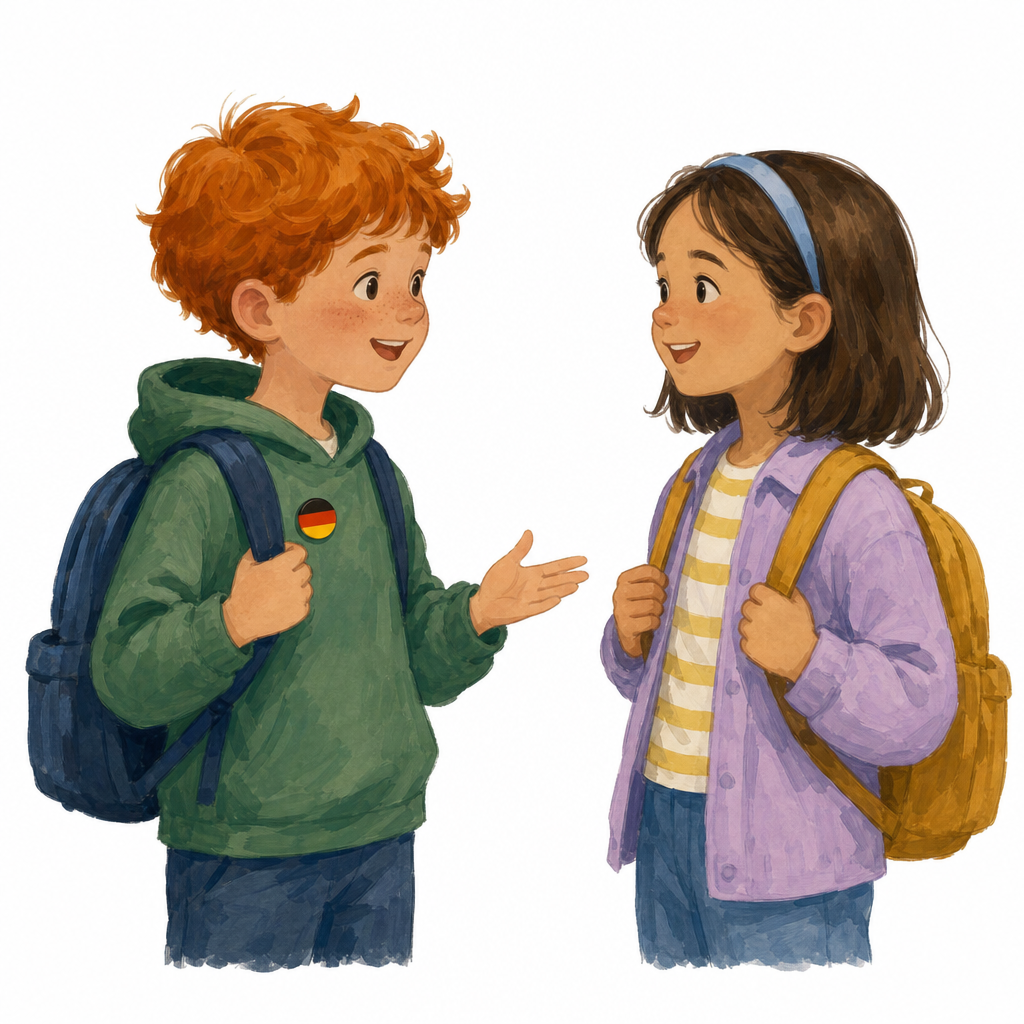
You can already say your name in German. Imagine a visiting pupil from Hamburg has just joined your class for the week. What else do they want to know about you?
Age? Where you live? Something you like? Today you will build three short sentences about yourself so you can chat with that guest.
Paint a quick picture: a Gastschülerin or Gastschüler from Hamburg (or Graz) is spending a week with the class. Take three or four ideas from pupils (age, home town, hobbies, favourite colour). Do not teach the German yet; the flashcards will carry the new phrases. Link briefly to the introductions work they already have, so they see this lesson as the next step rather than a fresh start. Keep the energy light: "By the end you'll be ready to welcome our visitor in German."
Here are today's eight about-me phrases on the cards. Listen to each German line first, then repeat it together with the class before anyone checks the English. Listen for the soft ch in Ich (like a gentle breath, not a hard k) and the long ah in Jahre (YAH-ruh).
After the set, thumbs up if the card was about age, home, likes, or something else: sort with your hands, not your books.
A full chat with our Hamburg visitor sounds like this:
Wie heißt du? (What is your name?)
Ich heiße … (My name is …)
Wie alt bist du? (How old are you?)
Ich bin zehn Jahre alt. (I am ten years old.)
Was magst du? (What do you like?)
Ich mag Fußball. (I like football.)
Do not ask pupils to guess German before they hear it. For each card: play or say the German, class repeats twice (once whole class, once by table), then reveal the English. Work in two gentle passes of four if attention dips (name + age + home + like first; then don't-like, colour, pet, birthday).
Pronunciation guides: Ich heiße… (ikh HIGH-suh), Ich bin ... Jahre alt (ikh bin … YAH-ruh alt), Ich wohne in… (ikh VOH-nuh in), Ich mag… (ikh mahg), Ich mag … nicht (ikh mahg … nikht), Meine Lieblingsfarbe ist… (MY-nuh LEEB-lings-far-buh ist), Ich habe ein Haustier (ikh HAH-buh ayn HOWSS-teer), Mein Geburtstag ist am… (mine guh-BOORTS-tahk ist am).
Celebrate the soft ich-sound when a table nails it: "Super, das war echt deutsch!" Model the full exchange once so pupils hear question and answer together. Quick thumbs sort at the end: age / place / like / other. Core production later will lean on name, age and one like; the other stems stay for recognition and choice in partner work.
A short introduction from our Hamburg visitor is about to play. Before it starts, hold these two jobs in your head:
You will hear it twice on the class speakers before anyone answers.
In German you say your age with every part of the phrase: 'Ich bin zehn Jahre alt' (I am ten years old). Leaving out Jahre alt sounds unfinished to a German ear, even though English speakers often just say "I'm ten".
After that, be ready to answer about yourself out loud with the class: your real age and one true fact.
Scenario script (introducing-myself) — approximate lines the audio uses:
Hallo! Ich heiße Lena. Ich bin zehn Jahre alt. Ich wohne in Hamburg. Ich mag Fußball. Meine Lieblingsfarbe ist blau.
(Hello! My name is Lena. I am ten years old. I live in Hamburg. I like football. My favourite colour is blue.)
Expected focus questions / answers:
Play twice on the class speakers with books closed. After the second play, take answers. If answers scatter, replay just the age line and chorally say Ich bin zehn Jahre alt.
Culture do-task (still this step): Partners say the short English age, then the full German line. Pronunciation if you say it aloud: Ich bin zehn Jahre alt (ikh bin TSAYN YAH-ruh alt). Offer elf (elf) for eleven-year-olds so everyone can personalise. If a pupil knows another language that counts age the same way, welcome the comparison, but keep the German pattern clear. Display only; pupils never type. This lands before writing and partner work so the full phrase is locked in first.
Choral questions for later pairs (about 1 minute): Drill only the three questions Partner A will need, with you modelling first: Wie heißt du? (vee HIGHST doo), Wie alt bist du? (vee alt bist doo), Was magst du? (vass mahgst doo). Class repeats each twice. These are classroom prompts for the exchange, not new flashcard targets.
Whole-class oral substitution: Point to yourself and prompt Wie alt bist du? / Was magst du?. Volunteers or tables answer with real details: Ich bin zehn/elf Jahre alt, Ich mag … (true like). Shape full sentences chorally before anyone writes. If audio fails, read the script aloud twice yourself using the pronunciation guides above.
First, whisper your three lines to yourself using the board model. Then open your copy and write the same three sentences about you: your name, your age, and one thing you like.
Board model (copy the pattern, swap in your details):
Ich heiße ______.
Ich bin ______ Jahre alt.
Ich mag ______.
Word bank: zehn · elf · Fußball (or Fussball) · lesen · Musik · Dublin · Hamburg
Capital letter on Ich, on Jahre, and on any noun like Fußball — copy the board model exactly.
Pause the interactive board clutter; keep only the gapped model and word bank visible. Run one quick choral pass pointing at yourselves: name, age (zehn / elf), one like — then pencils up. Walk the room and check noun capitals (Jahre, Fußball). If a keyboard or handwriting lacks ß, accept Fussball. Accept a taught like or a place name as the third sentence. Do not collect these. Support: sentence starters already on the board. Extension: add Ich wohne in … as a fourth line.
You are chatting with a visiting pupil from Hamburg. Work with a partner. Partner A asks, Partner B answers with name, age and one more fact, then swap. Keep the frame on the board and stay in German.
Keep this strip visible (only these three questions for A):
A: Wie heißt du?
B: Ich heiße ______.
A: Wie alt bist du?
B: Ich bin ______ Jahre alt.
A: Was magst du?
B: Ich mag ______.
Extension answers B may swap in if ready (point at the stem, then say it): Ich wohne in ______. · Meine Lieblingsfarbe ist ______.
Ich wohne in Dublin — und du? Ich wohne in Hamburg.
Before pairs open, re-chorus the three Partner A questions only (already met in the listen step): Wie heißt du? (vee HIGHST doo), Wie alt bist du? (vee alt bist doo), Was magst du? (vass mahgst doo). Do not add extra question forms on the board. Model one full round with a volunteer using the gap-fill frame (include the recycled name question from earlier introductions).
Pair pupils so each faces a partner. Pupils must use their real age (zehn / elf) and a like or fact that is true for them — Fußball and Dublin are only board examples. Core third answer is Ich mag …. Stronger pairs may point to an extension stem and answer with Ich wohne in … or Meine Lieblingsfarbe ist …; if their town is not Dublin, they swap it in. Explicitly allow the taught model wording if a pupil cannot yet substitute.
If live-in or colour need a boost, chorally revisit the answer stems Ich wohne in… and Meine Lieblingsfarbe ist… once (answers only, not new questions). Circulate and listen for the age formula staying whole (Ich bin ... Jahre alt, not a bare number). After the first swap, pause and praise full age sentences you overheard before inviting two pairs to perform. Cheer a clean German mini-chat with no English fillers.
You're previewing this lesson. Get full access to this lesson and hundreds more — each one ready to teach, with interactive activities, printable resources and pupil progress tracking built in.