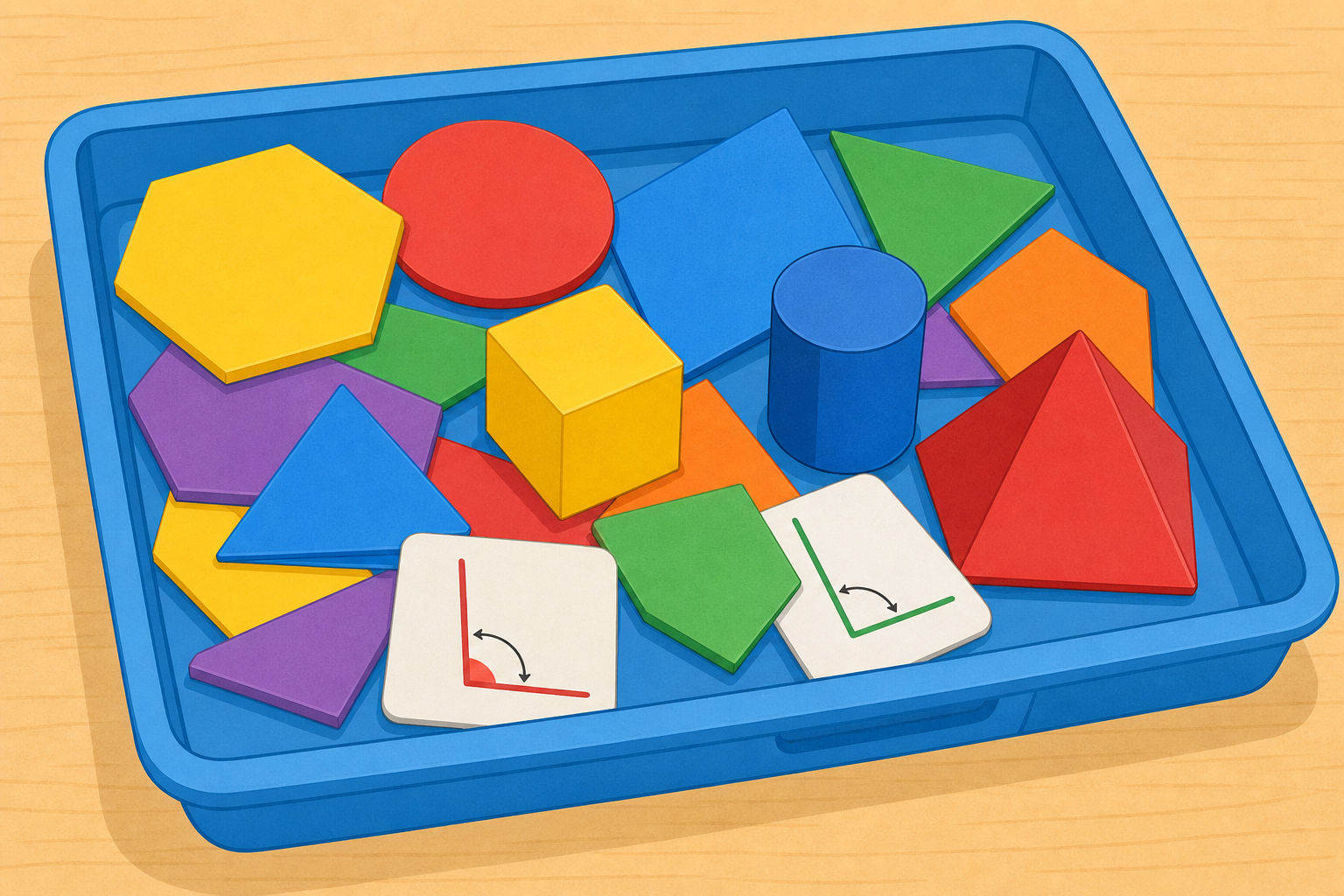
On screen is a mixed tray: some flat shape cards, some solid shapes, and some angle cards, all jumbled together.
If you had to sort every one of these into groups, what is the very first question you would ask about each one to help you decide?
Take three hands-up answers, not open call-outs. Listen for property questions like how many sides? or does it have a right angle? rather than colour or size. If a pupil names a sort by look, gently steer to a maths property.
Watch the sorts on the board. Each one starts with a single property question. As each card is placed, get ready to say what question decided its group.
First we sort the flat shapes by how many sides they have. Your teacher will place a six-sided shape in its group.
Now the question changes. To tell solid shapes apart we stop counting sides and start counting faces, edges or vertices.
Watch one full sort of solids by number of faces. Your teacher will count every face of a cube: 6 faces, so the cube goes in the 6-faces group. Next, every face of a square-based pyramid: 5 faces, so the pyramid goes in the 5-faces group. The same method works with edges or vertices when that is the better question.
One good property question leads straight to the name and the group.
Worked live by you on the board, not a script. Ask the property question aloud before each card lands, then let the class predict the group.
Today we sort this mixed set together on the board. The rule is: is it a right angle or not a right angle?
We will place these in turn:
Watch the ruler's edge carefully when you apply the square-corner test.
Before each card lands, say whether it fits the square-corner test or not.
Talk this one through together — pupils take turns at the board and the class agrees or corrects out loud.
Use a folded-paper right-angle checker as your reference. Hold out for a reason each time (it fits the square corner exactly), not just a group name. The straight-edge card is the trap: it is a straight angle, bigger than a right angle, so it does not fit — the board now says this, so draw pupils' eyes to it. Rotate four pupils so several place a card.
In your maths copy, pick any one flat shape, one solid shape and one angle from the lesson.
Beside each one, write one true property sentence — for example, a cube has 6 faces, a pentagon has 5 sides, or this angle is smaller than a right angle, so it is acute.
Walk the room glancing for a real property (a count or an angle name), not a colour or a size. This is whole-class copybook practice, not marking.
Today we work through four sorting rounds, each one a step harder:
Before each round, say aloud the one test that will decide the sort.
Before Round 2, we sort one triangle together on the board. We compare its three sides: if all 3 match it is equilateral, if only 2 match it is isosceles, if no sides match it is scalene. Then we place it in its family bucket.
Before Round 3, we test one angle together with the folded-paper square corner. If the angle is smaller than the square corner it is acute, if it fits exactly it is right, if it is wider it is obtuse. Then we place it in its bucket.
After each worked example, you take turns dragging the rest. Use Check when every card is in a bucket.
Practice round: pupils take turns at the board, class confirms, keep it brisk. Use Check as narration: yes, that is it.
You're previewing this lesson. Get full access to this lesson and hundreds more — each one ready to teach, with interactive activities, printable resources and pupil progress tracking built in.