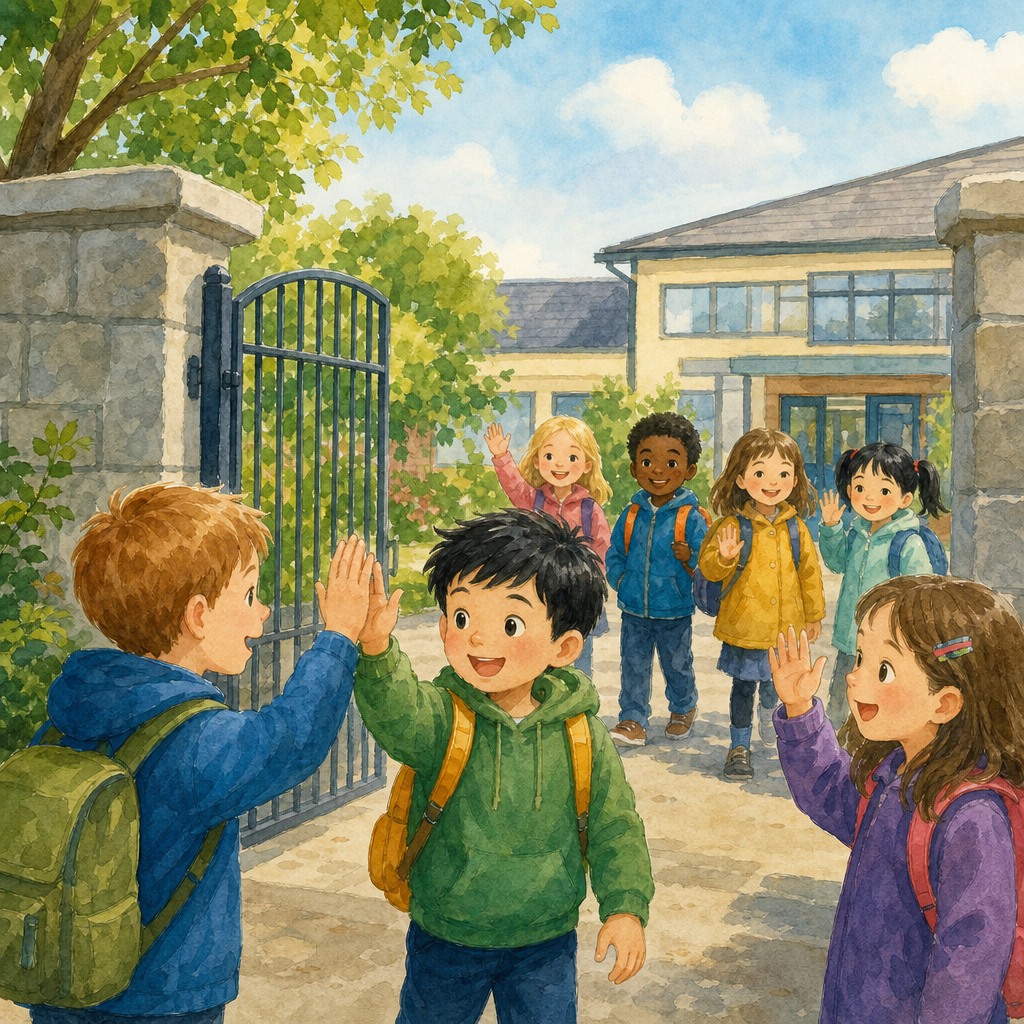
Before nine o'clock this morning, how many different ways did you say hello? Think of four. English has more than you might expect: hi, hello, morning, hey...
Collect four English greetings quickly from the class and leave them on the board. Do not translate into French yet; the word-table in the next step does that job. The point of the hook is to notice that English already has several hellos, so French having more than one will not feel strange. Keep it light: smile when someone offers a creative one like 'howya' or 'yo'.
Here are today's eight French greetings on the board. Listen to each one, then say it back together.
We will meet them in two short waves so they stick. Listen for the soft zh sound in Bonjour, like the s in treasure.
Run the table in two waves so the class can hold the words. Wave 1 first: tap Bonjour, Salut, Comment ça va ?, Ça va. Class repeats each twice (once all together, once by table). Flag: Salut is for friends; Bonjour works with almost anyone; Ça va is the short answer to Comment ça va ?.
Wave 2: tap Bonsoir, Bon après-midi, Comment allez-vous ?, Enchanté. Flag: Bonjour / Bon après-midi / Bonsoir follow the time of day; Comment allez-vous ? is the polite form for a teacher or adult; Enchanté is for meeting someone new (girls/women often write Enchantée with an extra e; same idea when spoken).
Pronunciation guides if audio is slow: Bonjour (bohn-ZHOOR), Salut (sah-LOO), Comment ça va ? (koh-mahn sah VAH), Ça va (sah VAH), Bonsoir (bohn-SWAHR), Bon après-midi (bohn ah-preh-mee-DEE), Comment allez-vous ? (koh-mahn tah-lay VOO), Enchanté (ahn-shahn-TAY).
The first choral repeat will be messy. Celebrate the soft zh in Bonjour the moment you hear it: 'That's the treasure sound. You're already sounding French.'
Watch the board. Volunteers flip two cards at a time and find each French greeting with its English meaning. When a match is found, the whole class says the French aloud together.
Freeze-frame next: your teacher will call out a situation in English. Answer together with one French greeting from today's list, meeting a teacher at 9am, seeing a friend, evening, afternoon, asking how someone is (friend or teacher), answering how you are, or meeting someone new.
Run matching as whole-class IWB only: you or a volunteer flips the cards on the board. No pupil devices. After every correct match, the whole class repeats the French phrase once chorally before the next turn. Every second match, add a quick 'whisper it to the person beside you' so row 3 still gets a speaking beat. If a pair is missed twice, stop and say the French word together before moving on. Insist on the full phrase: Comment ça va ? needs all three parts, and Comment allez-vous ? needs the full polite form.
When all pairs are matched, move straight into the freeze-frame round (about 3–4 minutes). Call each situation in English; class answers chorally with one French greeting. Target answers in order: Bonjour; Salut; Bonsoir; Bon après-midi; Comment ça va ?; Comment allez-vous ?; Ça va; Enchanté. Cover all eight once so the quieter items get a production beat before copy and partner work. If two answers could fit, accept either and briefly say why. Keep energy up: a clean full-class answer earns a thumbs-up and you move on.
Open your copy. Write four greetings you could use at school before lunch, and write the English meaning beside each one.
Tip: Bonsoir is for the evening. Pick four you could say this morning or at break. Keep the word-table on the board while you write.
Pause the board interactives. Everyone writes: this is the only three minutes where every pupil's pen is moving. Keep the word-table on screen so spellings and accents stay visible. Sensible before-lunch choices include Bonjour, Salut, Comment ça va ?, Ça va, Comment allez-vous ? and Enchanté; Bonsoir belongs later in the day and Bon après-midi is for the afternoon. Do not collect these.
You are at the school gate meeting a French pen pal, or walking into a boulangerie (bakery). Work from the three prompt cards on the board. Take turns as Partner A and Partner B, then swap after each card.
Card 1, friend at the gate
A: informal hello + ask how they are
B: short 'I'm fine' answer
Card 2, into the bakery
A and B: polite hello both ways
Card 3, meeting someone new
A: polite hello + nice to meet you
B: nice to meet you back
Pairs work from the board prompts only (no pupil devices). The partner-practice interactive supplies the French lines; if you need a fall-back script on the board, use exactly these taught phrases:
Card 1: A: Salut ! Comment ça va ? — B: Ça va.
Card 2: A: Bonjour ! — B: Bonjour !
Card 3: A: Bonjour ! Enchanté. — B: Enchanté.
Frame the scene first: Partner A is the pen pal or the shopkeeper; Partner B is the visitor. Model Card 1 once with a volunteer before they start: you say Salut ! Comment ça va ? (sah-LOO, koh-mahn sah VAH) and the volunteer answers Ça va (sah VAH). Circulate and listen for the soft zh in Bonjour. After each card, pairs swap A/B so everyone asks and answers. Extension for a confident pair: try Card 1 with Comment allez-vous ? if they imagine greeting a teacher. When you hear a clean exchange, freeze the room for a quick round of applause. Use only today's phrases; do not add untaught follow-ups.
You're previewing this lesson. Get full access to this lesson and hundreds more — each one ready to teach, with interactive activities, printable resources and pupil progress tracking built in.