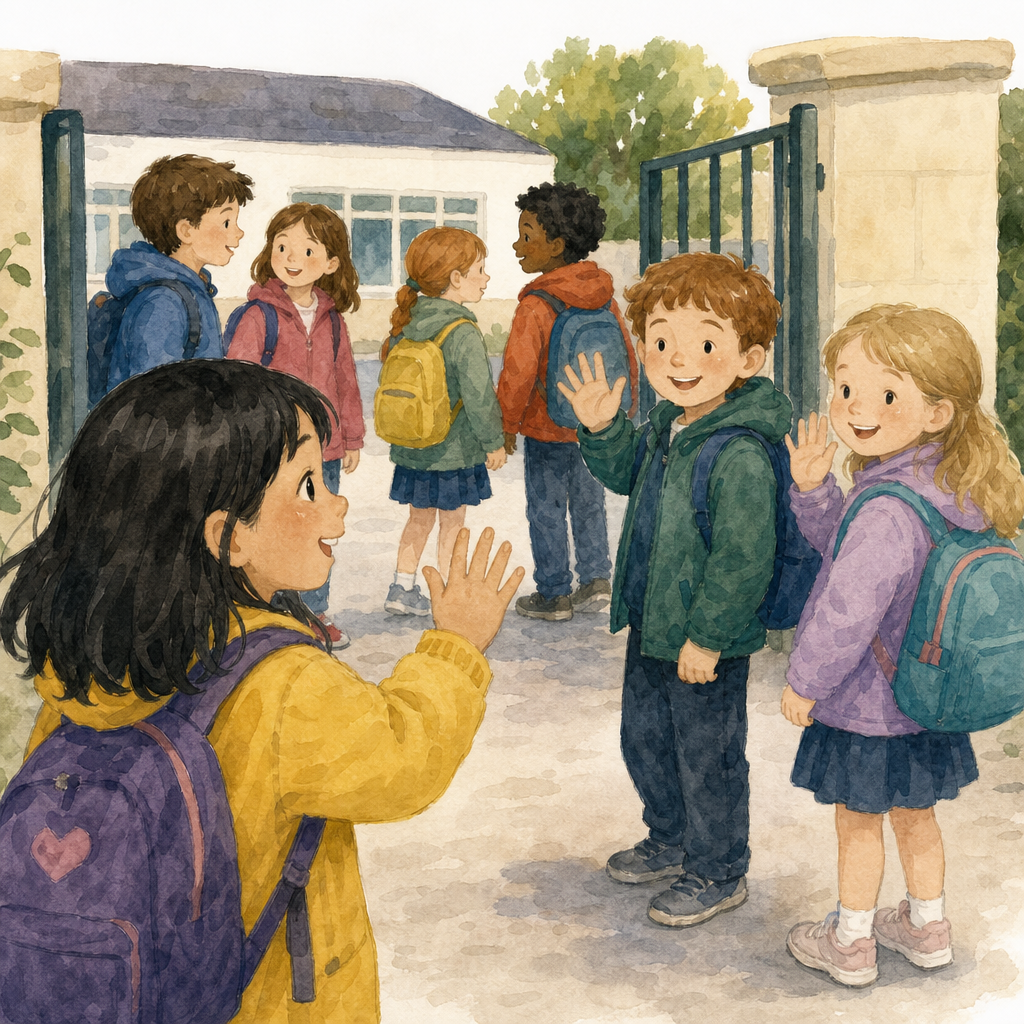
Before nine o'clock this morning, how many different ways did you already say hello? Think of four. We say hi, morning, howya, hey... German has its own set, and some of them will sound almost familiar.
Collect four English hellos from the class and write them on the board. Keep it light and quick: the point is to notice that English already has several, not to list every one. Do not confirm any German yet; the word-table in the next step reveals them. If a pupil offers a German word they already know, smile and park it for the next step.
Listen to each greeting, then say it back together with the class. First we will meet the time-of-day set, then a few friendly extras. Listen for the soft oo in Guten and the little ö sound in Hallöchen.
Run the word-table on the IWB. Pupils do not tap; you tap each row, play the audio, then lead two choral repeats (whole class, then by table).
Teach in two waves so the set does not feel huge:
Confirm any cognates pupils guessed in the hook. Say the pronunciation guide aloud yourself before the audio if you need it.
Watch the board. When it is your turn, flip two cards, say the German greeting out loud, and find its English meaning. After every match, the whole class says the German greeting together.
Run this exclusively on the IWB as a whole-class volunteer game. No desk devices. Two volunteers per turn: one flips the first card, the other hunts the match. After each correct pair, lead a quick whole-class choral repeat of the German so row-3 pupils still speak.
If eight pairs (16 cards) feel heavy in ten minutes, run two shorter rounds of four pairs each: first the time-of-day set (Hallo, Guten Morgen, Guten Tag, Guten Abend), then the friendly extras (Hi, Hallöchen, Willkommen, Freut mich). Still cover all eight words.
Model the first match yourself: flip Guten Morgen, say it (GOO-ten MOR-gen), then find Good morning. If a pair is missed twice, stop and say the German together before moving on. Insist on the full phrase, not a half-remembered scrap.
Open your copy. From the before-lunch shortlist on the board, copy four hellos: Hallo, Guten Morgen, Guten Tag, Hi or Hallöchen. Beside each one, write morning or daytime.
Do not choose Guten Abend (evening only), Willkommen or Freut mich for this task — those two are for welcoming someone or meeting them for the first time, not for a clock time.
Pause the board. Everyone writes; this is the only three minutes where every pupil's pen is moving. Keep the word-table on screen while they copy so they can check spelling and accents (especially the ö in Hallöchen).
Shortlist on the board (or leave only these five highlighted): Hallo, Guten Morgen, Guten Tag, Hi, Hallöchen. Pupils pick any four and label each morning or daytime. Typical labels: Guten Morgen → morning; Guten Tag → daytime (all-purpose from late morning on); Hallo / Hi / Hallöchen → either, usually daytime.
Explicitly blocked for this task: Guten Abend, Willkommen, Freut mich. Walk the room and check the morning/daytime labels. Do not collect these.
Time to practise with a partner. Partner A greets, Partner B answers with a different greeting, then you swap roles. Your teacher will model a morning exchange and an evening exchange first — watch, then try both with your partner.
Model two short exchanges with a confident volunteer before pairs begin. Leave a simple role prompt on the board in English only (do not reprint the German word list — the partner-practice interactive already shows the phrases):
Scripts to model aloud (teacher only — say them, do not paste the full German list into the pupil slide):
Confident pairs can stretch to Hallöchen, Willkommen or Freut mich once the core time-of-day exchanges are secure (remind them those last two are for welcoming or first meetings). Circulate and listen for full phrases. After about five minutes, signal a swap of roles so both partners lead. If a pair freezes, re-model one exchange yourself rather than sending them back to a printed word list.
You're previewing this lesson. Get full access to this lesson and hundreds more — each one ready to teach, with interactive activities, printable resources and pupil progress tracking built in.