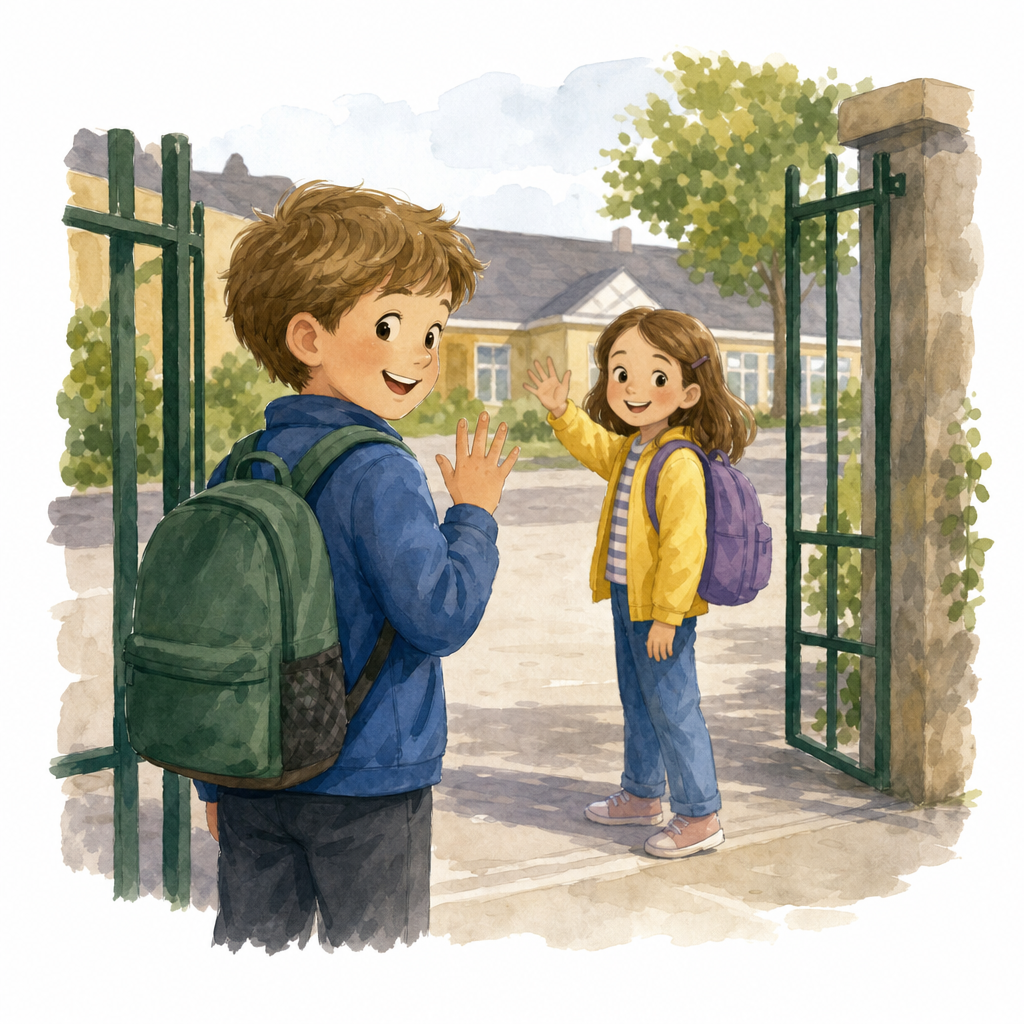
Think about the last phone call you ended in English. Did you say just one word and hang up? Or did it go on a bit: bye, talk later, love you, bye again?
French goodbyes often work the same way. One word is fine, but a short follow-on phrase makes you sound more natural.
Take three or four quick answers about how pupils end a call or leave a group chat. Keep it light and do not correct English here. The point is to notice that leave-taking is often more than one word, which sets up today's French phrases.
You can recycle Salut from the greetings work if anyone offers it: it works for both hello and bye. Do not teach the full list yet; the flashcards do that next.
Today's eight goodbyes come in two short clusters on the flashcards. For each card, listen to the French first, then repeat with the class.
Listen carefully for two sounds as you go: the soft zh in Bonne journée (like the s in treasure) and the nasal ending in À demain.
After both clusters, practise a finished goodbye together: one phrase starts, and the class answers with a different follow-on from the board.
Run this whole-class on the board. Work in two clusters of four so pupils are not hit with eight new items at once. Do not read a full word list off the IWB prose; the flashcards carry the phrases.
Cluster 1 (general and informal): Au revoir, Salut, À bientôt, À plus tard. Flip each card to French with audio (or your model) first. Class listens, then repeats twice: once all together, once by table. Quick choral pass through the whole cluster before moving on.
Cluster 2 (time and wishes): À demain, À tout à l'heure, Bonne journée, Bonne nuit. Same listen-then-repeat pattern.
Pronunciation guides: Au revoir (oh ruh-VWAHR), À bientôt (ah byan-TOH), À demain (ah duh-MAN), À plus tard (ah ploos TAR — the s in plus is sounded here), Salut (sah-LOO), Bonne nuit (bun NWEE), Bonne journée (bun zhoor-NAY), À tout à l'heure (ah too tah LUR).
Usage note: Bonne nuit only when someone is off to bed. For leaving in the evening, Bonne soirée is the usual wish (not taught today).
Point out that Salut is the informal bye for friends, while Au revoir works with almost anyone. Several phrases already carry a follow-on idea (soon, tomorrow, later).
Whole-class follow-on beat (about 2 minutes): Keep all eight phrases visible on the flashcards or a quick board list. You say one goodbye (e.g. Au revoir !); the class answers with a different follow-on (e.g. À bientôt ! or Bonne journée !). Do four or five rounds, then swap so the class starts and you answer. This models the two-line shape before bingo and partner work. Only after the full set has been heard once may you flip a few cards English-first as a quick recall game.
You each have a printed bingo card and a pencil. Listen carefully as each goodbye is called, and mark it when you hear it. First full line calls out!
How to Play Bingo:
Option 1: Students on Devices (Digital Version)
Option 2: Print Out the Bingo Cards
Write your own two-line goodbye from the partner work you just did: one line for what you say, one for what your partner says back. Choose both lines from the list below, and copy the accents carefully.
This comes after oral partner practice so the order is hear → say → write. Pause the board. Keep one model pair fully visible, for example Au revoir ! / À bientôt !, plus the phrase bank from the partner step if space allows. Every pupil writes their own two-line exchange; they may copy accents and spellings from the board rather than spelling unaided from memory. Walk the room and check accents on À and the spelling of bientôt and journée. Do not collect these; the point is handwriting the target language while the spoken exchange is still fresh.
Work with a partner on a two-line goodbye in a real situation. Pick one scenario from the board, then speak:
Starter pairs stay on the board for the whole activity. Use at least one starter pair first, then try a second goodbye with a different follow-on.
Partner A starts, Partner B answers, then swap roles so each of you begins an exchange.
Before pairs begin, write a clear two-column phrase bank on the IWB and leave it up for the whole step (do not rely on the pupil slide to list the French; the interactive and this board bank carry the words):
Start with… | Answer with…
Au revoir (goodbye) | À bientôt (see you soon)
Salut (bye, informal) | À plus tard (see you later)
Au revoir | Bonne journée (have a nice day)
Salut | À demain (see you tomorrow)
Also list the remaining phrases with tiny English glosses: À tout à l'heure (see you in a bit), Bonne nuit (good night, bedtime only).
Label two starter pairs clearly on the board and leave them up: Informal: Salut ! → À plus tard !; General: Au revoir ! → Bonne journée !.
Show two fully worked model exchanges slowly with a volunteer before anyone pairs up, for example: Au revoir ! (oh ruh-VWAHR) / À demain ! (ah duh-MAN), and Salut ! (sah-LOO) / À plus tard ! (ah ploos TAR).
Post the three scenarios on the board. Pairs choose a scenario first, then speak. Require each pair to use at least one labelled starter before trying a second combination. Pair pupils facing each other. Circulate and listen for a full two-line turn, not a single word dropped and silence. If a pair freezes, point them back to the starter cards on the board.
After about five minutes, swap roles so each pupil starts an exchange. After the first swap, freeze and harvest one confident pair to perform: big reaction from the class. Remind them: a two-line goodbye already sounds properly French — that is the win today.
You're previewing this lesson. Get full access to this lesson and hundreds more — each one ready to teach, with interactive activities, printable resources and pupil progress tracking built in.