 Think about the last phone call you ended in English. Did you say just one word, or a little string of them: bye, talk soon, love you, click?
Today we learn how Spanish goodbyes work the same way. You do not stop at one word. You add a short follow-on so the goodbye feels finished.
By the end of this lesson, you will be able to:
- Use Spanish goodbye phrases with a natural follow-on
- Hold a short two-line goodbye exchange with a partner
- Notice why leave-taking can take longer in some cultures
You will meet the phrases twice: the main goodbyes first, then the short follow-ons you can add after them. Listen and repeat with the class before you try any guessing, and on the second look at a card, say the Spanish yourself before the flip if you feel ready.
Worked exchange (what a full close sounds like):
Adiós. Cuídate. (Goodbye. Take care.) · Hasta luego. Que tengas un buen día. (See you later. Have a good day.)
Follow-ons you can add: Cuídate · Que tengas un buen día
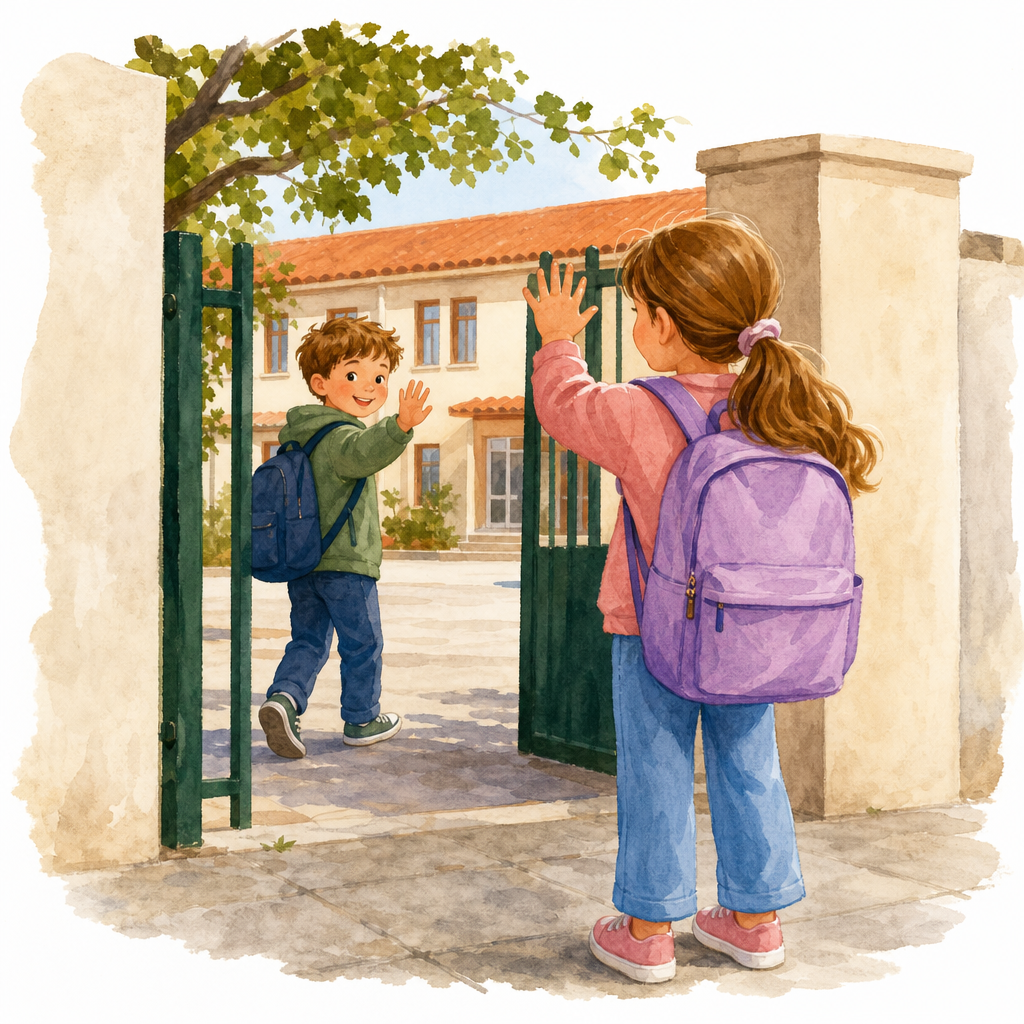
You are leaving a friend at the school gate in Valencia. Your own bingo card is on the sheet on your desk (or your own on-screen card if you have one). Squares show the Spanish, and cards are all different. When you hear a goodbye that is on your card, cross it off and whisper the phrase so the sound sticks. When every goodbye on your card is crossed off, call Bingo!
Open your copy and keep the model on the board in view, because you are going to copy or lightly adapt one two-line goodbye exchange from it: what you say, and what your friend says back. Pick one main goodbye and one follow-on from the list on the board, and copy the accents exactly as they are shown, especially in Adiós , mañana and Cuídate , since an accent changes how the word sounds.
Model: ¡Adiós! / ¡Cuídate! (Goodbye! / Take care!)
Main goodbyes: Adiós, Hasta luego, Hasta mañana, Chao
Follow-ons: Cuídate, Que tengas un buen día
- Adiós — Goodbye
- Hasta luego — See you later
- Hasta mañana — See you tomorrow
- Hasta pronto — See you soon
- Hasta ahora — See you in a bit
- Chao — Bye (informal)
- Cuídate — Take care
- Que tengas un buen día — Have a good day
Partner A is ending a video call; Partner B is the friend on the other end. Close the call with a main goodbye plus a follow-on, then swap. You may keep your copy open and read for the first turns. If you stall, glance at the board bank your teacher leaves up.
Frame
Partner A: [main] + [follow-on]
Partner B: [main] + [follow-on]
Model
Hasta luego. Cuídate. → Chao. Que tengas un buen día.
Unlock the full learning experience
You're previewing this lesson. Get full access to this lesson and hundreds more — each one ready to teach, with interactive activities, printable resources and pupil progress tracking built in.
This lesson is copyright of Coding Ireland 2017 - 2025. Unauthorised use, copying or distribution is not allowed.