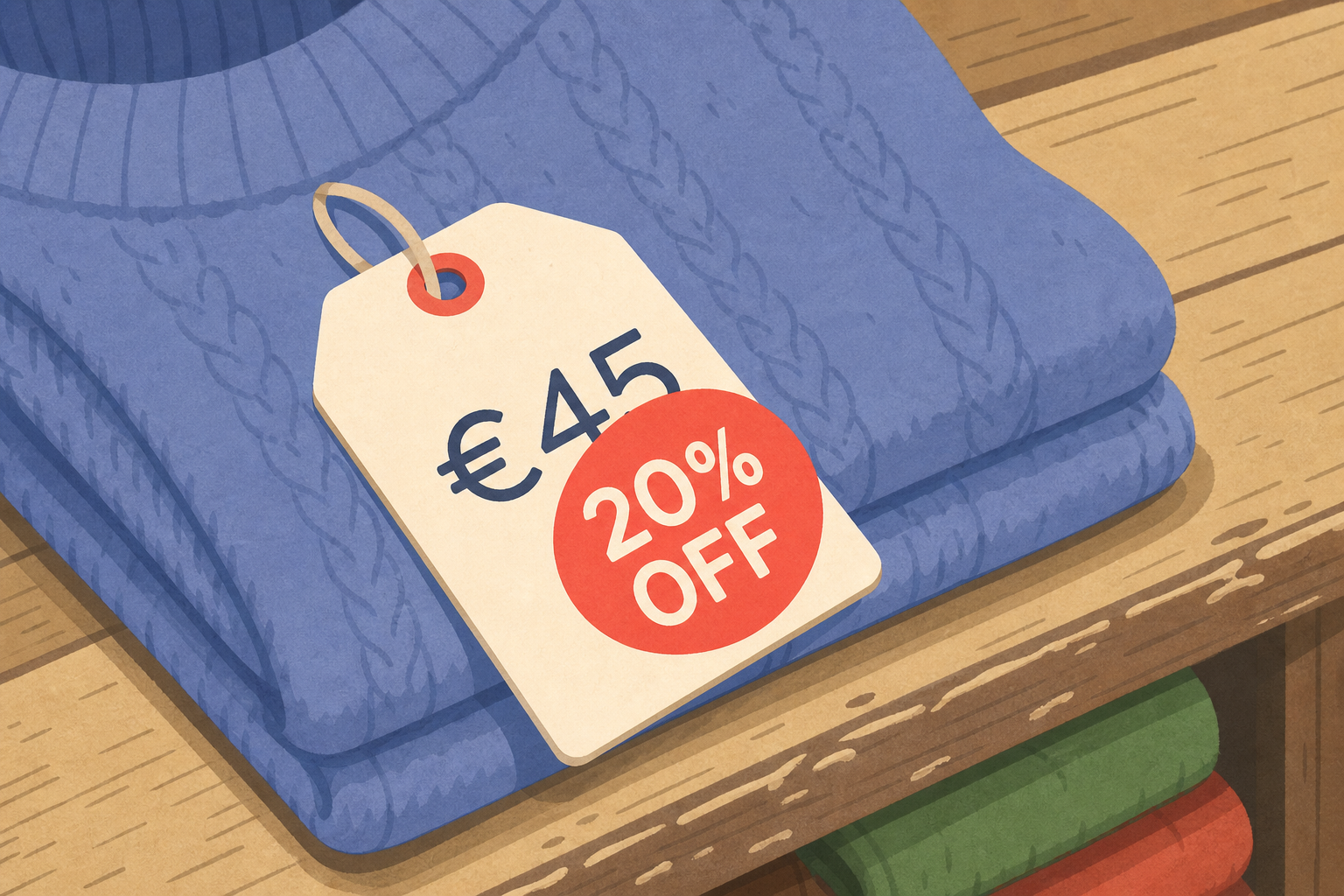
Look at this shop tag: a jumper marked €25, with a sticker over it saying 20% off. You hand the shopkeeper a €50 note.
There are two questions hiding in that one tag. What are they?
Take two or three hands-up answers, not open call-outs. Draw out that there are two hidden questions: what is the sale price, and what change do you get from €50. Don't solve either yet, that is the whole lesson.
Watch two shop tags on the coin tray. For each one we found the sale price first, then built the change with coins and notes.
To find 20% off the €25 jumper, we take 10% of €25 first, which is €2.50, then double it to get €5 off. That leaves a sale price of €20.
The second tag has a further discount taken off the already-reduced price. Watch how the sale price gets smaller before we count the change.
For the first tag, say the two steps aloud as you point: find the sale price, then count the change. Show finding 20% by taking 10% of €25 (€2.50) and doubling it (€5 off), so pay €20; count on from €20 to €50 to see €30. Model this 10%-then-double method on the board so pupils have a way to find any percentage of an amount.
Hold out on the second tag: ask what the second €5 comes off. The second discount comes off the €30, not the €40: €30 − €5 = €25, then change from €30 is €5. That is the one that catches people.
Today we work through these tags together on the board. For each one we find the sale price first, then build the change on the coin tray.
Talk this one through together — pupils take turns at the board and the class agrees or corrects out loud.
For €60 at 30% off, prompt for 10% (€6) then triple it (€18 off), so pay €42; count on €42 → €50 for €8 change. For the stacked tag, keep asking what does the €5 come off? On the two-shop tag, remind pupils only the cereal is discounted: take 10% of €4.50 (45c) and double it (90c off) to reach €3.60, add the €1.20 milk for €4.80, then find the change from €10. Individual pupils build each change on the tray while the class confirms the running total.
In your maths copy, work each shop tag in three lines: line 1 the percent off the original price, line 2 the sale price, line 3 the change from the cash paid. Underline the change at the bottom of each one.
Walk the room glancing for the three-line layout and that the percent is worked before the change — this is whole-class copybook practice, not marking.
Today we work through these shopping trails together. For each one, find the sale price first, then build the change owed on the tray. Remember: 50% off leaves half the price, and 75% off leaves a quarter of the price.
This is the practice round — pupils take turns at the board, check each answer, and the class confirms before moving on. Work the first tag aloud with the class so the discount step is visible, then keep the board work brisk rather than over-explaining.
The trail rises: 10% and 25% are friendly, 50% halves and 75% quarters (prompt what is a quarter of €24? for the toy), and the final tag stacks two 50%-off steps (€40 → €20 → €10, change from €20 is €10). Ask the class before the last one whether 50% then 50% is the same as 100% off — it is not, and that is the maths-talk to come.
You're previewing this lesson. Get full access to this lesson and hundreds more — each one ready to teach, with interactive activities, printable resources and pupil progress tracking built in.