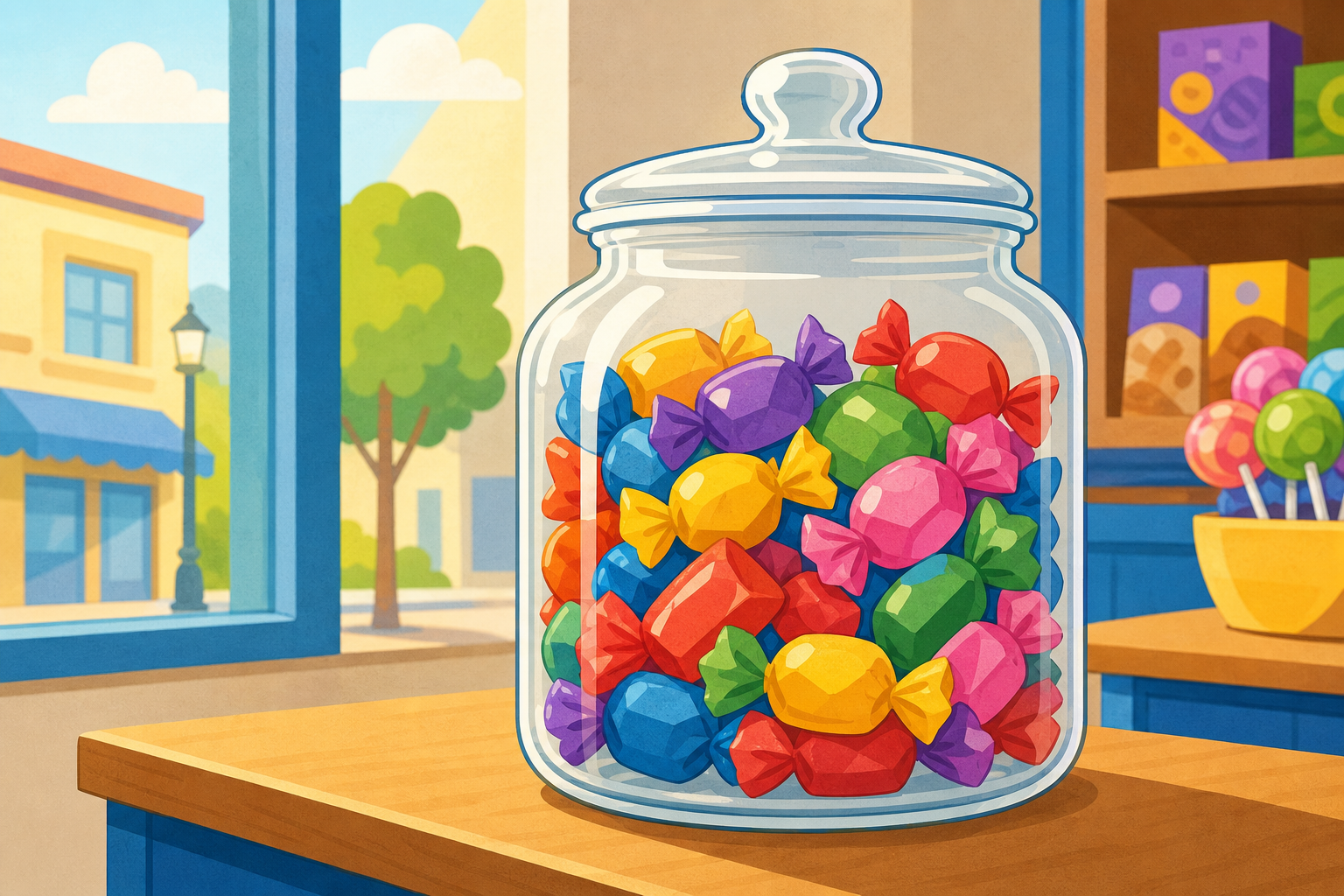
There is a jar of 37 sweets on the shop counter. If someone asked you roughly how many were in it, would you say about 30 or about 40? Which of those two tens do you think 37 is closer to?
Take three hands-up answers, not open call-outs. Don't reveal the number line yet — this is just to surface the idea of a number sitting between two tens. Listen for a pupil who says closer to 40 and hold that thought for the next step.
The interactive shows each number marked on a number line between two tens. Watch where the marker sits, and decide which ten it is closer to.
42: two steps past 40, units digit 2 is small, rounds down to 40. Stress the units digit tells you how far past the last ten, so it decides the direction.
68: two steps short of 70, units digit 8 is big, rounds up to 70. Ask what happens to a number exactly in the middle, and pause before revealing 35.
35: the key case. Exactly halfway between 30 and 40, closer to neither, so the rule decides: ending in 5 rounds up, so 35 goes to 40. Land this one slowly.
90: already on a ten, nothing to round, stays 90. The reassurance case.
Today we work through these numbers together, placing each one and rounding it to the nearest ten: 24, then 51, then 76, then 45. The 45 is the one to watch — it lands exactly halfway, so we will say the rule aloud before we round it.
This round is for talking it through together — pupils take turns at the board and the class agrees or corrects out loud.
Work through the four numbers in order. An individual pupil comes up, drags the marker to the number, then reads off which ten is closer.
In your maths copy, write each of these numbers and its nearest ten beside it. Underline the units digit you used to decide each time.
Walk the room and glance for the underlined units digit — that is the thinking you want to see, not just the answer. This is whole-class copybook practice, not marking.
Today's challenge round builds up in steps. Round each of these numbers to the nearest ten:
The 85 lands exactly halfway, so remember the rule. And 198 is the tricky one — rounding it up lands on 200, which is still just the nearest ten (200 is twenty tens), so watch what happens to the tens and hundreds.
These are the practice questions — pupils take turns at the board, check each answer, and the class confirms before moving on. Keep the board work brisk rather than over-explaining.
You're previewing this lesson. Get full access to this lesson and hundreds more — each one ready to teach, with interactive activities, printable resources and pupil progress tracking built in.