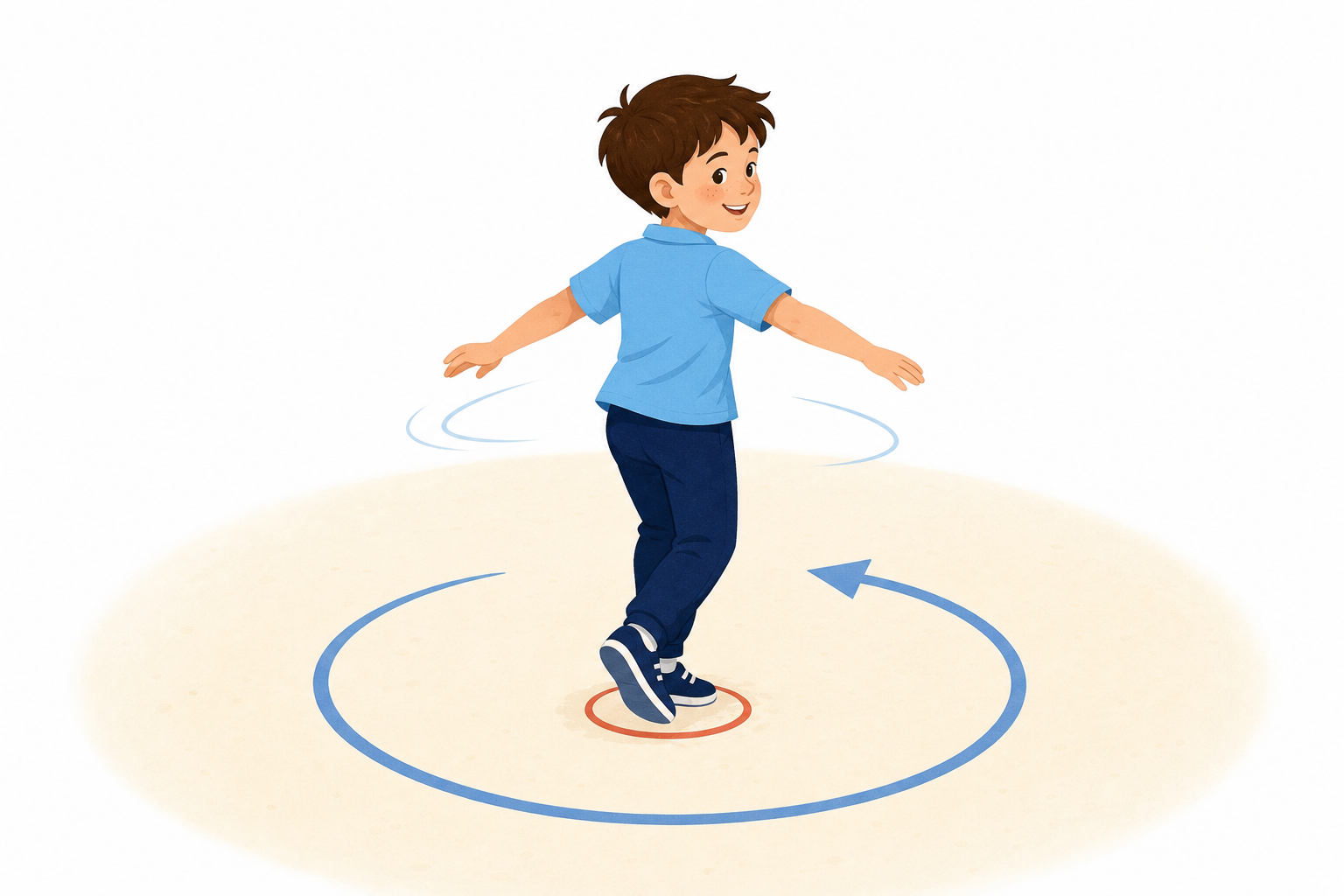
A turn is how far something spins around a fixed spot.
Everyone stand up in a clear space. Watch me turn on the spot, then copy each turn with me. First we turn all the way around, back to where we started. Now a half turn. Now just a quarter of the way. Each time we stop, notice which direction you are facing.
Stand and demonstrate the three turns yourself, pausing at each. Take three hands-up answers naming where you ended up facing (back the same way, opposite way, to the side). Do not name the turns yet — let pupils describe what they saw first; the naming lands in the next step.
Watch the arrow turn around the dot in its corner. It spins a quarter of the way, then halfway, then three-quarters of the way. Each of those turns goes clockwise, which means the way a clock's hands go. Look carefully: the arrow stays exactly the same size the whole time. Only the direction it points keeps changing. Be ready to say which way it faces after the half turn.
Now watch a second shape make a single half turn. Be ready to say which way it points when it stops.
In your maths copy, draw an arrow pointing up. Then, beside it, draw where the same arrow points after a quarter turn clockwise, after a half turn, and after a three-quarter turn clockwise. Remember, clockwise means the way a clock's hands go. You should end up with four arrows in a row.
Walk the room, glance for arrows kept the same length and pointing right / down / left in turn. No individual marking — this is whole-class copybook practice, not assessment.
Take your cardboard arrow with the pencil through one corner. When I call a turn, spin it around that fixed pencil point and tell me which way the tip now points. We work through these four in order:
Talk this one through together — pupils take turns at the board and the class agrees or corrects out loud.
Every pupil pivots their own arrow at their desk while one demonstrates at the front. Watch for arrows that get slid instead of turned — the pencil must stay put. Revoice a good answer: a quarter turn is the same as a right-angle corner. The last one is worth pausing on: from left, a three-quarter turn clockwise brings the tip all the way round to down.
Now for the tricky ones with your arrow. Work these in order, each a little harder. Try to predict the new direction before you turn.
This is the practice round — pupils take turns at the board, check each answer, and the class confirms before moving on. Keep the board work brisk rather than over-explaining.
The last challenge is the stretch: a full turn and four quarter turns both return it to up (a full turn is shown on the board in the next step). Head off the common slip that a three-quarter turn clockwise is the same as a quarter turn — it points a different way (left, not right). A half turn is the same as two quarter turns.
You're previewing this lesson. Get full access to this lesson and hundreds more — each one ready to teach, with interactive activities, printable resources and pupil progress tracking built in.