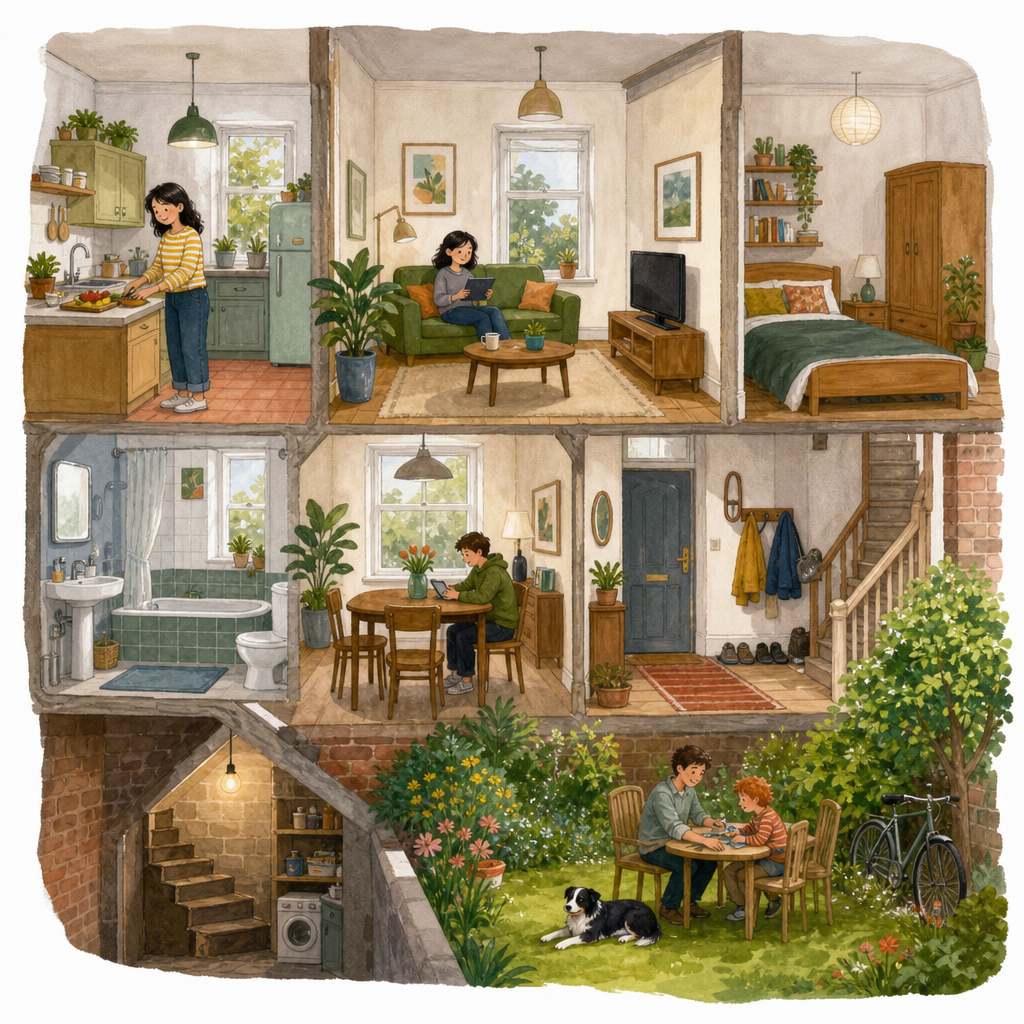
Which room do you spend most time in at home? Think of one thing you always do there.
Today we step inside a German flat, name eight rooms in German, and practise short sentences about what happens in each one.
The board arc runs to about 46 minutes; the last quarter of an hour is the Activity Book page at their desks. Take three or four quick answers to the favourite-room question in English only. Do not teach the German words yet; the flashcards do that next. Keep the pace light so the class is ready to listen rather than still chatting about their own houses. Mention briefly that today's cutaway is a typical German flat with a hallway where shoes often come off and a garden or cellar many families share.
Here are today's eight rooms from our German flat. First listen to the audio, then repeat the full German with its article together. Watch for der, die and das, and notice how many end in -zimmer.
After we have heard all eight once, we will try a quick second pass from English.
Whole class on the IWB. First pass only: play the audio, class repeats article + noun together, then flip to confirm. Do not ask pupils to guess German from English on first exposure. Insist on the article every time: Schlafzimmer alone is not enough; das Schlafzimmer (dahs SHLAHF-tsim-er) is the full answer. Point out that several rooms end in -zimmer (room). Warm hook: Küche has that soft ch at the back of the throat, like a gentle cat hiss; try it once together, then a little louder. Colour-code articles on the board if you can (for example der / die / das in three colours) and keep that key visible all lesson.
After all eight have been heard once, a quick second pass: show English, class tries German with article, then check with audio.
In der vs im (say this clearly for yourself too): after the word in, feminine rooms keep in der (die Küche → in der Küche). Masculine and neuter rooms use im, which is the short form of in dem (das Schlafzimmer → im Schlafzimmer; der Garten → im Garten). You do not need a full grammar lesson; just leave the ready-made sentences on the board.
Display this full sentence bank and model each line with the pronunciation; class repeats each one once chorally. Leave all eight lines visible for label, Match and say, and the exit round:
Concrete aside: in many German flats the Flur is where shoes come off; it is often the first room you meet. Leave the full eight-line sentence bank visible for the rest of the board work (including Match and say and the exit round). The copybook write will use a shorter six-line subset of this same bank.
Look at the cutaway of our German flat. Volunteers place the correct German label on each room while everyone else whispers the article and noun, then shows a thumb up or thumb down.
After every two or three labels we say together one practised sentence for that room from the sentence bank.
Run on the IWB with volunteers. (Optional support only if your school already uses devices: pairs may mirror the board task on tablets.) Before the first label, remind them: article plus noun every time. If a pupil hesitates, replay the matching flashcard audio rather than giving the answer yourself. Everyone else whispers and thumb-checks so the whole class stays active.
Keep the full eight-line sentence bank from the flashcards step beside the cutaway (including Ich bin im Flur and Ich bin im Keller). After every two or three correct labels, point to that room and run a choral line from the bank (for example after kitchen and bedroom: class says Ich koche in der Küche and Ich schlafe im Schlafzimmer). Every labelled room has a sayable line; do not improvise new verbs. After a clean label: "Nice — full article, capital-letter energy."
Sentence bank (stay with these lines):
We say three of these together first. Then open your copy and write two sentences chosen from the bank. Keep the article with every room name and use a capital letter on every German noun.
Writing comes only after flashcards chorus, label choral lines, and Match and say. Before pens move, leave this six-line writing bank large on the IWB (a subset of the full eight-line bank still used for match and exit) and run a whole-class oral chorus of three frames (pick three from the six listed). Pupils may only write lines from that practised set; they are not inventing free German. Everyone writes two sentences in the three minutes. Walk the room and check three things: the article form matches the bank (in der / im), the noun is capitalised, and the line is one of the practised sentences. Support: point to the bank rather than re-explaining case. Do not collect these copies.
Flip two cards at a time and find each German room with its English meaning. When a pair is correct, one volunteer says the German with its article and the class answers with the matching practised sentence from the bank.
Whole class on the IWB with volunteers (pairs on devices only if you already use them). This is still the same eight rooms, but every correct match must end in two beats of speaking: pupil A says article + room; the class (or pupil B) answers with the matching line from the visible eight-line sentence bank. Keep all eight bank lines large on the board, including Ich bin im Flur and Ich bin im Keller, so every match has a sayable reply. If a pair is missed twice, stop and say the German together before moving on.
Focus free oral production stretch on four core rooms if time is tight: die Küche, das Schlafzimmer, das Wohnzimmer, der Garten. The other four stay as recognition plus the fixed bank line. Keep energy up: a clean match with a clear sentence is worth a quick cheer. This is the last structured oral pass before pens move; the next step is writing two lines from a six-line subset of the same bank.
You're previewing this lesson. Get full access to this lesson and hundreds more — each one ready to teach, with interactive activities, printable resources and pupil progress tracking built in.