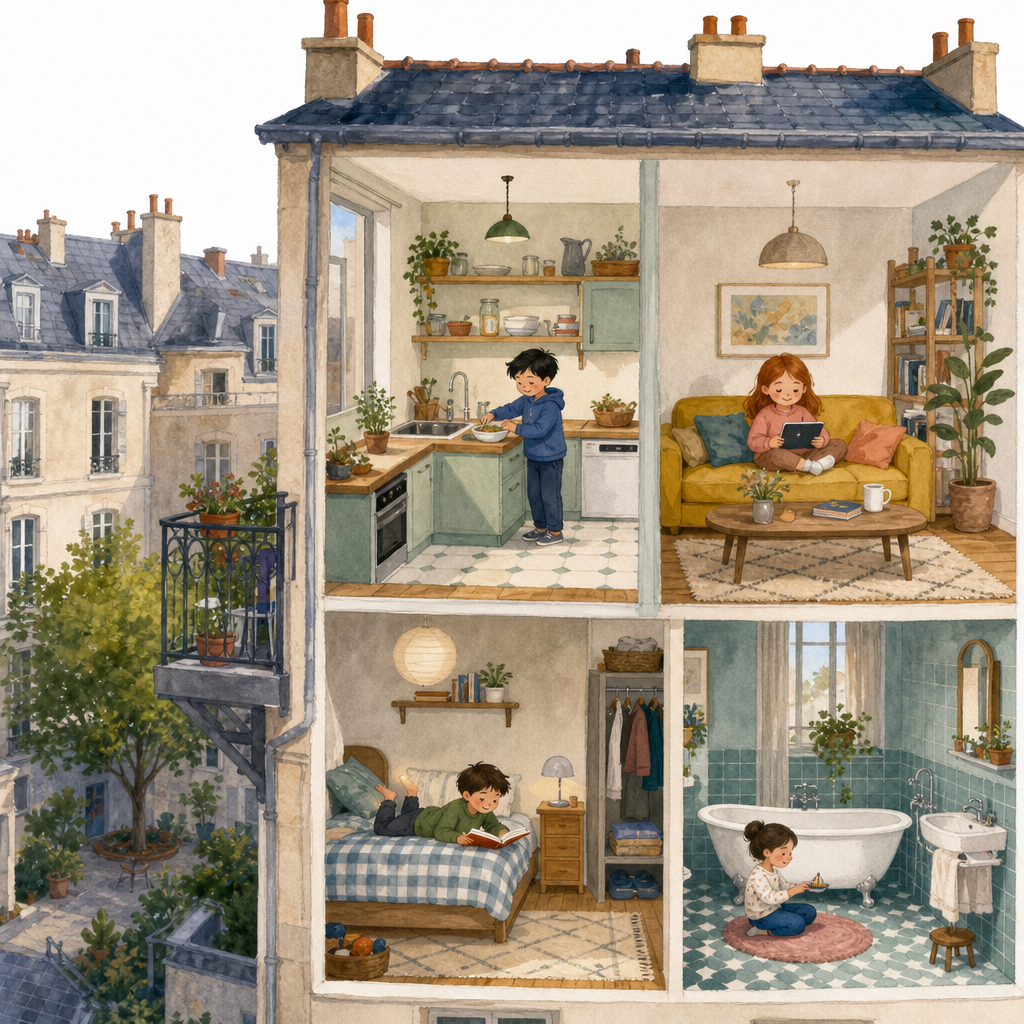
 Which room do you spend most time in at home? Think of one thing you always do there.
Today we tour Léa's family flat in a French city. We name eight rooms in French, then say what happens in each one, not just the name on the door.
By the end of this lesson, you will be able to:
- Name eight rooms of the house in French
- Say one thing you do in each room
- Notice how French city homes often differ from homes here
We are touring Léa's family flat near a busy square in Lyon. First we listen, then we repeat.
Listen to each room name with its article (le or la / l'). Say it with the class. When it is your turn on a card, say the French aloud before the flip.
Listen, then repeat: e.g. la cuisine
After the cards, your teacher says eight short French sentences, one for each room, and we say them together. You will see them written down when we open our copies.
We take an oral tour of Léa's cutaway flat on the board. For each room we first say the full activity sentence together, then we place the French label.
When it is your turn: (1) lead the class in the sentence for that room (your teacher starts it if you need), (2) say the room with le / la / l', (3) we place the label. Everyone else whispers the sentence and the room along with you.
Notice which rooms might feel smaller than in many Irish houses. Many city flats have no garden at all, so look out for a balcony instead: a small outdoor platform off one of the rooms.
Open your copy. Here are the eight sentences we said:
- Je mange dans la cuisine.
- Je regarde la télé dans le salon.
- Je dors dans la chambre.
- Je me lave dans la salle de bain.
- On dîne dans la salle à manger.
- Je joue dans le jardin.
- Je range mon vélo dans le garage.
- Je laisse mon sac dans l'entrée.
Copy two sentences that are true for you (or almost true). You may swap the room if you keep the pattern Je … dans + room. Check each article and accent carefully.
Fast writers may add a third favourite from the strip.
- la cuisine — The kitchen
- le salon — The living room
- la chambre — The bedroom
- la salle de bain — The bathroom
- la salle à manger — The dining room
- le jardin — The garden
- le garage — The garage
- l'entrée — The entrance
Click each French room, then its English meaning. Say the French quietly as you click each one.
After every match we build the sentence in two parts (not free invention):
- Class says the activity half from the strip (e.g. Je dors).
- The volunteer finishes with the room half (e.g. dans la chambre).
- Everyone repeats the full sentence once.
Unlock the full learning experience
You're previewing this lesson. Get full access to this lesson and hundreds more — each one ready to teach, with interactive activities, printable resources and pupil progress tracking built in.
This lesson is copyright of Coding Ireland 2017 - 2025. Unauthorised use, copying or distribution is not allowed.