 You already know how to search well and read a results page carefully.
Two sources say different things. Which one do you trust, and why?
- You will learn four questions to ask about any source.
- You will use them to give each source a trust verdict, which is your decision on how far to trust it.
- Then you will try them on two sources of your own.
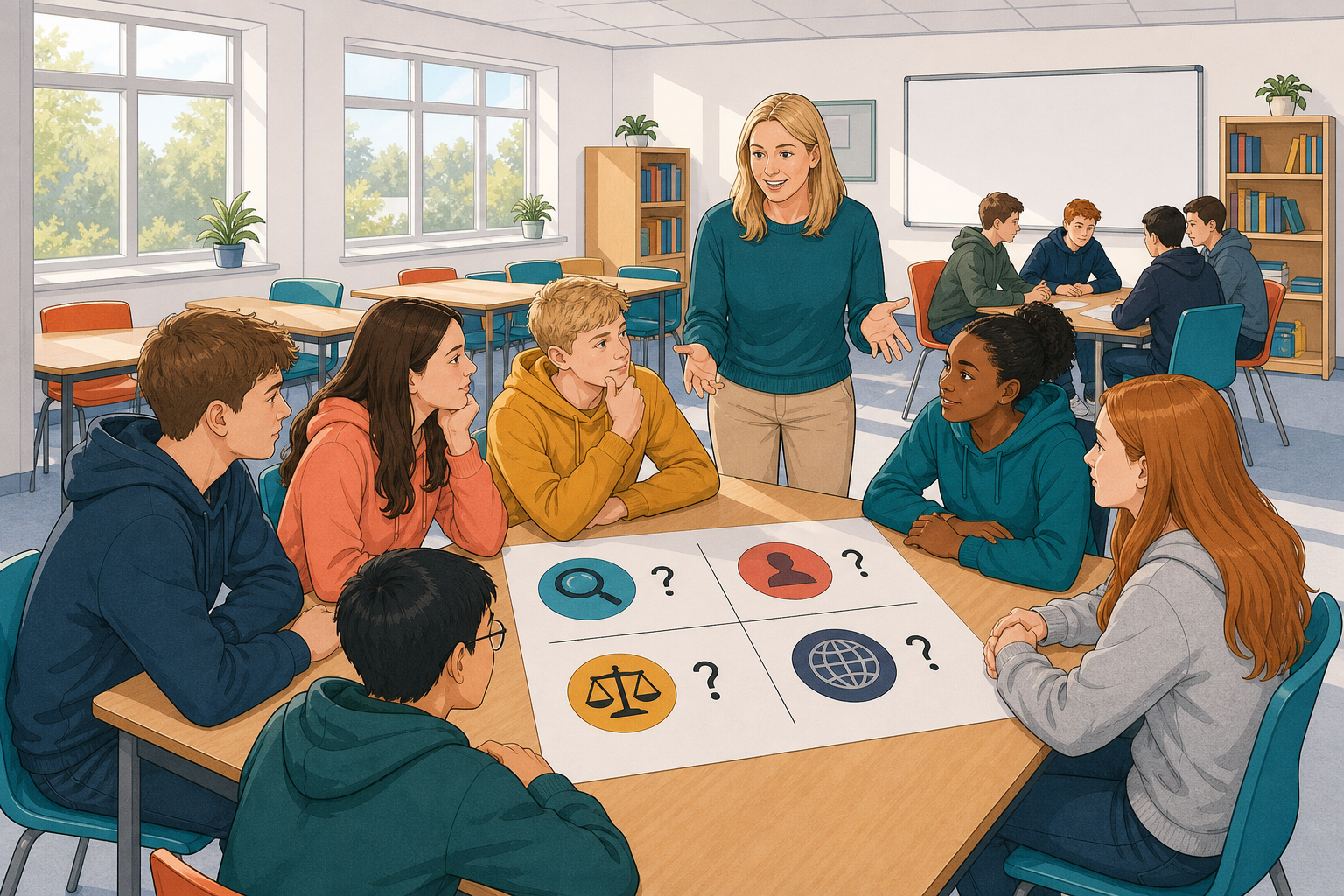 In the next steps you will use these four questions on made-up sources about outdoor study breaks: one source together, then four more in a class poll.
- Who made it, and why? Look for a named author or organisation. Is it there to inform, persuade (change your mind), sell or entertain?
- Is it accurate? Look for evidence you can follow and numbers that make sense.
- Is it still current? Current means up to date, so look for a clear date.
- Can it be verified elsewhere? Verified means shown to be true, so ask whether other sources back up the main claim.
Choose Trust it, Check it further, or Do not rely on it.
Let’s try the four questions on one source together.
Who made it: Mr Darragh Quinn, a teacher, on his school’s website
What it says: “Fresh air, fresh minds.” During exam week the school gave students a ten-minute walk between study sessions, and most students said they felt more focused afterwards.
When: September last year
Can you check it: It quotes three students. There are no numbers and no link to a study.
Think about each of the four questions, then choose your verdict: Trust it, Check it further, or Do not rely on it. Be ready to say which question made up your mind.
Our call, once the class has made its own
Check it further. The writer is named, the post is recent, and the school is not selling anything. But it tells you how students said they felt in one school, which is not the same as measuring how well they concentrated, and there is nothing you could check. It is a good lead, not evidence.
Do not click on the sources in the activity below yet. They are the four sources for the class poll in the next step, and clicking one now shows its reasoning straight away.
A page that looks neat and professional is not always reliable, and a careful "Check it further" is often the best answer.
Reliable or not?
Now everyone votes on the four sources, on their own device. Each one is a fresh vote.
Everyone votes on every source, and there is no score or time limit. When the class has voted, the board shows how everyone voted, and then the reasoning. After the discussion, the vote can open again to show who changed their mind.
- Read the source and make your choice.
- When the reasoning comes up, compare it with the reason you gave.
Each source has a best verdict, but being able to give a clear reason for your choice matters more than matching it.
Class Poll
Now use the same four questions on two sources you find yourself.
First, pick a topic you can research in a few minutes, such as one from an earlier search or something new.
Does listening to music help you study?
- 3 minutes: Find two different kinds of online source, for example a news page and an organisation's page, that both answer the same question. If you have none after 3 minutes, use the backup sources below.
- 6 minutes: For one source, write short notes on all four questions and give it a verdict. For the other source, write down who made it and the date, then give it a verdict.
- 3 minutes: Write one sentence saying which source you trust more and why, using at least one of the four questions.
- Who made it, and why?
- Is it accurate?
- Is it still current?
- Can it be verified elsewhere?
Who made it and why: a named reporter on a national news site, to inform readers. Accuracy: it names the study it describes and quotes one of the researchers. Current: dated March this year. Verified elsewhere: the study is named, so you can look it up and check it says the same. Verdict: Trust it.
- Backup 1: A post on a music streaming app’s blog, called ‘The perfect study playlist’, written by the app’s editorial team and dated last month. It says music “boosts focus for everyone” and links to the app’s own playlists, but to no research.
- Backup 2: A page on a university psychology department’s website, written by Dr Aoife Brennan and dated this year. It explains what three small studies found: music with lyrics made reading harder, and music without words made little difference. It links to each study.
Check that you have the titles or links of both sources, your notes and verdicts, and your sentence on which you trust more. Save your notes the class way, in the place your class keeps its work, not only in this browser, because work on a shared device's browser can disappear. You will need them next time, when the class builds a shared checklist.
Unlock the full learning experience
You're previewing this lesson. Get full access to this lesson and hundreds more — each one ready to teach, with interactive activities, printable resources and pupil progress tracking built in.
This lesson is copyright of Coding Ireland 2017 - 2026. Unauthorised use, copying or distribution is not allowed.