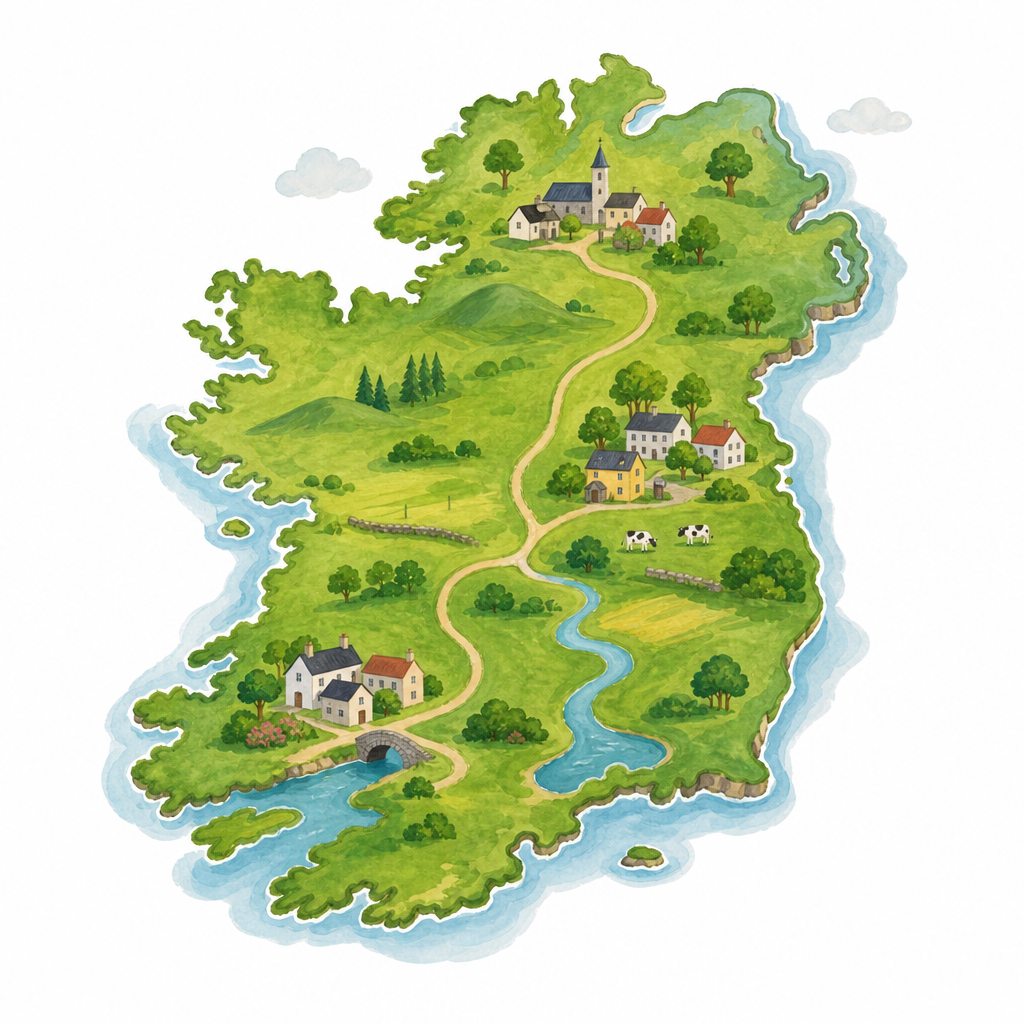
 Ballymore, Ballybeg, Ballyduff. Three different places, but one little word is doing the same job in all three names. Can you spot it?
By the end of this lesson, you will be able to:
- Break open an Irish placename and say what it first meant
- Notice that many towns are named after something you could once see there
Watch a town open on the map. Listen to the Irish pieces, then say them together with the class before the next town.
We will open three countries together on the map. In each one we are hunting for a place named after something people could once see: a river crossing, a hill, or a fort.
- Oxford (United Kingdom): a ford used by oxen
- Lyon (France): named from an old hill fort
- Frankfurt (Germany): a ford used by the Franks
When a country opens, listen for the languages spoken there, then say the matching find with the class and what the name is describing.
Write two full placenames we opened today. Beside each, write the picture the name paints (what it first meant).
In your copy:
- Placename: ________ Picture it paints: ________
- Placename: ________ Picture it paints: ________
Examples: Ballymore → a big town | Ballyduff → a dark (shady or black-soiled) town
Word bank (pieces, not full names): baile = town (BAL-ya); mór = big (MORE); beag = small (BYUG); dubh = dark / black (DOOV), often dark soil, dark water, or a shady spot
💬 Discussion time
Ballymore, Ballybeg and Ballyduff all share the same Irish building block: baile (BAL-ya), meaning town. The rest of each name paints a picture of what that town was like: big, small, or dark.
dubh (DOOV) means dark or black. In a placename it often points to something people could once see, such as dark soil, dark water, or a shady spot.
Many Irish places begin with Bally- for that reason. The name is often a plain description of something people could once see there.
- Why would so many towns be named after something you could once see there?
- If you were naming a new town tomorrow, what would you name it after, and why?
Unlock the full learning experience
You're previewing this lesson. Get full access to this lesson and hundreds more — each one ready to teach, with interactive activities, printable resources and pupil progress tracking built in.
This lesson is copyright of Coding Ireland 2017 - 2026. Unauthorised use, copying or distribution is not allowed.