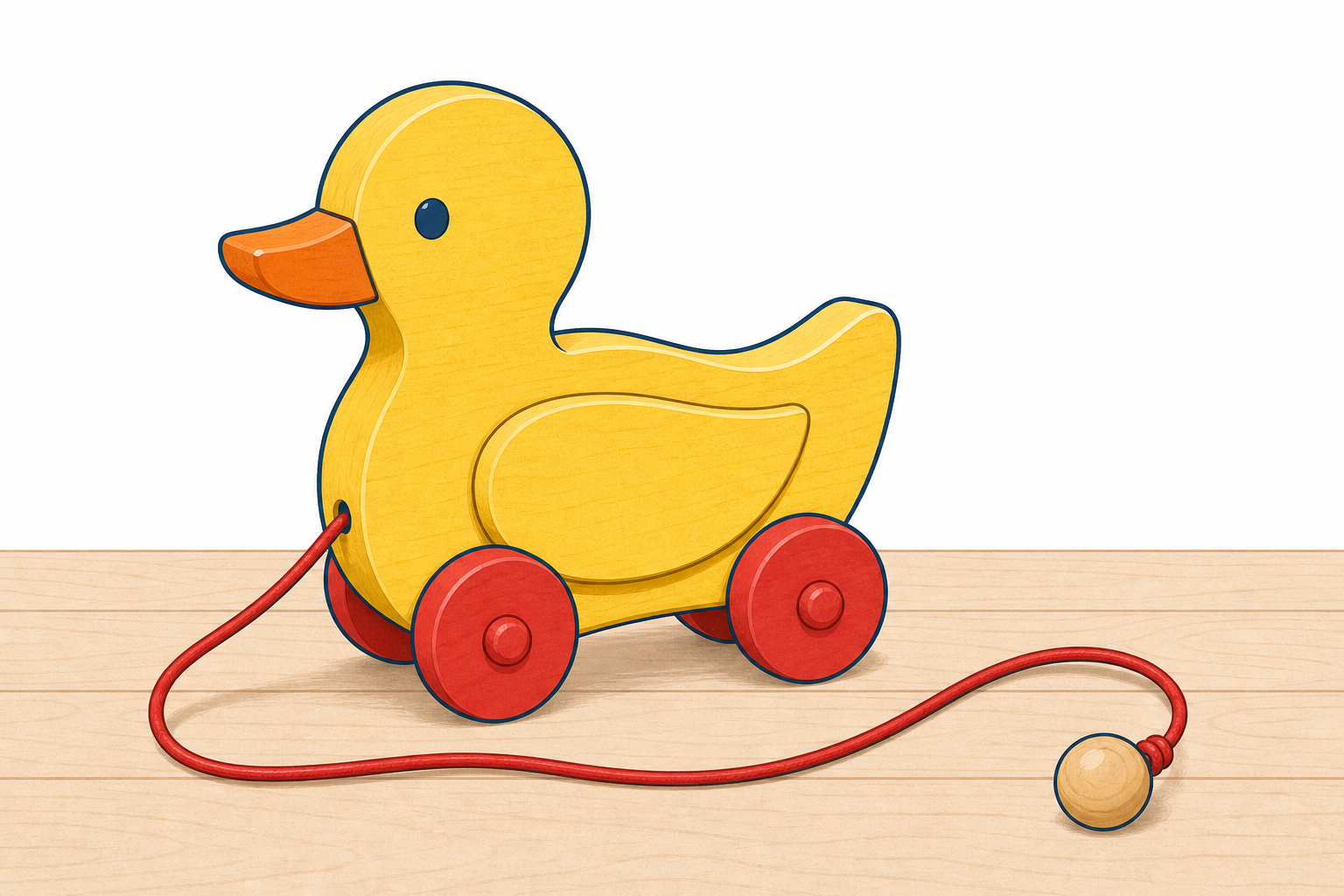
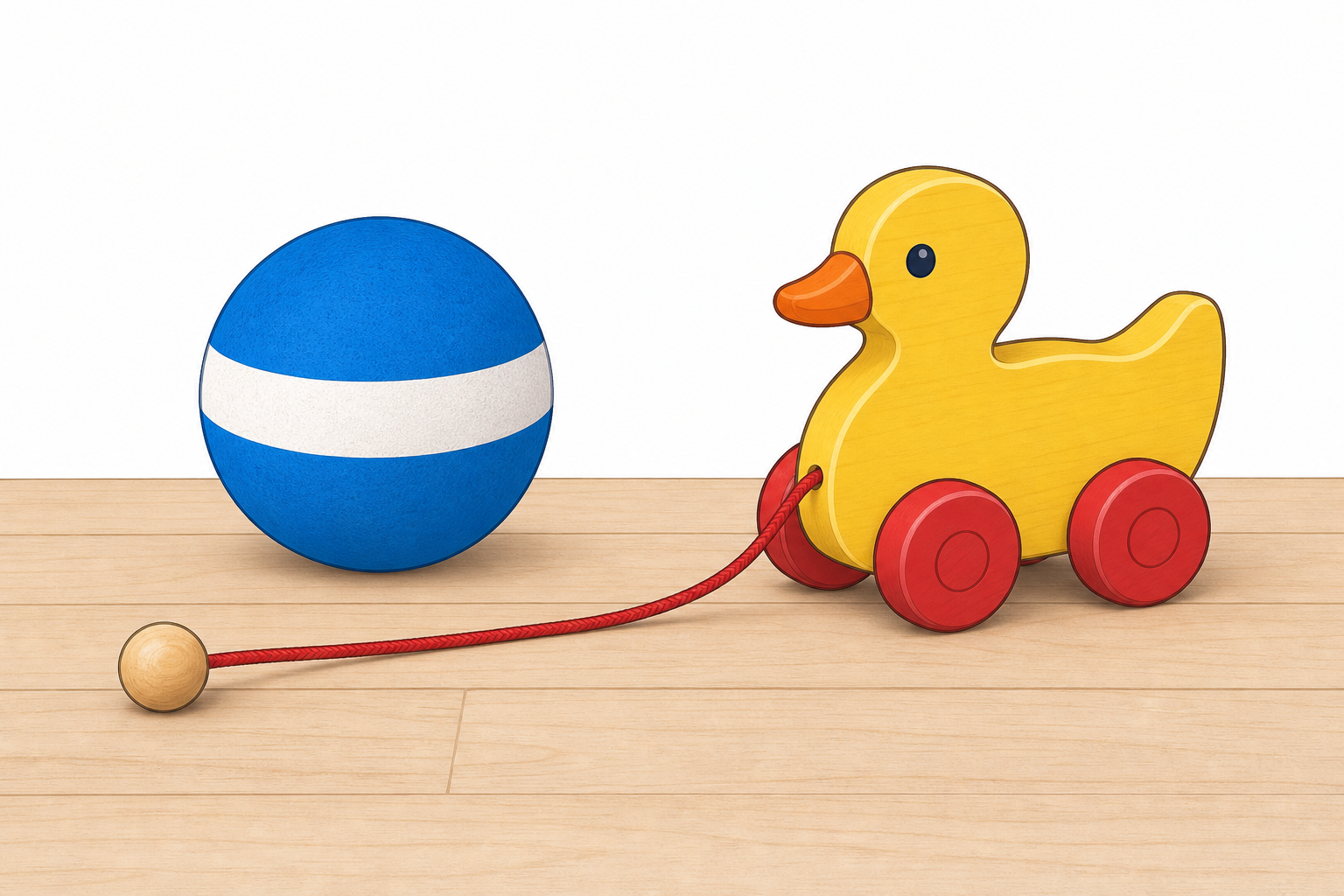
Watch this toy. How can we make it move without picking it up?
Hands up if you have an idea.
Have one pull toy ready beside you (nothing else laid out yet). Give the toy one gentle pull so it rolls toward you, then one gentle push so it rolls away. Do not name push or pull yet.
Ask: How did the toy start moving? Accept any ideas. Keep this beat short and curious. The floor materials come out in the explore step.
Today's words:
Push moves something away from you.
Pull brings something closer to you or along with you.
Which one will start this ball rolling: a push or a pull?
| Concept | Why it matters | Example |
|---|---|---|
| Push — a force that moves something away from you | We use pushes all day: doors, balls, swings, trolleys | Pushing a ball so it rolls across the floor |
| Pull — a force that brings something closer to you or along with you | Pulls help us move things we cannot push easily, like a wagon behind us | Pulling a toy wagon so it follows you |
| What changed — a push or pull can start, stop, speed up or turn something | Naming what changed is stretch language for children who are ready; the must-have for everyone is push vs pull | A soft push starts a ball; a hand stops it; a side push makes it turn |
Live model only (keep this tight):
Hold up the soft ball. Ask the board question. Accept answers, then model once:
Do not list start, stop, faster and turn on the board. You will coach those words orally at the floor later for children who are ready.
Misconception to head off: children may say any movement is a push. Keep asking did your hands push it away, or pull it toward you or along with you?
Time to try it yourselves. In your group, use a push on the ball and a pull on your string toy.
Each time, say: was that a push or a pull?
Clear a safe floor space so small groups can sit or kneel with room to roll. Set out materials so every group is active at the same time and every child can try both a push and a pull (no waiting for a shared station):
Groups of three to four work best. Aim for about four to six groups so everyone has a ball and a pull toy. You stay mobile and coach the naming words.
Core job for every child: name push or pull after each try. Every child should complete at least one push and one pull in the 12 minutes.
Stretch (optional, oral only): for children who are ready, add What changed — did it start, stop, go faster, or turn? Do not require the four change words from every child.
Safety: push and pull gently; keep space from other children; roll balls away from feet and faces; no throwing; keep strings away from necks.
Differentiation: less confident children only name push or pull. Ready children also name what changed (start, stop, faster, turn). Early finishers try a bigger push and a smaller push on the ball and say which went further.
Come back to the carpet. Show us one thing you did. Was it a push or a pull?
Whole-class carpet share. Invite three or four children to show (or mime) one action from the floor. After each show, the class choruses: push or pull.
If a child is ready, invite the stretch: What changed — start, stop, faster, or turn? Peers can agree or gently add a reason. Do not hold every child to the change words.
Look-fors:
If someone mixes push and pull, re-model with the ball once: hands move away from body = push; hands bring the toy toward you or along with you = pull.
This is the oral recording beat. There is no Investigation Journal page for this lesson.
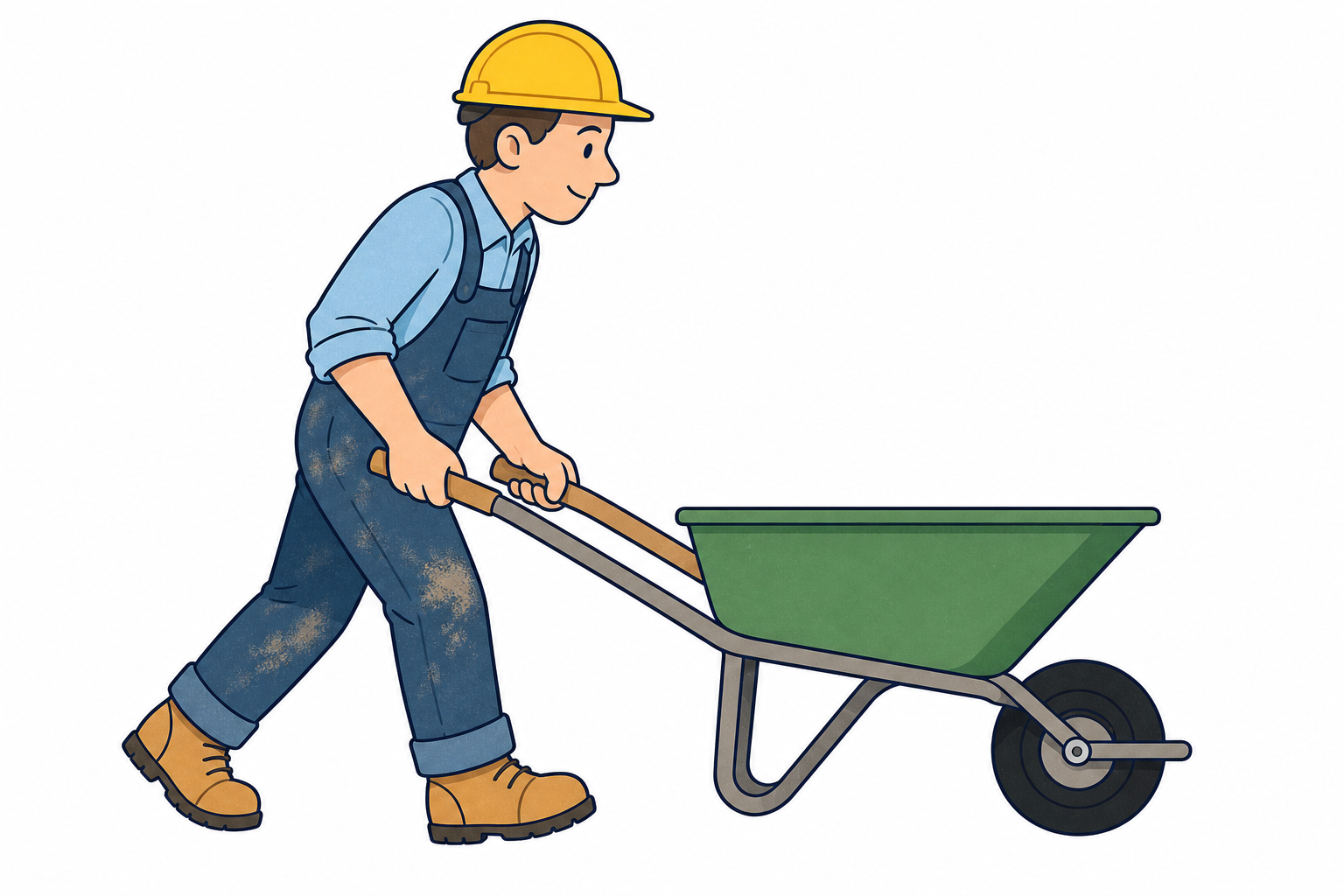
Look at this picture. The builder is pushing a wheelbarrow.
Tell your partner one push and one pull. You can use something from today's play, or the builder, a buggy, or a bag on wheels.
Display-only science talk. Keep it oral.
Before partner talk: show one clear picture on the IWB (or mime) of a builder pushing a wheelbarrow. Name it aloud: This is a push. The wheelbarrow moves away from the builder. Then mime pulling a trolley of tools toward you: This is a pull.
Next, anchor in what they just did: You pushed your ball. You pulled your string toy. Only then open partner talk. Children may name a push and a pull from today's play or from a shared example already modelled (builder, buggy, bag on wheels). Do not require that every example came from their own hands-on turn.
If pairs stall, offer two more quick teacher examples they can echo:
Close with: Pushes and pulls help people move things every day, just like we did on the floor.
Do not add a written reflection. One partner share and two class examples is enough.
You're previewing this lesson. Get full access to this lesson and hundreds more — each one ready to teach, with interactive activities, printable resources and pupil progress tracking built in.