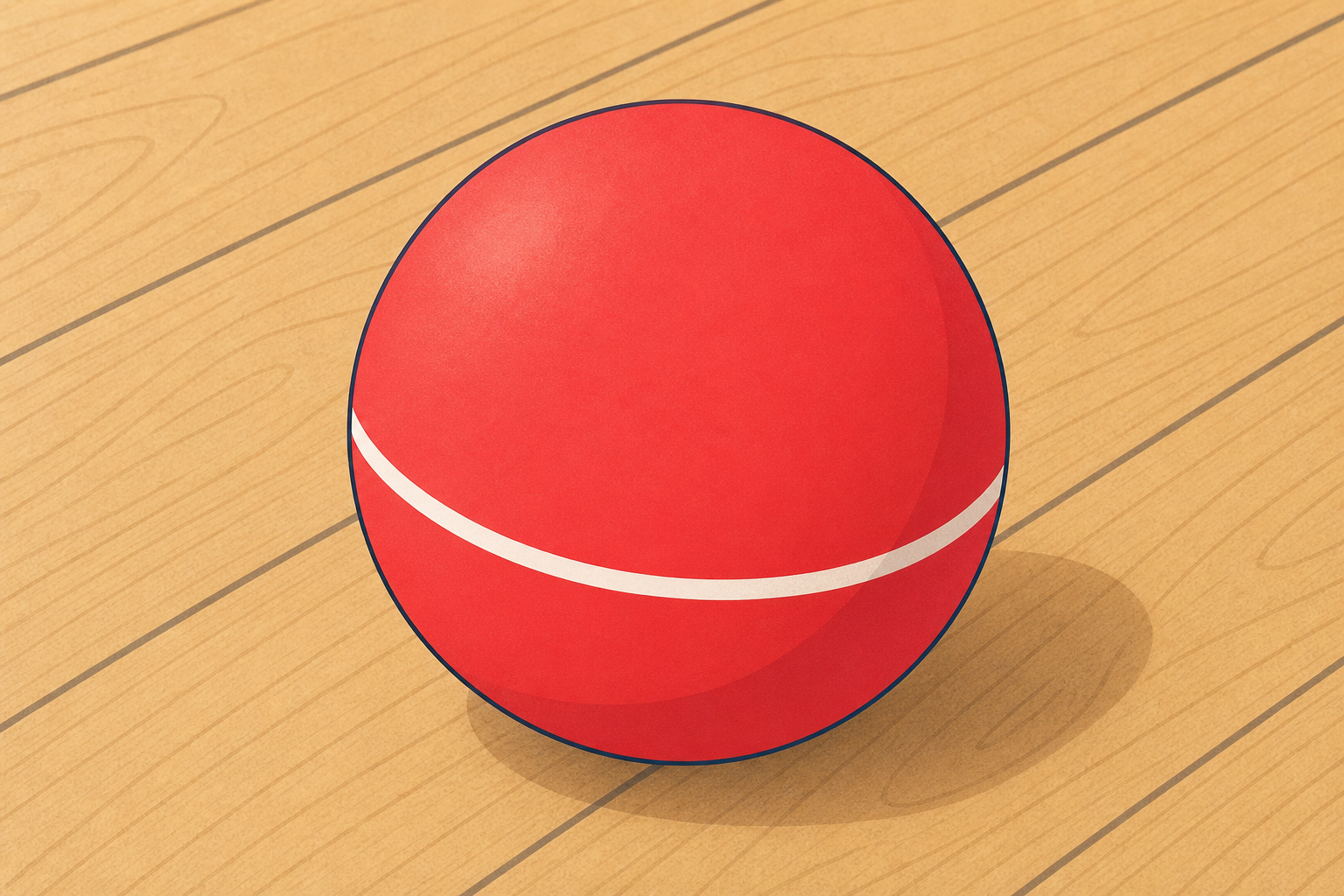
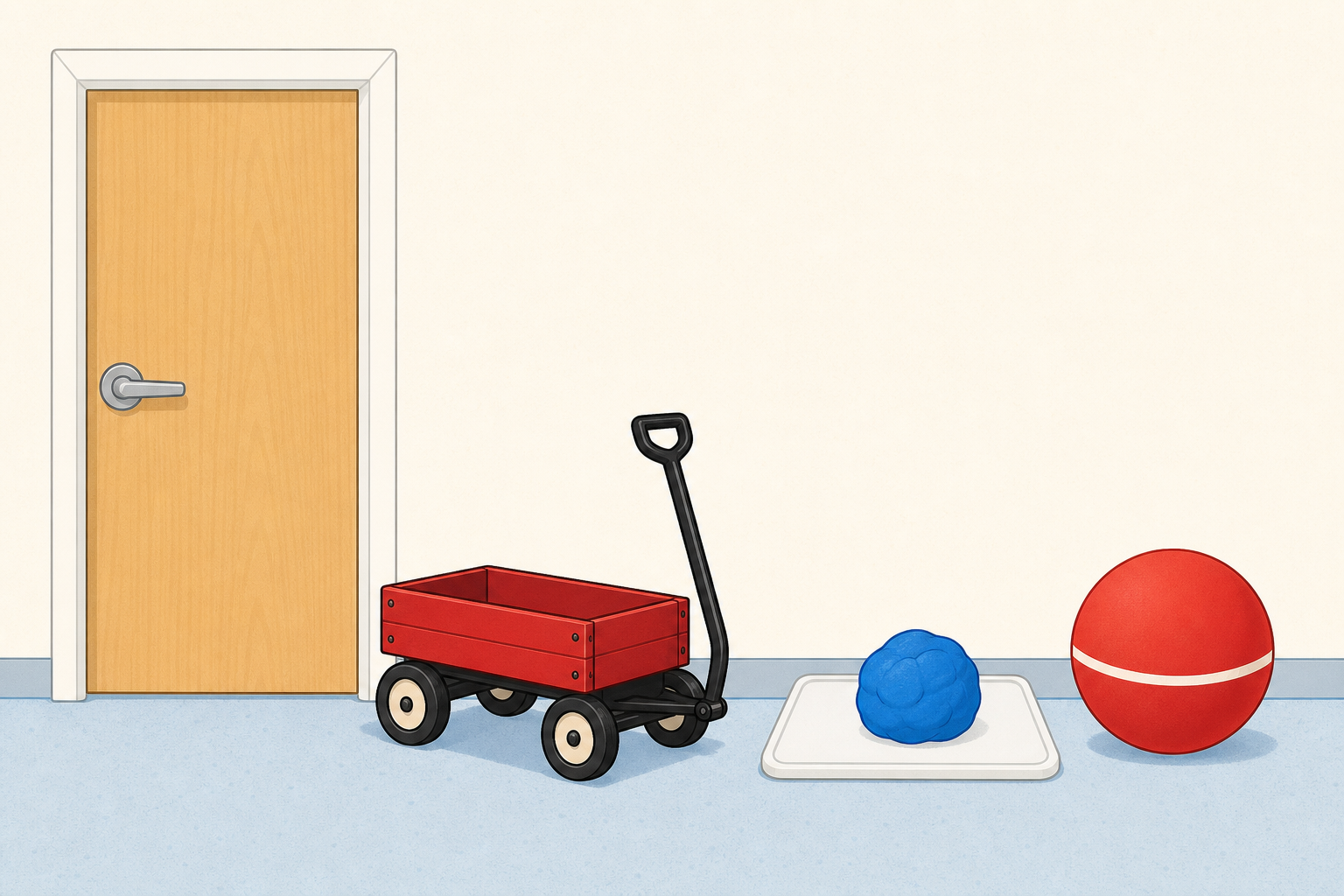
Watch this ball. How could we make it move without kicking it with our feet?
Could we send it away from us? Could we bring it toward us? Hands up if you have an idea.
Have one soft ball ready on the floor in front of the class. Keep the wagon and a small lump of play-dough with you for the short models in the next step; do not open the stations to the children yet.
Take two or three ideas. If a child says kick, smile and steer them: Without our feet — what could our hands do?
Keep this light. Do not name push and pull yet; that comes next. The ball comes out again in the circuit (one ball on the lane; any spares stay in the box).
Today we have two special words for what our hands can do. A push moves something away from you, or can change its shape. A pull brings something toward you.
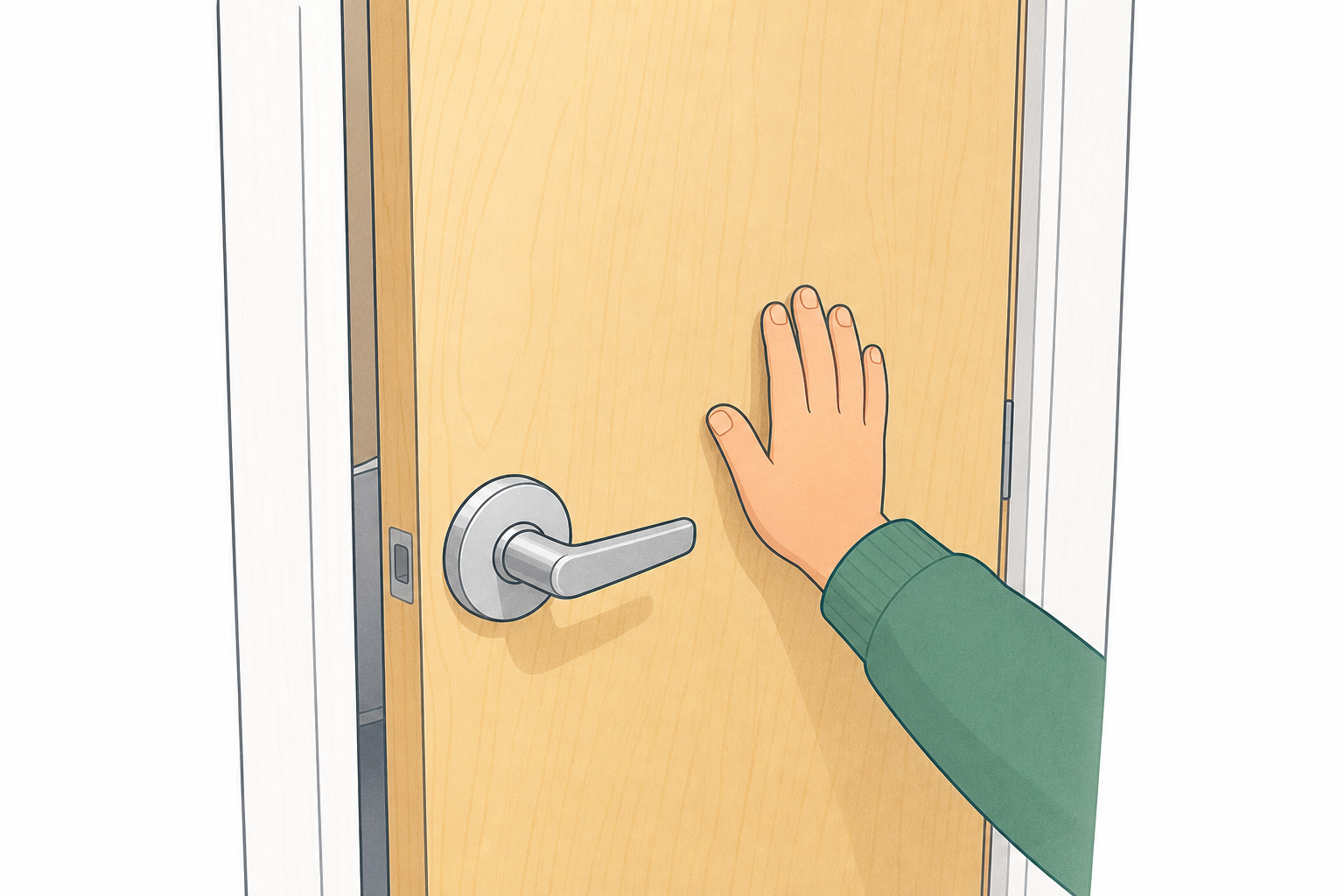
Watch the door. When I open it, is that a push or a pull?
Stand by the classroom door. Open it slowly once toward you (pull) and once away from you (push) so both actions are clear. Ask the class to call out which is which.
Keep pupil talk on push and pull first. Only after both door actions, add the short wrap-up: A push or a pull is called a force. A force can make something move or change. Do not put force up as a third equal definition block on the board.
Minimum path if time is tight (about 5 minutes): door both ways with call-outs → one push model (ball away or play-dough flat) → one pull model (wagon) → force wrap-up line. Drop the second push model rather than rushing the circuit with no clear models.
The wagon stays with you for the pull model, then moves to its station. Keep a small lump of play-dough with you for the shape-change push model, then place it on the Play-dough tray.
| Concept | Why it matters | Example |
|---|---|---|
| Push — a force that presses something away from you; it can make the object move or change shape | Pushes help us move things and shape soft materials every day | Pressing play-dough flat with your hand is a push; so is rolling a ball away |
| Pull — a force that brings something closer to you when you tug it toward you | Pulls let us bring things with us, like a bag or a toy on a string | Pulling the wagon handle toward you so the wagon comes closer |
| Force (later label) — a short wrap-up name for a push or a pull that can make something move or change | Gives children one short label for both actions once they can name them; not a third starter definition | Opening the classroom door uses a push or a pull so the door swings |
Misconception to head off: children sometimes think only big, hard shoves count as pushes. A gentle press on play-dough is still a push. Size of the force comes next lesson; today we only name the kind.
Worked model (say this aloud while you act): I wonder if I can make this ball move with my hands. I think if I press it away, it will roll. I try… I push. I saw the ball roll away from me. So a push moves things away from me. Then with the play-dough: I press the play-dough flat — that is still a push. It did not roll away, but it changed shape. Then model a pull with the wagon: I pull the handle toward me — the wagon comes closer. A pull brings things toward me. Finish: A push or a pull is called a force.
We will visit four stations: Door, Wagon, Play-dough and Ball.
At each station try the simple action: open the door, pull the wagon, press the play-dough, or roll the ball.
Take short turns with the object. When it is not your turn, watch and say out loud: was that a push or a pull, and what happened?
Move gently. Keep hands and feet away from friends. When you hear the signal, go to the next station.
If we have three stations today, we will visit Wagon, Play-dough and Ball, and share the door together between turns.
Set four simple stations around the room (or three if space is tight — drop the door station and use a shared whole-class door stop between rotations). Label each with a sticky note: Door, Wagon, Play-dough, Ball.
Three-station fallback (board match): if there is no cupboard door, drop Door as a rotate station. On the board name Wagon, Play-dough and Ball only, and use the classroom door as one brief shared stop between rotations (whole class names push or pull once together). Rotate three groups, or keep four groups and give one group a short “spot a push or pull from where you stand” stop while others rotate the three object stations. Point to the three-station line already on the board so the class hears the same plan.
Split the class into four mixed groups (about six to eight children each in a typical class; three groups if you are on the three-station path). About three to four minutes per station, then a clear clap or chime to rotate. You stay mobile: at each stop ask Push or pull? What happened?
Turn-taking: one object per station. Children take short turns so each child tries the action at least once. The rest of the group watch and join the call-out (push or pull?) — watching and naming is part of the work, not waiting to be busy.
What good looks like: a child presses the play-dough and says push — it went flat; tugs the wagon and says pull — it came closer; rolls the ball and says push — it rolled away; opens the door toward themselves and says pull — the door moved closer.
If a station stalls: model once yourself, then hand it back. If two groups finish early, ask them to spot one more push or pull they can see from where they stand (a chair being tucked, a bag being lifted).
Safety: gentle actions only; roll the single ball along the floor away from feet; no throwing; keep the wagon path clear.
On your Investigation Journal page, choose two stations you tried.
For each one, show whether it was a push or a pull, and draw or write what happened to the object.
Pupils record on the paper Investigation Journal page. Circulate and prompt with the same two stems: Push or pull? and What happened?
Accept drawings with a single word label (push / pull) for children who find writing hard. A full sentence is a stretch, not a must.
Sentence starters if a child stalls on writing: I used a push and the ball rolled away. / I used a pull and the wagon came closer. / I used a push and the play-dough went flat. Children may copy the stem and finish with their own object, or stick to a drawing plus the word push or pull.
Look-fors: the action matches the station (wagon = pull; rolling ball = push; flattening dough = push; door can be either depending how they opened it). If a child swaps push and pull, take them back to the object and redo the action once with them.
If time runs short: finish as a quick oral share (each child names one push and one pull from the circuit), or send the oral noticing home: Spot one push and one pull at home and tell someone what happened. Do not start a second written task. The journal page can be completed later the same day if needed.
No typing into the platform. The Investigation Journal page is the record.
Look around our classroom. Where can you spot a push? Where can you spot a pull?
Tell your partner one of each. Then we will share a few with the class.
Display-only science talk. No new materials. Give pairs about one minute, then take four or five shares on the board as a quick list (e.g. push: closing a drawer; pull: opening a blind; push: shoving a chair in; pull: zipping a coat).
If ideas dry up, walk to the window blind, a chair, or a school bag and ask What would my hands do here?
STEM eyes: finish with Where else might we see pushes and pulls — in the yard, on the way home, at the playground? Keep it oral; do not start a second recording task.
Bridge: next time we will compare a small push with a big push and see which moves something further. Do not teach that idea now.
You're previewing this lesson. Get full access to this lesson and hundreds more — each one ready to teach, with interactive activities, printable resources and pupil progress tracking built in.