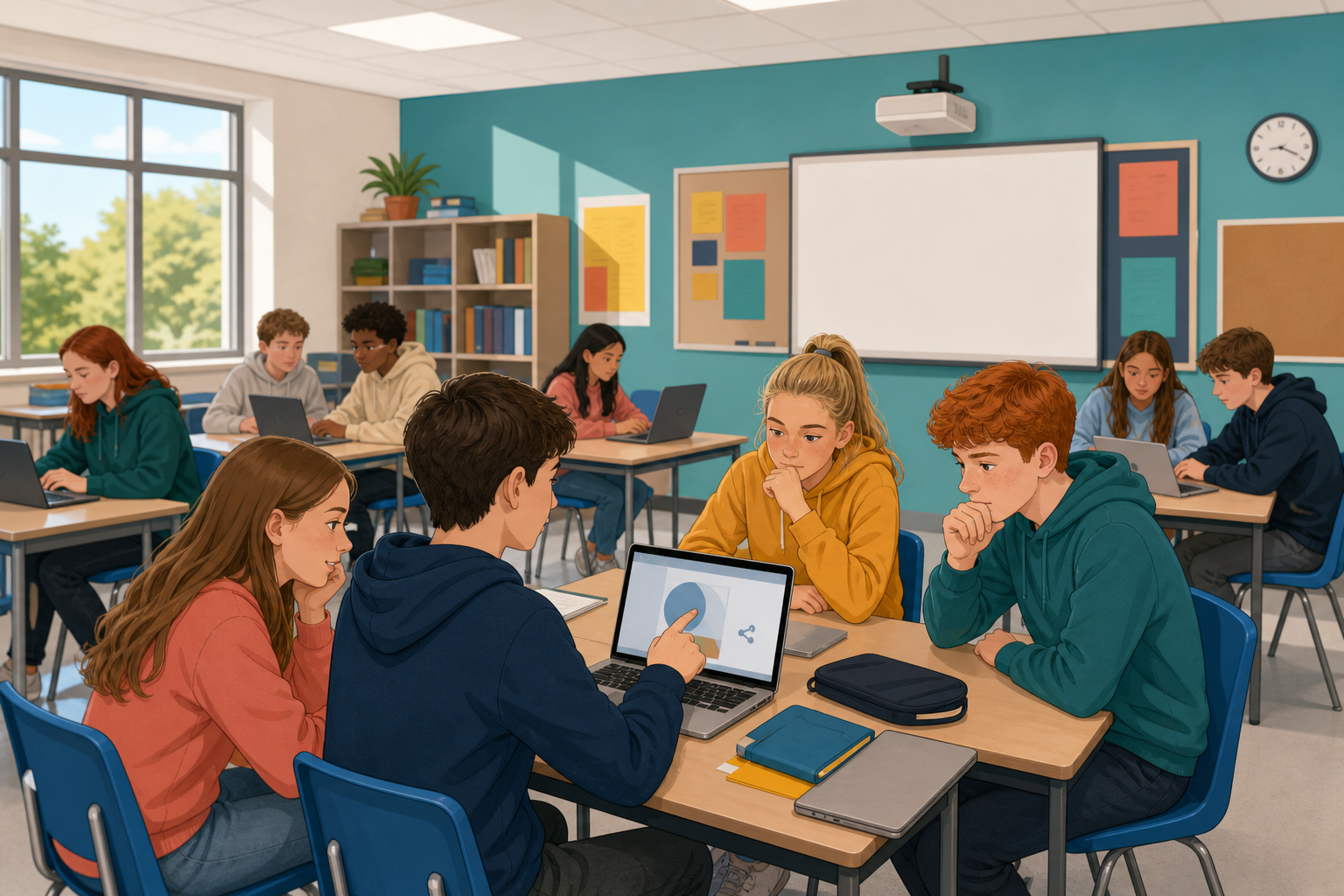
 Today you decide whether your checked draft goes out or stays back.
You will make three final decisions yourself. Then you will either publish to the place the class agreed, or say honestly that your piece is not ready yet. Holding it back is a real choice, not a failure.
If you cannot open your checked draft, say so now and get it back the class way. Do not start a new piece.
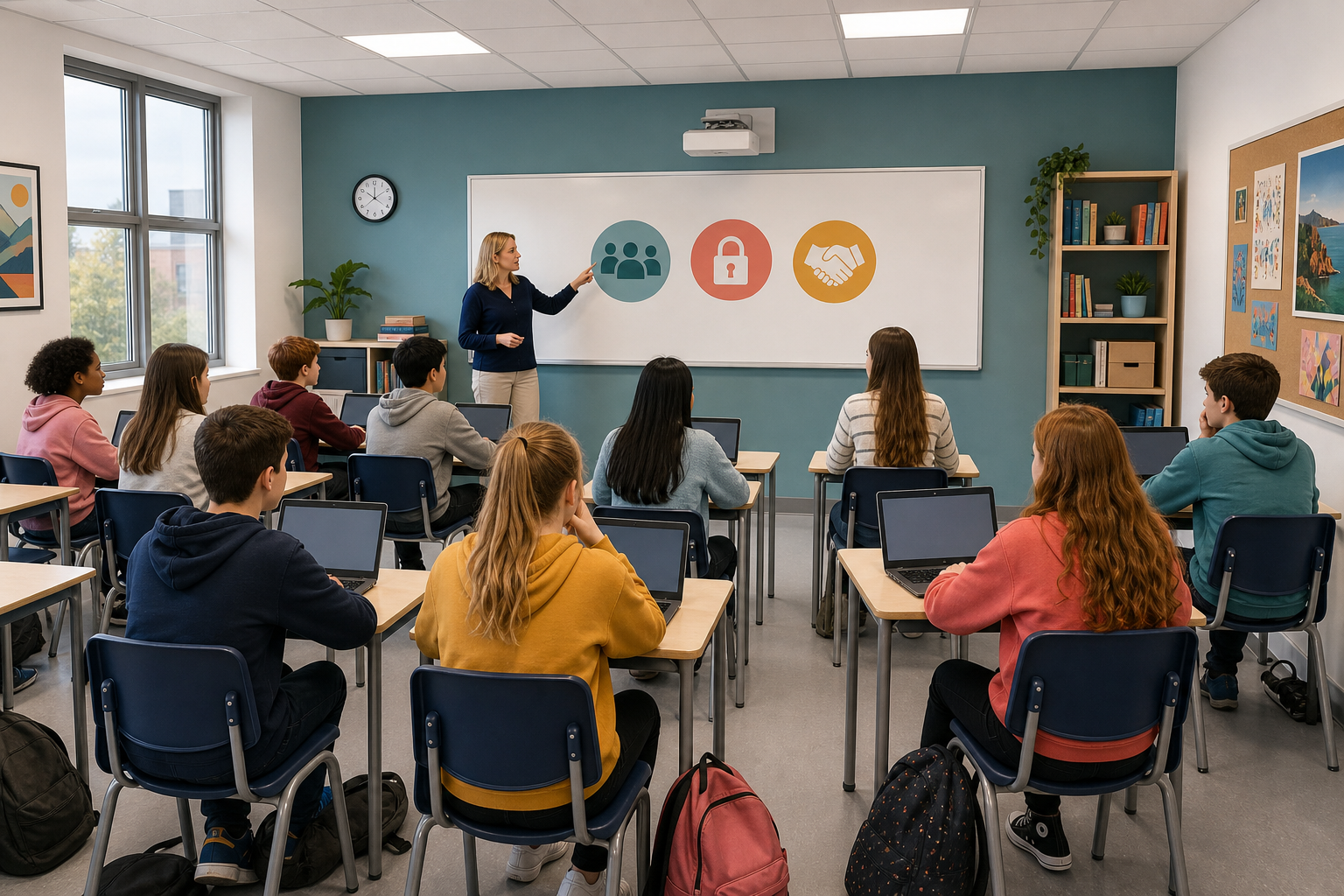 Before anything goes public, the publisher, which is you, makes three decisions. You will try them as a class on this draft, and then on your own piece.
This draft is made up. It is not about anyone in this room.
Why our town needs a youth bus late on Fridays is a short opinion piece. It has:
- a photo of three friends at the bus stop. Two of the friends posed for the photo and the third did not. One of the three friends is not in this class.
- a screenshot of a private group chat where people complain about missing the last bus.
- the writer's full name, school and year group in the byline, which is the name line under the title.
It will be shared by link, so anyone with the link can open it.
Answer each question clearly.
- Who can see this? Should anyone who gets the link see it, or should it stay in the class space?
- What personal information is in it? Which parts should be cut, blurred or kept?
- Whose consent did this need? Consent means someone has said yes to being in the piece. Think of the writer, the three friends and everyone in the chat. Who has said yes, and who has not?
A private chat and missing consent are not up for a vote, so those parts must be cut, blurred or held back. Only the audience size is still open to discussion.
Open your checked draft first. If you cannot open it, get it back the class way.
Write one or two sentences for each question in your planning log or on a note beside your draft.
- Who can see this? Name your audience, such as this class, the year group, a school folder or a public link, and say why it suits your piece.
- What personal information is in it? List every personal detail still showing, such as names, faces, school, places or private messages. Decide whether to keep, remove, blur or replace each one.
- Whose consent did this need? List everyone who appears, is quoted, or whose work or picture you used. Mark each person as "clear for this audience", "need to ask" or "take out".
Audience: I will publish to… because…
Personal information still showing: … I will keep / remove / blur…
Consent: … clear for this audience / need to ask / take out of the piece
Make sure your three answers are written down. If anyone's consent is missing and you cannot get it today, remove that part now, along with any private chat. Be ready to say in one sentence who the piece is for and whether it is safe to go out.
If you have time left, blur faces or change details that identify people. Anything unfinished can wait for the next step.
Now make your decision and act on it.
If your piece is ready
This means your three decisions are done, your checks passed and consent is clear for this audience.
- Publish it only to the place the class agreed, unless your teacher agrees a different audience.
- Check that someone else can open the finished version.
- In your planning log, write the date, where it went and who can see it.
- Save the final file and your log the class way.
If your piece is not ready
This means consent is missing, a check failed and you could not fix it, the file is unfinished, or you are not sure it is safe.
- Do not publish it.
- Write one honest line in your log about what is stopping it and what you will do next.
- Save the draft and your log the class way.
Holding a piece back is a proper choice. Publishing something unfinished or unsafe is not.
Before you finish, you should have either published in the agreed place or written a clear reason for holding back. Be ready to tell a partner in one sentence what you decided and why.
Some of you published today and some held back on purpose, and both are real choices.
Call out one decision someone might have made, such as a smaller audience, a blurred face, a cut quote or holding the whole piece back. It can be your own, but you do not have to say whether it was.
Publishing is your decision. Keep checking the three questions right up until your piece goes out. If a draft does not pass all three questions, it should stay offline.
Unlock the full learning experience
You're previewing this lesson. Get full access to this lesson and hundreds more — each one ready to teach, with interactive activities, printable resources and pupil progress tracking built in.
This lesson is copyright of Coding Ireland 2017 - 2026. Unauthorised use, copying or distribution is not allowed.