Mathematics
Advanced
50 mins
Teacher/Student led
+65 XP
What you need:
IWB/Projector/Large Screen

Problem-solving with Discounts and Increases

Work out the final price when a discount or increase is applied, using 10% as a stepping stone. Compare two offers to find the better deal.
Teacher Class Feed

Load previous activity

    1 - Getting Started ~4 mins

    Illustration for Getting Started

    Key point

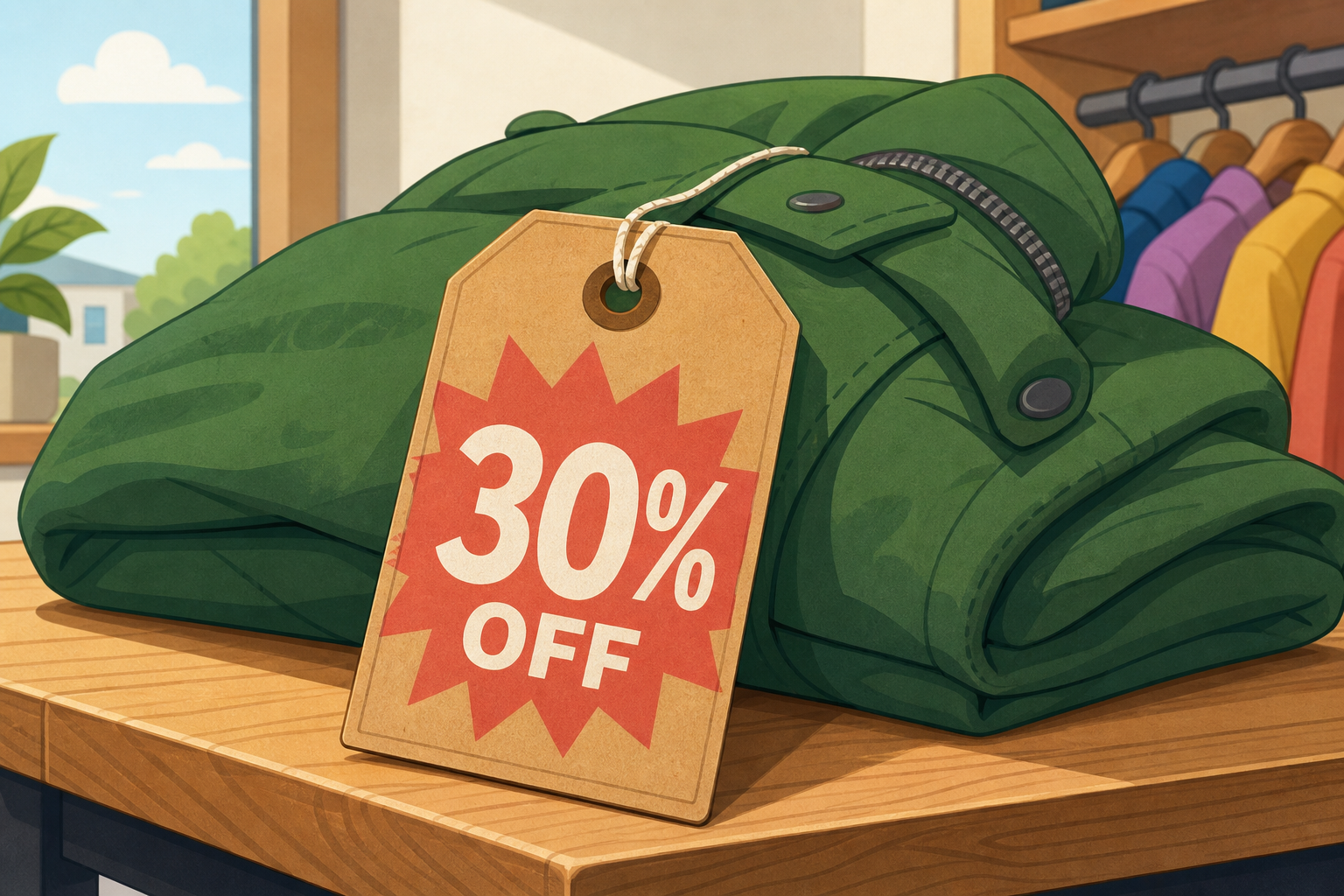
    You are in a shop and you spot a sale tag: 30% OFF, €50. So what do you actually hand over at the till, and how much did you just save? Take a moment and picture it before we work it out together.

    2 - Watch and Notice ~10 mins

    Three price tags. Each time we build the percentage from one starting fact: 10%. Watch how the saving and the price to pay always add back to the original, and on the last one the total grows instead of shrinking. Predict each answer before you check.

    Three price tags

    3 - Try It Together ~12 mins

    Today we work through this short shopping list together, one item at a time: a €60 jacket with 20% off, then a €30 top with 25% off, then a €120 bill with 10% service added, and finally a €80 pair of boots with 15% off. For each item we find the change, then say the final price, and check it makes sense against the original.

    Worked example

    Here is one worked all the way through, so you can see the moves. Take the €30 top, 25% off: 10% of €30 is €3, halve it for 5% (€1.50), so 25% is €3 + €3 + €1.50 = €7.50. The saving lands on a cent here, €7.50, which is fine. Take €7.50 off €30 and you pay €22.50.

    Shopping list

    4 - Build the Four-column Row in Your Copy ~3 mins

    COPYBOOK MOMENT

    In your maths copy, make a four-column row for each item: the original price, the percentage change, the amount of change, and the final price. Box the final price in each row.

    • €60 jacket, 20% off
    • €30 top, 25% off
    • €120 bill, 10% added
    • €80 boots, 15% off

    5 - Class Challenge ~9 mins

    Today we'll work through a set of shopping problems together, and they get a little harder each time. First, find the sale price of a €35 game with 30% off, then the saving on a €150 coat with 40% off, then the total after 23% VAT is added to €120 (VAT is a tax added on top of the price — here 23% is added to €120), and finally, here's the tricky one: which is the better deal, 30% off €90 or €70 with 10% added?

    Worked example

    The VAT one is the biggest step, so here is how we build 23%: 10% of €120 is €12, so 20% is €24. For the last 3%, find 1% first (divide €12 by ten = €1.20), then 3% is 3 × €1.20 = €3.60. Add them: €24 + €3.60 = €27.60 of VAT, giving a total of €147.60.

    Shopping challenge

    Pupil practice
    Module 3 · Fractions, Decimals and Percentages Number
    Lesson 38 · Problem-solving with Discounts and Increases
    Download Activity Book page (PDF)
    123learn · Online learning platform

    Unlock the full learning experience

    You're previewing this lesson. Get full access to this lesson and hundreds more — each one ready to teach, with interactive activities, printable resources and pupil progress tracking built in.

    Hundreds of curriculum-aligned lessons
    Interactive activities in every lesson
    Printable resources & progress tracking
    Copyright Notice
    This lesson is copyright of Coding Ireland 2017 - 2025. Unauthorised use, copying or distribution is not allowed.
    🍪 Our website uses cookies to make your browsing experience better. By using our website you agree to our use of cookies. Learn more
