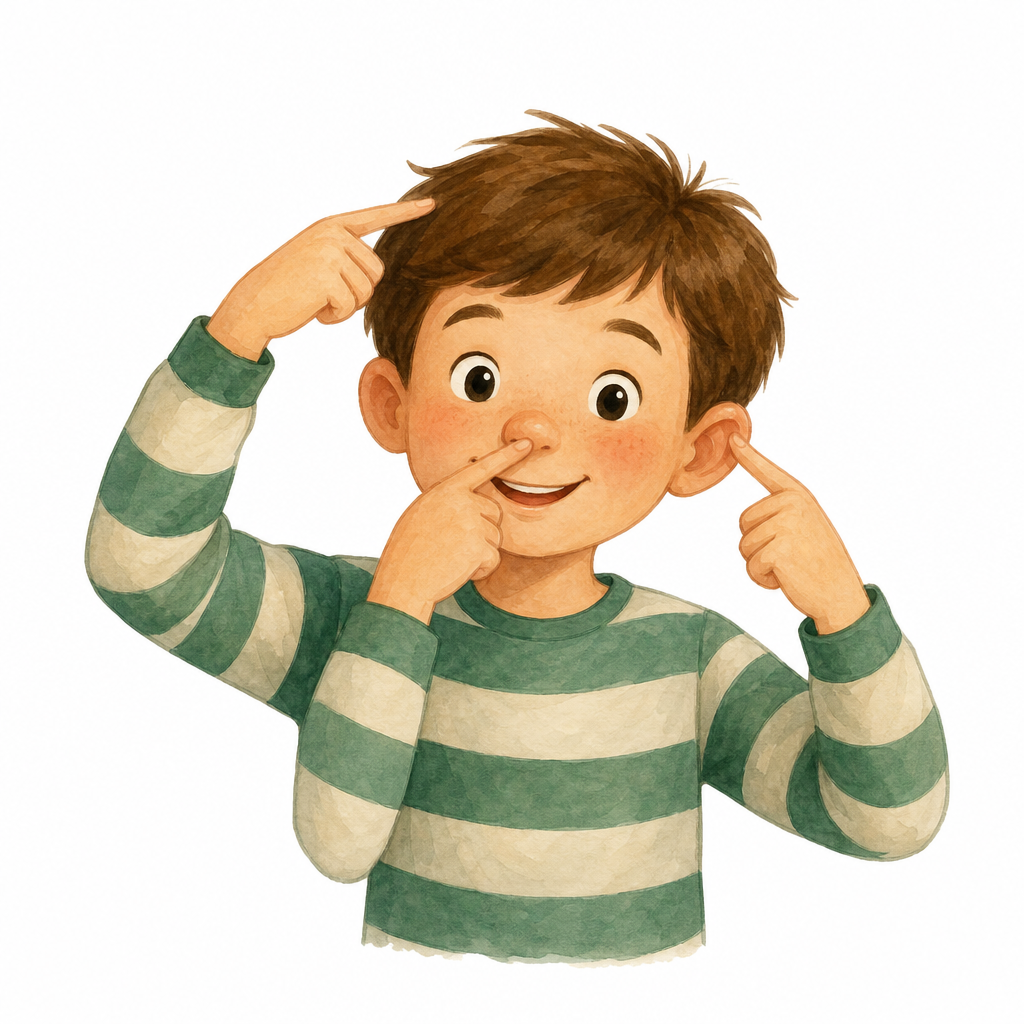
Touch your head, your nose, your ear. You already know what they are called in English. Today you will name eight body parts in German, including ones that come in pairs, and you will keep der, die or das with every word.
Lead a quick silent mime first: point to your own head, nose and ear while the class copies. Keep it light and do not teach any German yet. The point is to wake up the body words they already know in English before the word-table arrives. Smile and keep the energy playful; body-part lessons work best when pupils feel free to move.
Listen as each body part is played on the board, then say it back together with the class. Watch whether it takes der, die or das.
First you will meet four face words, then four more for mouth, hand, foot and leg. After each set, point to that part on yourself when you hear the German.
Run this on the IWB only. Split the eight words into two passes so articles stick.
Pass 1 (face): der Kopf (dair KOPF), die Nase (dee NAH-zuh), die Augen (dee OW-guhn), die Ohren (dee OH-ren). Tap each word, class repeats twice (all together, then by table). Point at the article every time. Quick thumbs check: hold up one finger for der, two for die, flat hand for das (you will meet das in pass 2). Choral point-on-self for all four before moving on.
Pass 2 (mouth and limbs): der Mund (dair MOONT), die Hand (dee HAHNT), der Fuß (dair FOOS), das Bein (dahs BINE). Same listen–repeat–point pattern. Highlight that das Bein is the one das word in today's set, so the flat-hand thumbs signal finally has a match. Note that die Augen and die Ohren take die because they are plurals; each singular noun still has its own fixed article to learn with the word. German nouns always start with a capital letter.
TPR chant (about 2 minutes at the end of this step): Everyone stands. When you say der Kopf, hands on head; die Augen, cover eyes; die Ohren, cup ears; die Nase, touch nose; der Mund, point to mouth; die Hand, wave; der Fuß, stamp; das Bein, touch a leg. Start slow, then faster each round. Cheer messy first tries; the goal is joyful recall, not perfect drill.
Volunteers flip two cards on the board and hunt for each German word with its English meaning. When a pair is found, the whole class says the German word with its article together.
Run this on the IWB with volunteers taking turns at the board. Model one pair first: flip until you find der Kopf and "the head", say der Kopf (dair KOPF) aloud, then have the whole class echo before the next volunteer comes up. After every match, the class says the German (article included) once together so row-3 pupils speak, not only the volunteer. If the same pair is missed twice, stop and say it together before moving on. Insist on the article: Kopf alone is not the full answer. Watch for das Bein: pupils who only expect der or die may drop das.
Keep the word list on the board. Open your copy and write the eight body parts with their articles. You may copy from the screen. Circle the two you found hardest to say.
Model line: der Kopf : the head
Pause other board apps and keep the word-table clearly visible while they copy. State aloud: they may copy spellings from the screen; they do not invent them. Everyone writes: this is the only three minutes where every pupil's pen is moving. Check that each noun has its article and a capital letter. For der Fuß, the last letter is ß (scharfes S), not a double s. For das Bein, check they wrote das, not der or die. Show the model line once on the board if helpful. Do not collect these.
Imagine a child at German PE (Sportunterricht) who has taken a small tumble on the playground. The nurse asks where it hurts. Watch each German label go onto the figure on the board. When a label lands, say the German word together and point to that part on yourself.
Single whole-class path (IWB only; no pupil devices). Set the scene briefly in English: a child at Sportunterricht has had a soft fall; we help the nurse label where it hurts. Model one label first: drag die Nase (dee NAH-zuh) onto the nose, say the word as it lands, and have the class point to their own nose and echo. Then invite volunteers (or tables in turn at the board) to place the rest while the class says each German word, article included, as it lands and points on their own body.
After the figure is complete, run a teacher-calls-German / class-points round on their own bodies (e.g. you say der Fuß, everyone points to a foot; you say das Bein, everyone touches a leg) so every pupil responds, not only the volunteers. The oral check is always on their own body; the figure work is the drag-and-label task on the board.
You're previewing this lesson. Get full access to this lesson and hundreds more — each one ready to teach, with interactive activities, printable resources and pupil progress tracking built in.