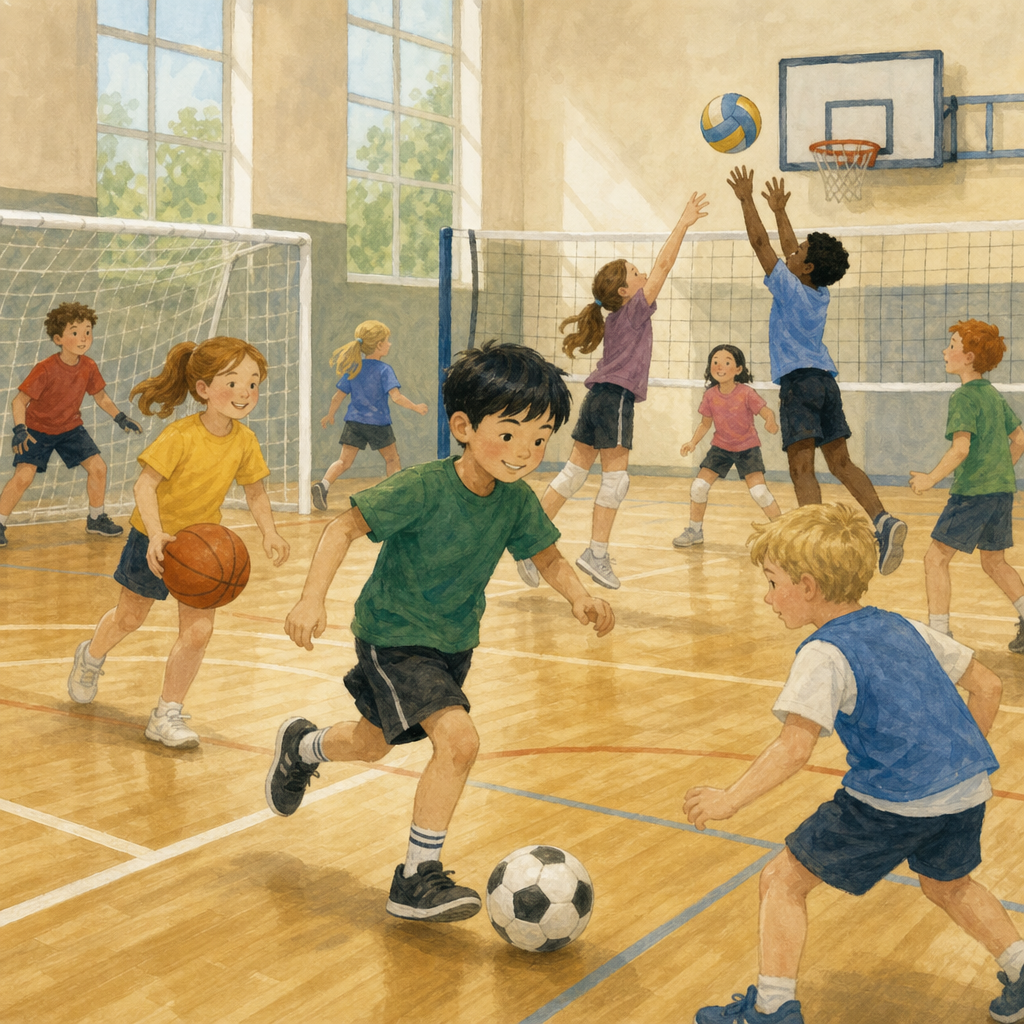
Which sport does this class play most? Think for a moment and show your choice with a hand up or a quiet point at a picture. Today you will learn eight sports in German and put a sport and a day together in one short sentence, so you can say what you play and when.
Run the class vote in English (or with gestures and pictures only). Cheer any brave German attempt if a pupil offers one, but do not require German yet and do not correct heavily: wrong article is fine at this point. The word-table in the next step will lock the forms in. Signal that a short days-of-the-week strip is coming next so everyone can build sport-and-day sentences later.
Here are today's eight sports. Listen to each one, then say it back together. Notice der and das every time.
Your clear job: listen to the sport, repeat the full noun with its article, then chorally repeat one model day sentence when your teacher cues it.
Days of the week (keep this strip visible):
Day pattern: am Montag means on Monday. You will use am + day in your sentences.
Keep a compact days strip on the IWB beside the word-table and leave it up through the copybook step: Montag (MOHN-tahk), Dienstag (DEENS-tahk), Mittwoch (MIT-vokh), Donnerstag (DON-ners-tahk), Freitag (FRY-tahk), Samstag (ZAHMS-tahk), Sonntag (ZON-tahk). This is a quick recap bank for non-specialist teachers and pupils; do not assume days were mastered earlier.
Tap each sport, class repeats twice (once together, once by table). Point at the article every time so the pair is what they hear.
Then model the three play frames clearly:
Naming vs playing: Naming = der Fußball / das Schwimmen (article stays). Playing sentence = Ich spiele Fußball am Montag (no article after spiele / gehe / fahre).
That trio is the whole trick today: spiele / gehe schwimmen / fahre Rad. Give the class a round of applause when they land the right verb. Finish with 4–6 quick teacher-led call-and-response frames (point to a sport image + a day; class says the matching sentence chorally). Optional 30-second pair echo: one asks Welchen Sport spielst du? (VEL-khen shport SHPEELST doo — Which sport do you play?); partner answers with one sport-and-day frame from the board.
Look at the sports-hall scene on the board. Volunteers come up to choose the correct German label for each sport. Everyone else points or whisper-says the full phrase (der or das + sport) before the click is confirmed.
Run this on the IWB only; volunteers say the full noun with article aloud before tapping. Do not plan a devices-on-desks path. Insist on the full noun with its article when a pupil answers: der Baseball, das Hockey, not bare stems. If two labels are mixed up, pause and replay the word from the table before moving on. This is recognition with the picture as the anchor, after the full list has already been heard. Smile when a table nails a tricky article: that is the win for this step.
First we say a few sport-and-day sentences together. Then open your copy and write two full sentences about sports you play and the day you play them.
Models to keep on the board:
Days bank: Montag, Dienstag, Mittwoch, Donnerstag, Freitag, Samstag, Sonntag (use am + day).
Capital letter on every German noun. After spiele, gehe or fahre, do not add der or das. Choose sports you can spell from the word-table (four or five favourites are enough for writing).
Before anyone opens a copy, run a 2–3 minute whole-class oral beat: point to a sport image + a day; class chorally says the matching frame using spiele / gehe schwimmen / fahre Rad. Keep the word-table and days strip visible the whole time.
Then pause interaction and leave two (or three) models up:
Naming = der Fußball; playing sentence = Ich spiele Fußball am Montag (no article). Treat der/das as naming forms from the word-table, not as something required inside every Ich spiele… sentence.
Everyone writes two full sentences, not a bare word list. If a pupil picks swimming or cycling, steer them to gehe schwimmen / fahre Rad: do not accept spiele with those two. Hunt for capital letters like a detective as you walk the room and quietly celebrate any sentence that already follows the model. Support: allow a word bank of 4–5 high-frequency sports plus the days strip. Do not collect these copies.
We will hear a short Sportplatz (sports ground) scene twice as a class. Listen for sport words you know and which day each one happens. Your teacher will read or play the lines and then ask the class four questions together. Ask if you need a line again: your teacher controls the audio.
PRIMARY PATH (always run this first — fully scripted, no platform transcript needed): Close any interactive for a moment. Keep the word-table and days strip visible. Useful phrases: Hört zu (hurt tsoo, listen) and Noch einmal (nokh EYE-nmal, once more).
Read the four lines below twice, slowly and clearly. Pupils listen with eyes on the word-table. Do not hand out a transcript.
Teacher read-aloud lines (today's sports only):
Class questions after the second reading (answers in brackets) — go through every question orally as a class:
For each answer ask, "Which German word gave it away?" Tick any of today's sports pupils heard: der Fußball, der Basketball, der Baseball, das Tennis, das Schwimmen, der Volleyball, das Radfahren, das Hockey.
OPTIONAL EXTRA only if time remains and the listen-answer interactive loads cleanly on theme: Play the on-screen at-the-park clip once as bonus listening. If a line uses outdoor or park language beyond today's list, translate it quickly in English and move on. If the clip is unclear, off-theme, or fails to load, skip it entirely — the primary path above already meets the listening objective.
After answers, add one cultural hook: many towns in German-speaking countries have a public Sportplatz (sports ground) where clubs train midweek: same family of sports, different setting from an Irish GAA pitch or school yard.
You're previewing this lesson. Get full access to this lesson and hundreds more — each one ready to teach, with interactive activities, printable resources and pupil progress tracking built in.