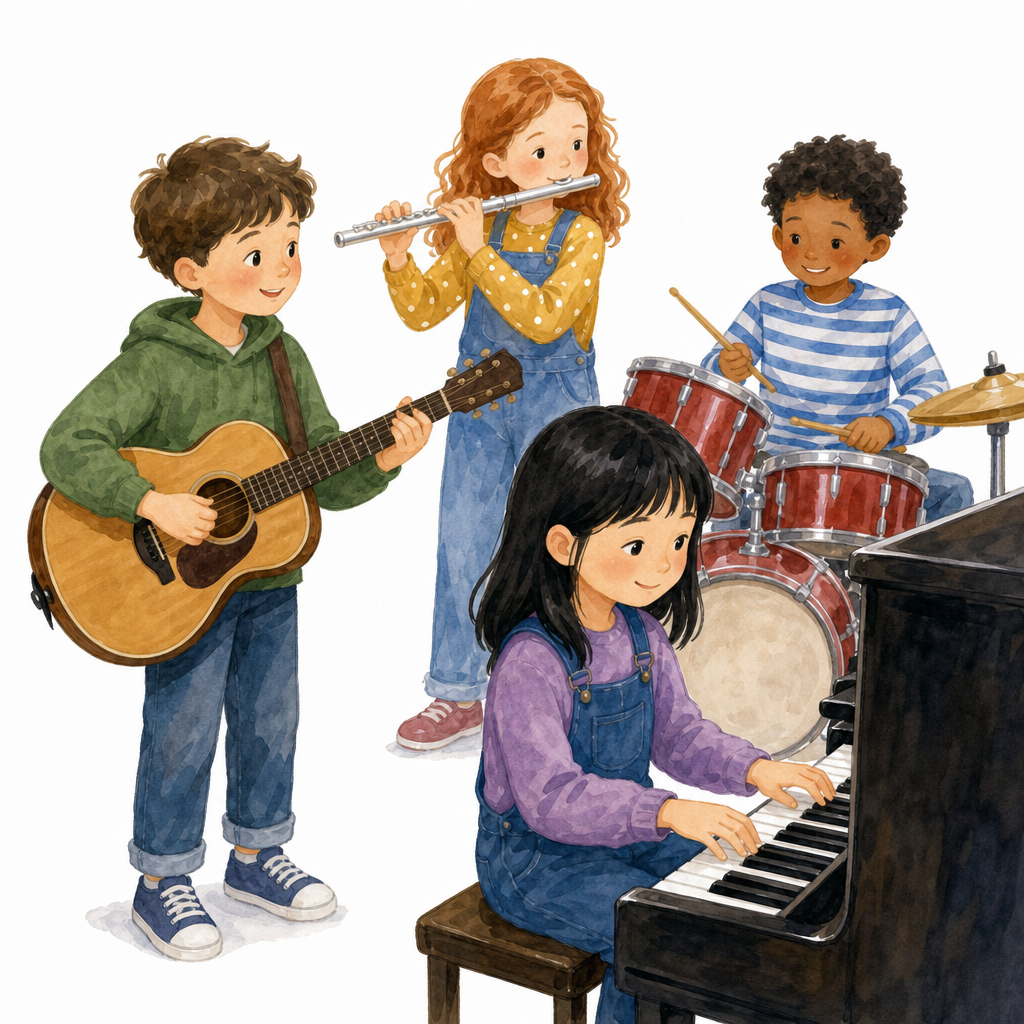
Hands up if you play an instrument. Hands up if you do not play one yet, but you would like to try.
Today you will name eight instruments in German, and say both what you play and what you would like to play.
Take a quick show of hands only: who already plays, who would like to try. Do not dig into long stories yet; the point is to open the two sentence patterns the lesson will use.
Write the two frames on the board if it helps you later: Ich spiele … (ikh SHPEE-luh) and Ich möchte … spielen (ikh MURKH-tuh … SHPEE-len). Leave a blank for the instrument name with no article after spiele or before spielen (native pattern: Ich spiele Gitarre, not die Gitarre). You will model them fully on the word-table step, after the nouns have been heard twice.
Here are today's eight instruments. We meet them in two groups. Tap each one, listen, then say it back together. Keep die or das with the name when you label it.
Group 1: listen and repeat each word twice. Then try the play frame: Ich spiele Gitarre (I play guitar).
Group 2: listen and repeat each word twice. Then try the would-like frame: Ich möchte Klavier spielen (I would like to play piano).
Language cousins: Gitarre, Trompete, Saxophon and Cello sound close to English. Instrument names often travel between languages.
Pass 1 (first four): Tap das Klavier, die Gitarre, das Schlagzeug, die Flöte. Class repeats twice each time: once all together, once by table group. Point at the article so pupils hear the pair, not a bare noun.
Pass 2 (second four): Same routine for die Geige, die Trompete, das Saxophon, das Cello. Geige sounds a bit like “guy-guh”: say it big, then soft like a real violin. Keep all eight on screen after both passes.
Only then model the frames (articles stay on the word list for gender; they drop after spielen). Say Ich spiele Gitarre (ikh SHPEE-luh gi-TAH-ruh), class echoes. Then Ich möchte Klavier spielen (ikh MURKH-tuh klah-VEER SHPEE-len), class echoes. One contrast line for you: das Klavier = the instrument word on the list; Ich spiele Klavier = I play piano (the skill). Invite two volunteers to swap the instrument slot only.
Quick cognate beat (30 seconds): point at Gitarre, Trompete, Saxophon, Cello and ask “Which English words are hiding inside?” Celebrate the near-matches; note that Klavier, Geige and Schlagzeug took different paths.
Pronunciation guides: das Klavier (dahs klah-VEER), die Gitarre (dee gi-TAH-ruh), das Schlagzeug (dahs SHLAHK-tsoyk), die Flöte (dee FLUR-tuh), die Geige (dee GUY-guh), die Trompete (dee trom-PAY-tuh), das Saxophon (dahs zak-so-FOHN), das Cello (dahs CHEL-oh).
This picture is a small-town Blaskapelle line-up: the kind of village brass band you might hear at a local festival. Look at each instrument. When it is your turn, say the full German name with die or das, then help us choose the label on the board.
Everyone else: whisper the word with its article to your shoulder partner before we click.
Run this on the IWB only. You or a volunteer taps the labels; there is no pupil-device path for this step. Before each click, the whole class whispers the article + noun (e.g. die Flöte, not bare Flöte). Then the volunteer confirms and you tap.
Frame the image as a Dorfkapelle / Blasmusik line-up so this step previews the village-band discussion later. Instruments such as die Trompete sit naturally in that sound world even when the graphic is generic.
If a label is missed twice, pause and say the word together before moving on. After a few correct labels, ask one pupil to reuse the would-like frame with no article after the verb: Ich möchte Trompete spielen (ikh MURKH-tuh trom-PAY-tuh SHPEE-len).
Open your copy and write one sentence about an instrument you play or would like to play. Use Ich spiele … or Ich möchte … spielen. Write the instrument name without die or das in the sentence (keep capitals on the noun).
Pause the board. Keep the word-table visible so pupils can copy spelling accurately. Everyone writes one full sentence: either Ich spiele Gitarre. or Ich möchte Klavier spielen.
Walk the room and check for capital letters on the noun, no article after spiele / before spielen, and the umlaut on Flöte or möchte if they use those words. If someone writes Ich spiele die Gitarre, smile and remind them: article on the list, no article when you say what you play. Do not collect the copies.
You will get a bingo card. Listen for the German name with its article and mark that square. When you have a full line, stand and say Bingo! then read your line in German with the articles.
How to Play Bingo:
Option 1: Students on Devices (Digital Version)
Option 2: Print Out the Bingo Cards
You're previewing this lesson. Get full access to this lesson and hundreds more — each one ready to teach, with interactive activities, printable resources and pupil progress tracking built in.