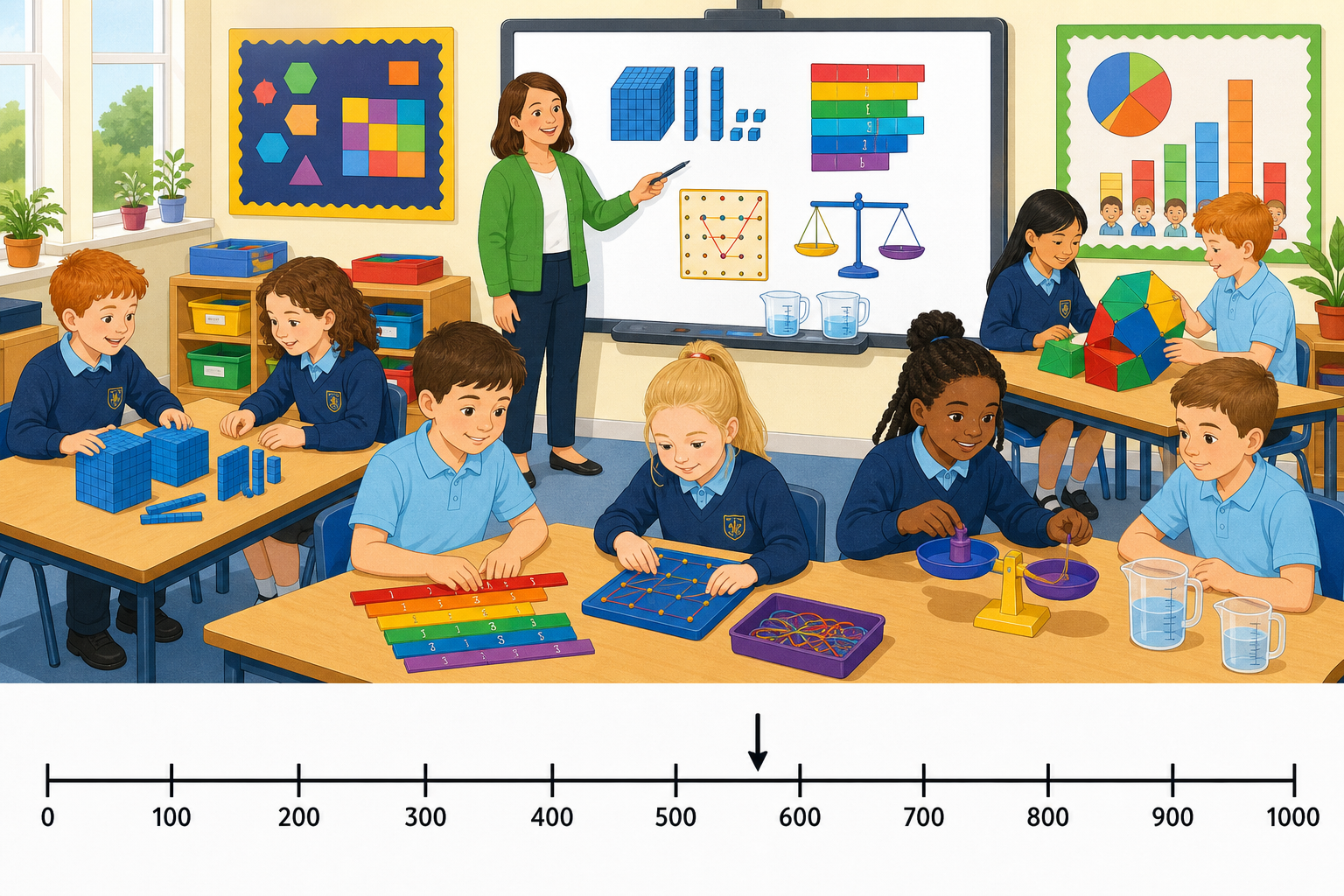
Here is a long line that runs from 0 all the way to 1,000, with a mark at every hundred. Now imagine I point to a spot that is a little bit past the middle. Roughly what number do you think is hiding there? Is it nearer 500 or nearer 600? Hands up and tell me which landmark you would look at first.
Display the 0 to 1,000 line and point to a spot around 550. Take three hands-up answers, not open call-outs. You are only warming up their eyes to use the hundred marks as helpers, so accept any answer that lands in the right neighbourhood.
Watch each number land on the 0 to 1,000 line. Notice which landmark it sits near, and how that helps us place it without counting every step.
500: halfway of 1,000 is 500, straight to the middle, no counting.
250: ask nearer the start or the middle before revealing. Nearer the start, between 200 and 300, since 250 is well below 500.
730: name both landmarks, 700 and 800, then which it hugs. Nearer 700 because 30 is a small step past.
90: not yet at the first hundred mark, just before 100, close to 0, one of the smallest.
Now we place some numbers together on the board. Today we work through these numbers, in this order: 300, then 550, then 820, then 60. Each one gives us something new to think about. For each number, we find the two hundred marks it sits between first, then we decide which mark it hugs. Watch 550 carefully, because it lands right beside the halfway point.
This round is for talking it through together — pupils take turns at the board and the class agrees or corrects out loud.
Call each number in order: 300 (lands right on a landmark), 550 (just past halfway — the key one, let the class predict where it lands before the pupil drags), 820 (between 800 and 900, near 800), 60 (before the first hundred mark). For each, ask the class first 'which two hundred marks does it sit between?', then send one pupil to drag the marker and press Check so the class sees whether the placement lands. If a placement is too far left or right, ask the class to say which way to nudge it and why before the pupil tries again.
In your maths copy, draw a straight line from 0 to 1,000 and mark it at every hundred, using your ruler. Then place an arrow for three of the lesson's numbers and label each one clearly:
Read each number aloud as you place its arrow, and check it sits between the right two hundred marks.
Walk the room glancing at whether pupils have spaced their hundred marks evenly and placed each arrow between the correct two landmarks. No marking — this is whole-class copybook practice, not assessment.
Now we take turns placing four numbers, and each one is a little trickier than the last. In order: 150, then 480, then 615, then 940. Before each reveal, predict which two hundred marks it will sit between. Watch 480, because it lands just before the halfway mark and it is easy to nudge too far to the right.
These are the practice questions — pupils take turns at the board, check each answer, and the class confirms before moving on. Keep the board work brisk rather than over-explaining.
Run the four targets in order: 150 (between 100 and 200), 480 (just before the 500 landmark — the common slip is placing it past halfway), 615 (just past 600), 940 (near the far end, between 900 and 1,000). For each, ask the class to name the two landmarks first, then a pupil drags and presses Check. Use the ✓ as part of the narration: 'yes — that's it, just before the middle.'
You're previewing this lesson. Get full access to this lesson and hundreds more — each one ready to teach, with interactive activities, printable resources and pupil progress tracking built in.