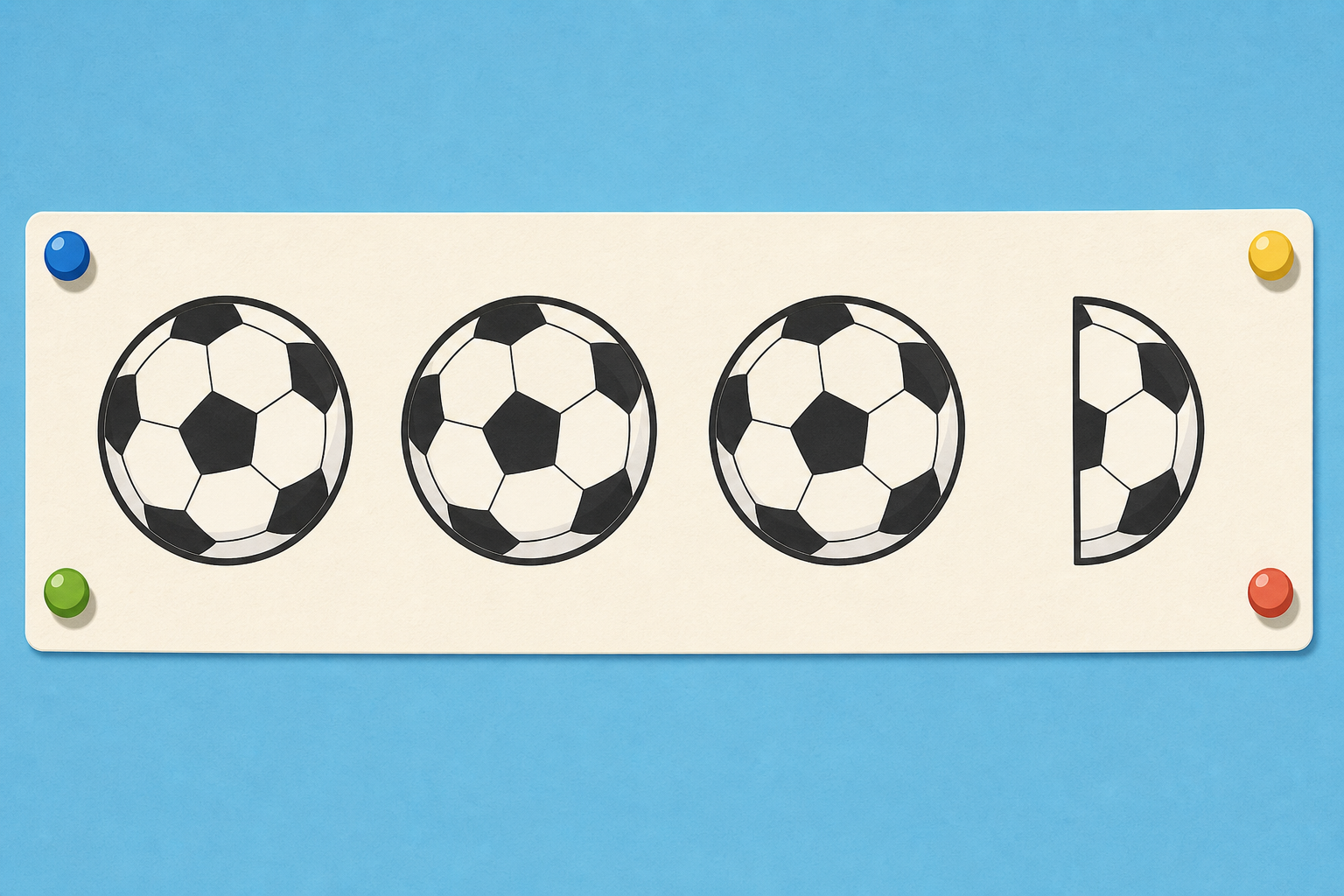
Here is a pictogram of goals scored by four football clubs. But look closely at the key: one football stands for 10 goals, not one.
If a club's row has 3 footballs, how many goals is that? And what do you think two and a half footballs would mean?
Take two or three hands-up answers. Do not confirm yet, this is the puzzle the lesson opens.
Listen for the mistake of counting 3 footballs = 3 goals. Revoice a good answer: so one football is worth ten, so three footballs is thirty.
Watch three pictograms, each with a different key. Read the key first, then work out the total. For the first one: 4 symbols, each worth 2. The last one has a half symbol, so get ready to say what half of the key is worth.
The move to draw out: read the key first, every time. Do not proceed until the class can say what one symbol is worth on each.
Today we build and read three pictograms together on the board. We choose a key that fits the biggest number, then place the symbols.
We build these three, in order:
Talk this one through together, pupils take turns at the board and the class agrees or corrects out loud.
The builder opens empty. You re-label the three rows and enter the data live for each dataset in turn: first the medals (three teams, biggest value 20, key of 5), then clear it and enter the points (biggest value 30, key of 10), then the single row of 25 on a key of 10 to show the half symbol. The 'Team 1/2/3' labels in the tool are just a starting point, rename them to the teams the class chooses.
For each set, ask the class which key to pick before anyone places a symbol: if the biggest number is 20, is a key of 1 sensible, or would that be a very long row? Watch for pupils placing the right count of symbols but forgetting the key when they read the total back.
In your maths copy, write the key for a pictogram: one symbol = 5 books. Then work out and write the total for each of these three rows:
Show your working beside each total, and remember the half symbol is worth half of five.
Walk the room glancing at whether pupils multiplied by the key rather than counting symbols. No individual marking, this is whole-class copybook practice, not assessment.
The row to watch is the 2½ symbols: look for pupils who write 10 (forgetting the half) or write 2 (counting symbols not values).
Today we read scaled pictograms and answer a question about each. The rounds build up:
This is the practice round, pupils take turns at the board, check each answer, and the class confirms before moving on. Keep the board work brisk rather than over-explaining.
Read the key aloud before each round. The last two rounds are the stretch: totalling across rows needs every row read correctly first, and the comparison needs two totals held in mind. If a round runs quick, pose a follow-up question to the whole class or turn-and-name a pupil to explain their reasoning.
You're previewing this lesson. Get full access to this lesson and hundreds more — each one ready to teach, with interactive activities, printable resources and pupil progress tracking built in.