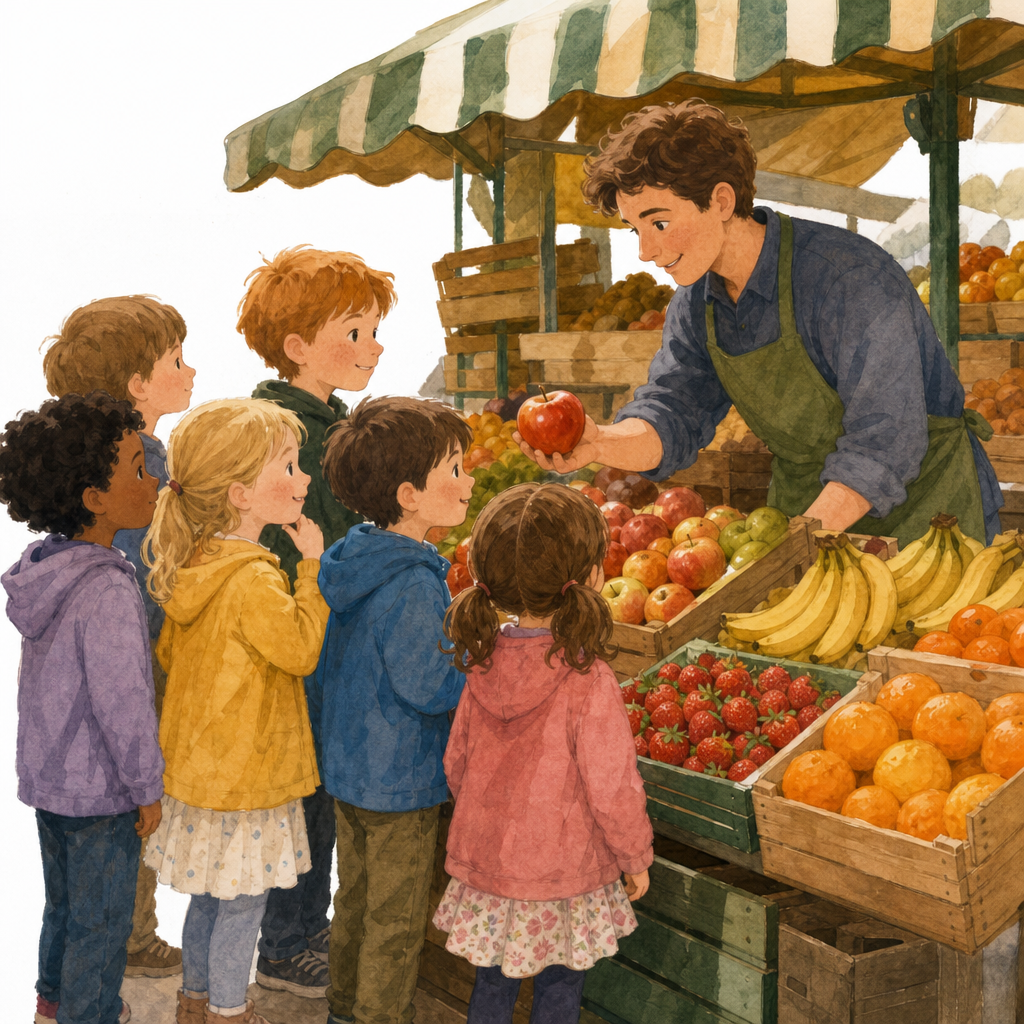
Which fruit word do you already know in German? Someone in this room will know at least one. Shout it out if you dare!
Collect three or four guesses and write any correct ones on the board with a star. Do not correct wrong articles yet; the word-table in the next step will settle them. If nobody offers a word, try prompting with Banane (bah-NAH-neh), which many pupils already half-know from English.
If a pupil asks about the group word for fruit: das Obst (dass OBST) means fruit as a food group. Today's individual fruits use der or die only; we are not teaching das words today.
Here are today's eight fruits, in two waves.
Wave 1: we tap each fruit on the board, listen, then say the full pair together (der or die plus the fruit). Keep the list on screen.
Wave 2: four more fruits the same way. Then we re-chorus wave 1 once more so both waves stay warm.
Learn each fruit as a pair with its article.
Introduce in two waves so eight new pairs do not land in one go. Wave 1 first: der Apfel, die Banane, die Orange, die Birne. You tap each word on the IWB; class repeats twice (once together, once by table). Point at the article every time so the pair is what they hear. Re-chorus wave 1, then reveal wave 2: der Pfirsich, die Erdbeere, die Zitrone, die Kirsche. Keep both waves visible as a running list for the rest of the lesson.
Full pronunciation crib (use if audio is slow or you need to re-model): der Apfel (dair AP-fel), der Pfirsich (dair PFIR-zish), die Banane (dee bah-NAH-neh), die Orange (dee o-RAHN-geh), die Erdbeere (dee AIRT-bay-reh), die Birne (dee BIR-neh), die Zitrone (dee tsi-TROH-neh), die Kirsche (dee KIR-sheh). Keep this list handy for steps 3 and 5 too.
After the first choral pass of wave 1, play one silly round: whisper der Apfel like a secret, then boom die Banane like a market seller. Praise the loudest clear article. German nouns always start with a capital letter: say that once, clearly. Stress that der Apfel and die Banane are the full answers, not bare nouns. Confirm any cognates from the hook here. This is the first proper meeting with grammatical gender, so go slowly and celebrate careful listening.
Watch the stall on the board. When your table is called, one pupil comes up and places one fruit label. Everyone else points at the fruit and whispers the full pair (article plus fruit) as each label lands.
Board-led only: no pupil devices. Model the first label yourself: drag der Apfel (dair AP-fel) onto the apple and say the full pair aloud. Then call tables in turn; one volunteer or table captain comes to the IWB for each fruit. After every correct placement, the whole class chorally says the full der/die pair. If a label lands wrong, have the class say the correct pair together before moving on. Keep the word-table list on screen as a reference. Pronunciation crib is in step 2 notes.
Open your copy and write today's eight fruits, each with der or die in front. Put a star beside any whose article surprised you. Take care with capital letters.
This is the first meeting with grammatical gender, so go slowly. Pause the interactive and keep the full article-plus-noun word-table on screen while everyone writes so pupils are matching, not recalling from thin air. Walk the room and check the article is going in front of every word: a list of bare nouns will not carry the gender pairing. Watch for missing capitals on the fruit nouns themselves. Do not collect these.
Watch the board. First we sort two together so you can see how it works. Then for each fruit, hold up one finger for der or two fingers for die (or point to the left or right column). A volunteer moves the label. Use the list still on screen and the pairs you wrote in your copy.
Der means a masculine word and die means a feminine word. In German every noun has a gender we learn with it.
Today's board shows only der and die columns; none of these eight fruits take das. Say that up front so nobody hunts for a third column.
Worked example first: drag der Apfel (dair AP-fel) under masculine and die Banane (dee bah-NAH-neh) under feminine while the class choruses each pair. Then frame the labels: 'der = masculine word, die = feminine word; we learn the gender with each noun.'
Whole-class routine after that: teacher or volunteer drags; before each move the class signals with one finger (der) or two (die), or points left/right. Keep the full word-table list on screen as a reference. After sorting, ask whether anyone found a rule they could hear. Most will not, and that is the point: gender is learnt with each word. Pronunciation crib is in step 2 notes.
You're previewing this lesson. Get full access to this lesson and hundreds more — each one ready to teach, with interactive activities, printable resources and pupil progress tracking built in.