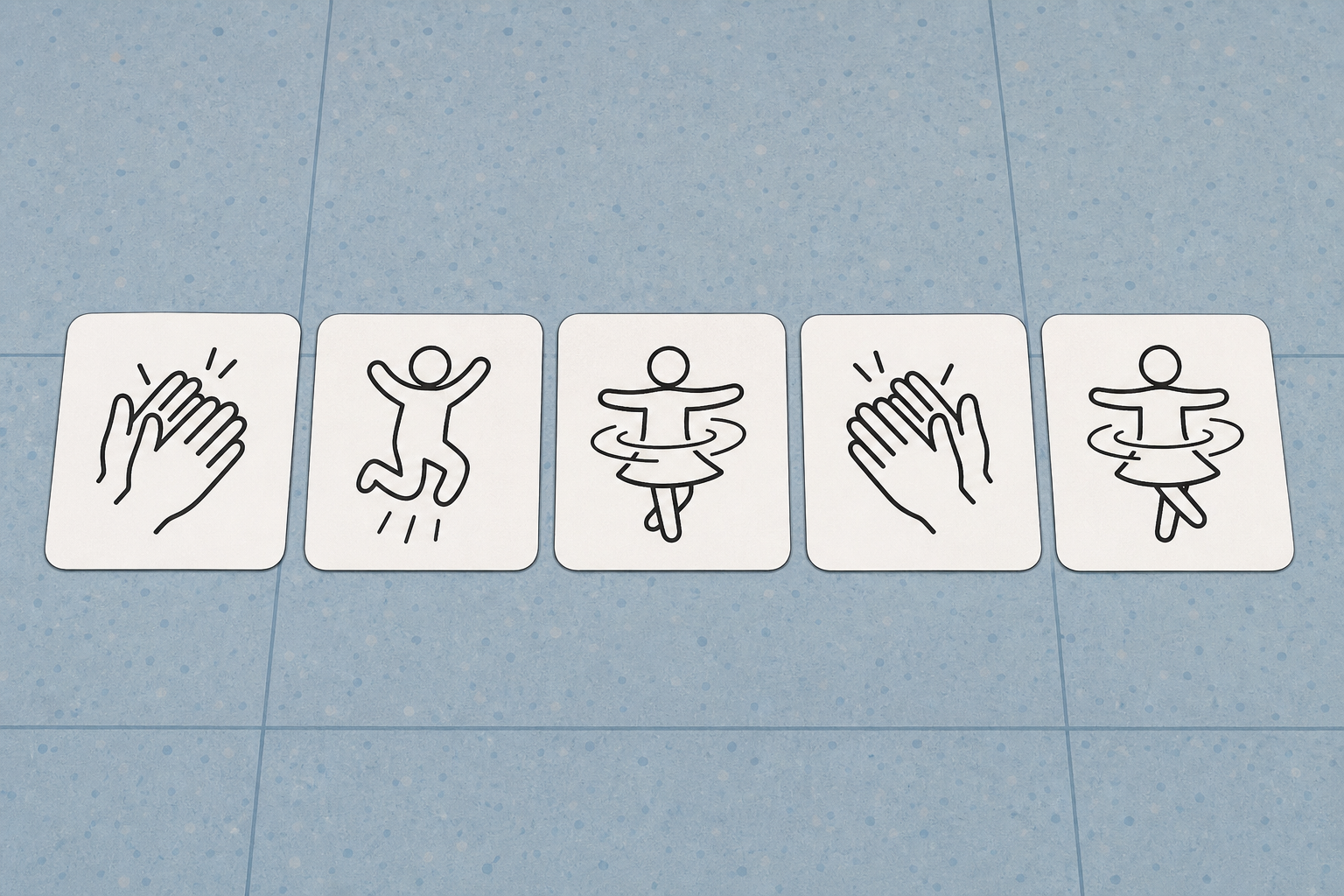
Watch carefully what my hands do. I will clap, clap, spin, then clap, clap, spin again. Which bit came back more than once?
That bit that comes back is called a pattern. Today we will spot patterns in short dances. We will also look for a bug (that means a wrong step) and fix it together.
Keep this light. Stand where everyone can see you. Do the three-move phrase twice, slowly: clap, clap, spin; clap, clap, spin. Ask hands-up: which bit came back? Accept any clear answer that names the repeat.
When you say bug, cross your arms for "wrong step" straight away so children do not picture an insect. Say the gloss out loud every first use: "a bug means a wrong step".
Do not lay out the step-cards or name every vocabulary word yet. The cards come out in the next steps. The star idea today is finding and fixing the wrong step; the pattern is the short acted support that helps them spot it.
Nature of STEM cue (keep tiny): people who make games look for repeats and fix wrong steps, just like we will.
Our star word today is bug. A bug means a wrong step (not a creepy-crawly). Watch my crossed arms when I say it.
When we change that wrong step so the dance works again, that is our fix. Give me a thumbs up for fix!
Board stays almost empty: just the words bug and fix. You carry the meaning with gestures. Do not project long definitions, and do not stack the full three-word list yet. Pattern already landed lightly in the hook; children will meet it again with the cards in the next step.
Say bug with crossed arms ("wrong step" — not an insect). Say fix with thumbs up. Keep this beat short so the class locks the star idea before any acted buggy line or card work.
Keep the board short; the table below is for you.
| Concept | Why it matters | Example |
|---|---|---|
| Pattern (repeat) — a bit of a sequence that happens more than once, in the same order | Spotting a repeat helps us notice when one step has gone wrong | Jump, jump, spin — then the same jump, jump, spin again |
| Bug — a wrong step that stops the sequence working the way we want (not a creepy-crawly) | Finding the wrong step is the first move toward making something work again | The dance should finish with spin, but clap was put in by mistake |
| Fix — changing the wrong step so the sequence works | Makers and game-makers fix wrong steps every day; we can too | Swap the wrong clap for a spin, then try the dance again |
Misconceptions to head off:
Lean the talk toward find-and-fix. Treat pattern as the short support that makes the wrong step easy to see. Children already know how to put simple steps in order; today we look inside the order for a wrong step.
Watch the step-cards on the floor. First we will find the bit that happens more than once. Then I will put one wrong card in on purpose. Can you spot the bug (the wrong step) and tell me how to fix it?
Print the provided action step-cards with duplicates (one demo set for you, and later one set per group). You need several of each action so a repeating line can sit on the floor. Lay a clear strip of floor space at the front.
Each demo/group set should include about 4 Jump, 4 Clap, 3 Spin, 3 Stomp, 2 Wave and 2 Half-turn so sequences such as Jump, Jump, Spin, Jump, Jump, Spin can actually be laid out, with a spare wrong card for the bug swap.
I wonder: can we find a pattern in this dance?
I show: lay Jump, Jump, Spin, Jump, Jump, Spin in a line (you need two Jump cards and two Spin cards for each half). Act it with the class once.
I notice: jump-jump-spin comes twice. That is our pattern. Circle those two groups with your finger or two hoops of wool on the floor. (Now the three words sit together for the first time with cards in view: pattern, bug, fix.)
I put a bug in: swap the last Spin for Wave. Act the new line: jump, jump, spin, jump, jump, wave.
I ask: which card is the bug (the wrong step)? How do we fix it?
I think: the last card should be Spin to keep the pattern. Swap Wave back to Spin and act it once more so the fix is felt.
What to expect: most children will point at Wave. If they say the whole second half is wrong, praise the notice and help them name the one card to change.
Keep moves gentle and on the spot so nobody bumps. Spin = full circle with a finger twirl; Half-turn = face the other way only, so the two cards stay distinct.
Burst 1: Look at the dance picture on the board. In your group, lay those same cards on the floor. Act the dance together once.
Burst 2: When I call "bug time", cover your eyes. Only the named helper swaps one card for a wrong one. Then everyone looks, points to the bug (the wrong step), says the fix, and the helper swaps it back. Act the fixed dance once more.
Split into small groups on clear patches of floor. Give each group one duplicate-rich set of action step-cards (about 4 Jump, 4 Clap, 3 Spin, 3 Stomp, 2 Wave, 2 Half-turn — same pack as the demo). Groups work standing, then sit to talk.
Board starter (only job on the IWB): show the provided pictured starter sequence (or arrange the same card icons once on the IWB) as the shared first move: picture icons for Clap, Clap, Stomp — Clap, Clap, Stomp. Children copy that line with cards; they do not invent a dance from scratch on the first burst.
Look-fors: children point to a single wrong card; they name the fix; they try the dance again after the fix. Guesses that miss are still useful: ask what they noticed, then try once more.
Differentiation: support groups keep the two-card board starter only (clap, stomp, clap, stomp). Stretch groups may try a second ready-made line in Burst 3, still with one bug at a time.
Safety: on-the-spot moves; soft landings; freeze when you say freeze. Spin = full circle; Half-turn = face the other way only.
Now we keep the same idea, find the wrong step, but with new robot moves on the board. First we will watch which way the robot is looking. One step is a bug. Where is it? What should we change? Tell me, and we will fix it together, then press run.
Open the algorithm-sequencer on the IWB in explore mode. Keep this whole-class and teacher-driven: children call out; you drag and run.
Spoken bridge (say this before the grid): "We are not making a dance pattern now. We are only bug-spotting: same idea as the wrong card, new moves for the robot."
What appears on screen: a small 3 by 3 grid, a robot sprite, a star goal, and the command cards forward, turn left, and turn right.
Grid facts (match the interactive exactly): robot starts at bottom-left facing the top of the board (start x 0, y 2, dir 0). Star is at top-right (x 2, y 0). Facing the top means forward moves the robot up the board toward smaller y.
Before any buggy run (pacing lever — do not skip):
Verified working path (build this live, then put the bug in):
Walk the correct path once with your finger on the grid so you are sure before the children watch the buggy run. Keep "adjust if your grid looks different" only as emergency backup; this path matches the configured start and goal.
Talk track:
Fold the watchers in: "Do you agree that is the bug? What would you try?" No separate desk task.
If the interactive is unavailable, rebuild the same idea with arrow cards on the floor and a child robot, using the same five-step path and the same one-card bug, still with a slow body-facing walk first.
You're previewing this lesson. Get full access to this lesson and hundreds more — each one ready to teach, with interactive activities, printable resources and pupil progress tracking built in.