Listen. What can you hear right now in our room?
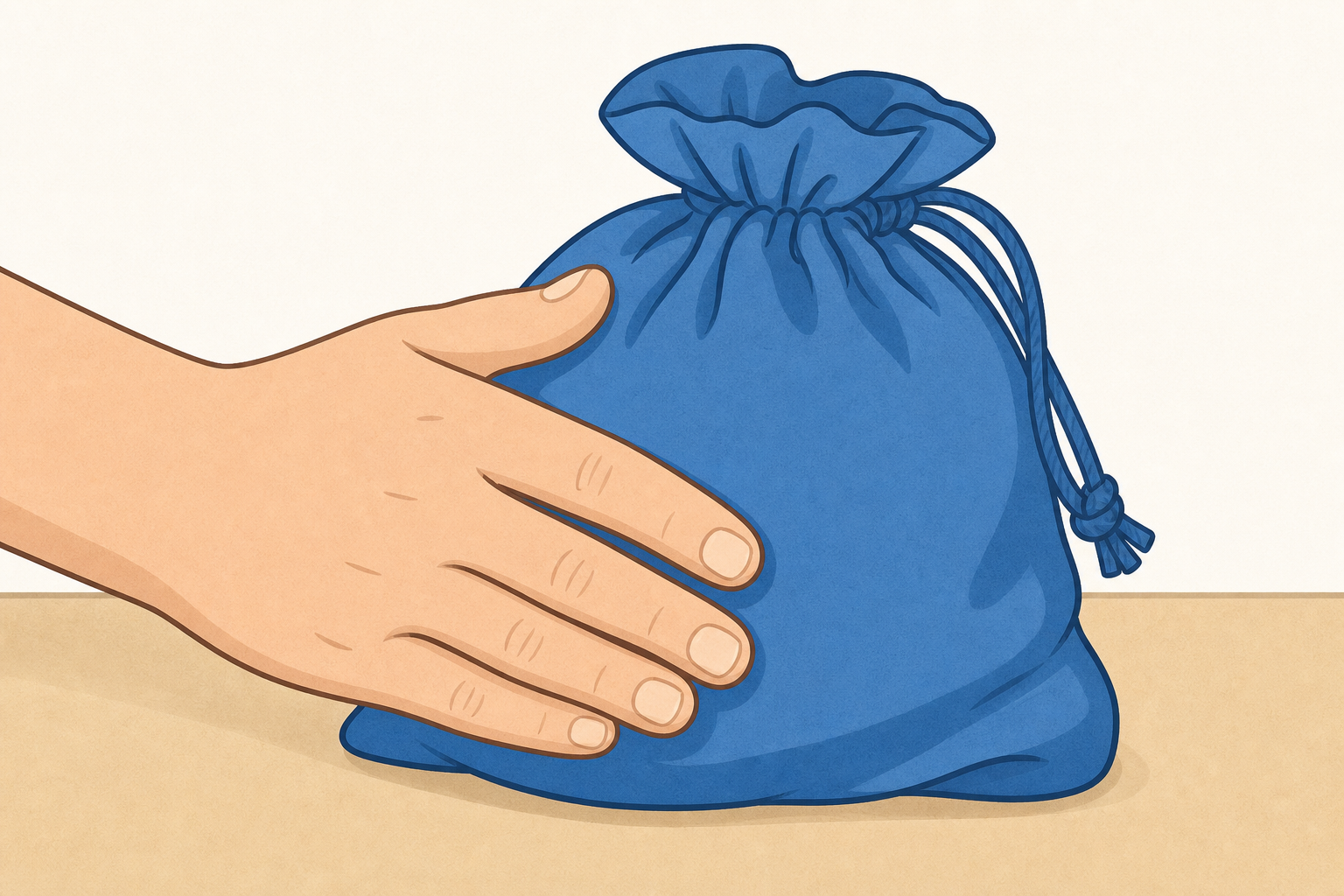
Watch this closed bag. I will notice something with my hands, then ask a question.
Keep this beat light and concrete. Have the closed feely-bag ready as a curiosity prop. Do not open stations yet.
Invite three or four quick answers about sounds in the room (a clock, traffic, a chair scrape).
Live model before naming the lesson job: hold up the closed bag. Feel one object yourself without looking. Say slowly: I notice it is smooth and round. I used touch with my hands. I wonder what it is? Peek and name it. Only then say: Today we will notice with our senses and ask I wonder questions, just like that.
Accept ideas such as shake it, feel it, smell it if children offer them. Say: Scientists notice with their senses too, then ask questions. So do people who help us, like a cook or a doctor.
Before the lesson: check class allergy lists for the fruit and smell pots; set three carousel stations plus a clear carpet space for the whole-class smell and taste moment; form three mixed groups on paper so you can name them quickly; wash and cut fruit before the lesson and keep pieces covered until the taste moment (do not leave stations to prep fruit mid-carousel); print nothing (no Investigation Journal page and no sense cards).
Look at the child on the board. We will place each label on the right body part together, then point to that part on ourselves.
Which part helps us see? Which part helps us hear, smell, taste and touch?
Hands and skin help us touch. Mouth and tongue help us taste.
Open the diagram-labeller on the IWB in explore mode so the labels start off the body. The five labels are: eyes, ears, nose, mouth, hands. Invite one child at a time (or drag yourself with the class directing) to place a label. Read each label aloud. After each place, the whole class points to that part on their own body. No reading is asked of them alone.
Lead with the place-and-point game. Say the sense words aloud while children touch the part. Do not put long definition sentences on the board for non-readers.
Say this once (non-optional): Hands and skin help us touch; mouth and tongue help us taste. Keep the five board labels as they are for this age, but say the fuller line so hands-only and mouth-only do not stick.
| Concept | Why it matters | Example |
|---|---|---|
| Senses help us notice and wonder — our body notices the world by seeing, hearing, smelling, tasting and touching, and we can turn a notice into an I wonder question | Noticing carefully keeps us safe, helps us enjoy food and play, and starts the questions people ask when they want to find things out | You hear the school bell with your ears and know it is time to line up. You might then wonder what comes next on the timetable. |
| Body parts that sense (support chant, not a second equal concept) — eyes, ears, nose, mouth and tongue, hands and skin | Naming the part helps children say clearly how they noticed something | Eyes for seeing, ears for hearing, nose for smelling, mouth and tongue for tasting, hands and skin for touching |
| I wonder (the question shape inside the main idea) — a question that starts from something we noticed | Wondering turns noticing into a question we can explore | I can smell something sweet. I wonder what fruit it is? |
Quick re-model of the stem (30 seconds, bag still closed or with a new object): I notice… I used my… I wonder… Children will hear this chant from you at every station; they are not expected to recite a four-part speech unaided.
Misconception to head off: some children think only eyes and ears count as senses. Gently name all five with a body point each time.
Nature of STEM weave: a cook smells food and tastes a sauce to notice if it is ready; a doctor looks and listens carefully, then wonders how to help. Careful sensing starts useful questions.
Find your group and go to the station your teacher shows you.
At your station: I notice… I wonder…
One careful turn each. Friends watch, then swap. Do not peek inside pots or bags.
Run three concurrent stations only (touch, hearing, sight). You circulate and coach the stem. Smell and taste are not in the free carousel: they are a short whole-class moment at the end of this step with you present the whole time. Do not place an adult permanently at taste while also circulating. Do not print or use sense cards; the body diagram on the IWB and your chant are the only supports.
If settling or turn-taking eats time: do two full rotations plus a lightning third (one quick notice only), and protect the teacher-led smell and taste block. A slightly longer slot helps when fruit and allergy checks run long, but the lesson is written for 30 minutes with these envelopes.
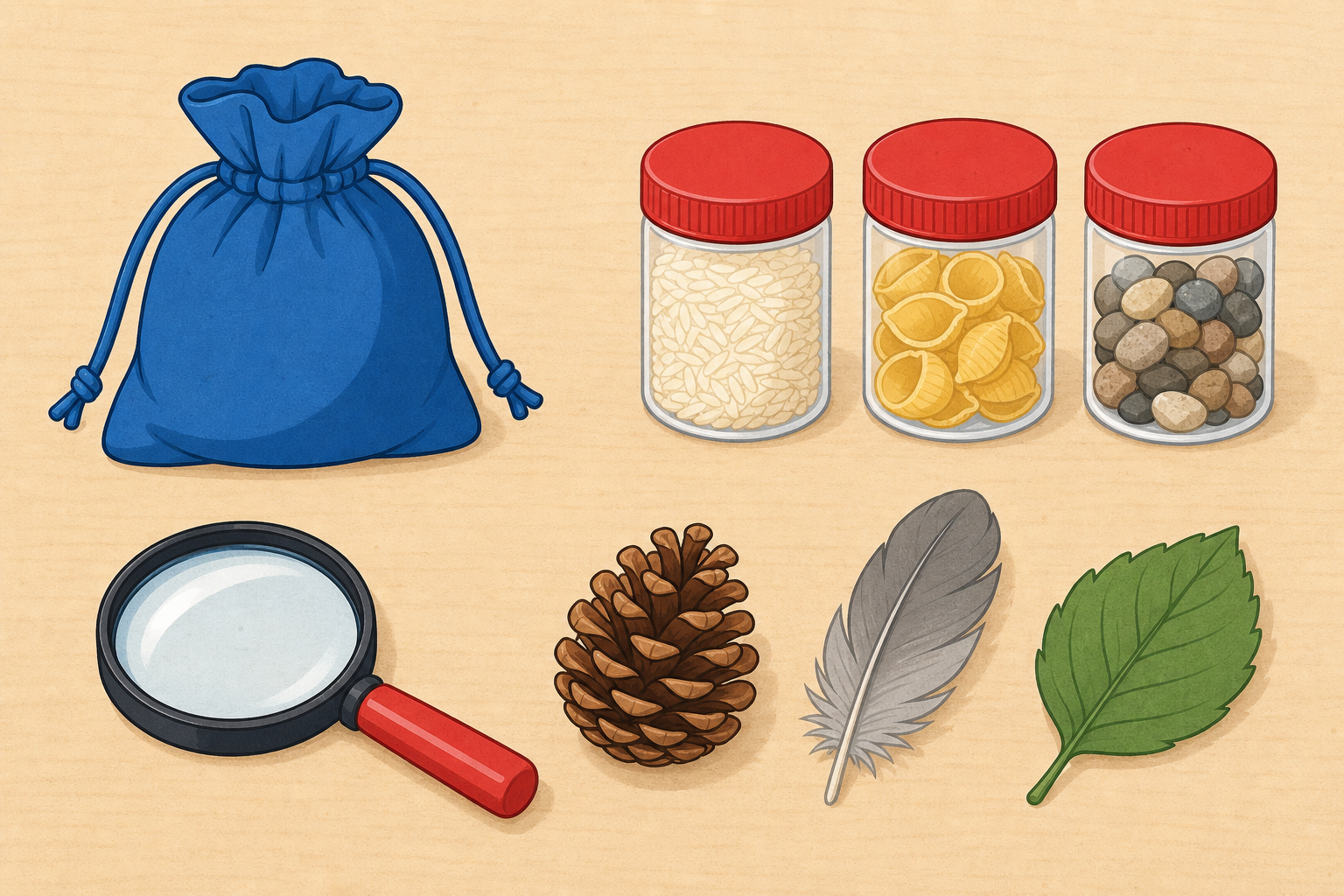
Station 1: Touch (feely-bags). Three cloth bags, each with one or two safe mystery objects (for example a smooth spoon, a soft sponge, a pine cone, a wooden block). Children take turns feeling without looking; parallel bags mean more children complete a turn. Turn cue: one bag per child who is feeling; watchers keep hands on knees until swap. Teacher chant: What do you notice? That is touch with your hands. What do you wonder?
Station 2: Hearing (shaker pots). Three sealed pots with different quiet fillings (rice, paperclips, cotton wool). Children shake gently near an ear. Same turn cue. Chant: I can hear… That is hearing with your ears. I wonder what is inside?
Station 3: Sight (magnifiers). A tray of leaves, bark pieces or fabric scraps and chunky magnifiers. Children look closely. Chant: What can you see now? That is sight with your eyes. I wonder…?
All children on the carpet. Smell routine that fits one class: do not pass a pot under every nose one by one. Hold each sealed pot, walk the carpet circle once, and pause for a small cluster of children to sniff together (or waft the pot gently so the row can smell). Three pots, quick pass of the circle, about two minutes total. Prompt: I can smell… That is smell with your nose. I wonder what it is?
Hands washed (or wiped then washed) before tasting. Teacher-prepared washed fruit pieces only (for example apple and banana), already cut before the lesson and kept covered; one piece per child. Children who cannot taste that fruit use a water sip and join the talk.
Taste wonder (do not ask which fruit it is if they can see it): either invite eyes closed for the first bite, or keep pieces visible and change the stem to what taste reveals. Prompt: I can taste… it is sweet / soft / juicy. That is taste with mouth and tongue. I wonder if the other fruit will taste the same? or I wonder why this one tastes sweet?
After tasting, quick handwash or wipe again before the next step. Fold this wash into the end of this block so tidy time is not the hygiene bottleneck.
Keep the full stem as your chant at every stop: I notice… I used my… I wonder… The board shows only I notice… I wonder… for children to echo. Children may offer only the notice and the wonder; you fold in sense and body part when you revoice. Guesses are never wrong. If a group rushes: Quiet hands and one careful notice first.
Differentiation: less confident children point to the body part while you name the sense; keep the diagram-labeller up on the IWB as a quiet reference if helpful. More confident children may try two senses on the same pot (shake, then feel the outside) and say a second wonder. No printed sense cards.
Come back to the carpet. Think of one station you liked.
Tell your partner what you noticed and your I wonder question.
Quick partner talk using a simple two-part frame only: notice + I wonder. Then take three or four shares on the carpet. When you revoice, fold in the sense and body part so the class hears the full pattern without every child having to perform all four parts from memory: You noticed a sweet smell. You used your nose. You wondered if it was orange. That is super sensing.
Look-fors:
If answers stay as single words, model the two-part frame again, then add sense and body part yourself.
Which station helped you ask a good I wonder question today?
A cook smells food to notice if it is ready. A doctor looks and listens, then wonders how to help. Our senses help us notice, then ask questions too.
Display-only, oral whole-class talk. Keep it warm and short.
Focus: a concrete choice tied to what they just did, not an abstract "how did senses help" unpack. Invite hands up for: which station, or which body part, helped you wonder?
Offer one short helper picture yourself in everyday words (do not turn it into a second hard prompt): A cook smells the food and wonders if it is ready. A doctor looks and listens, then wonders how to help. Other helpers (farmer, vet) can be accepted if children offer them; you do not need to introduce limp, warm ear or clinical detail.
Misconception: if children say heavy or big things are always easier to notice, gently return to careful noticing: a quiet shaker still gives a clue if we listen well.
End by celebrating one careful wonder from the class.
You're previewing this lesson. Get full access to this lesson and hundreds more — each one ready to teach, with interactive activities, printable resources and pupil progress tracking built in.