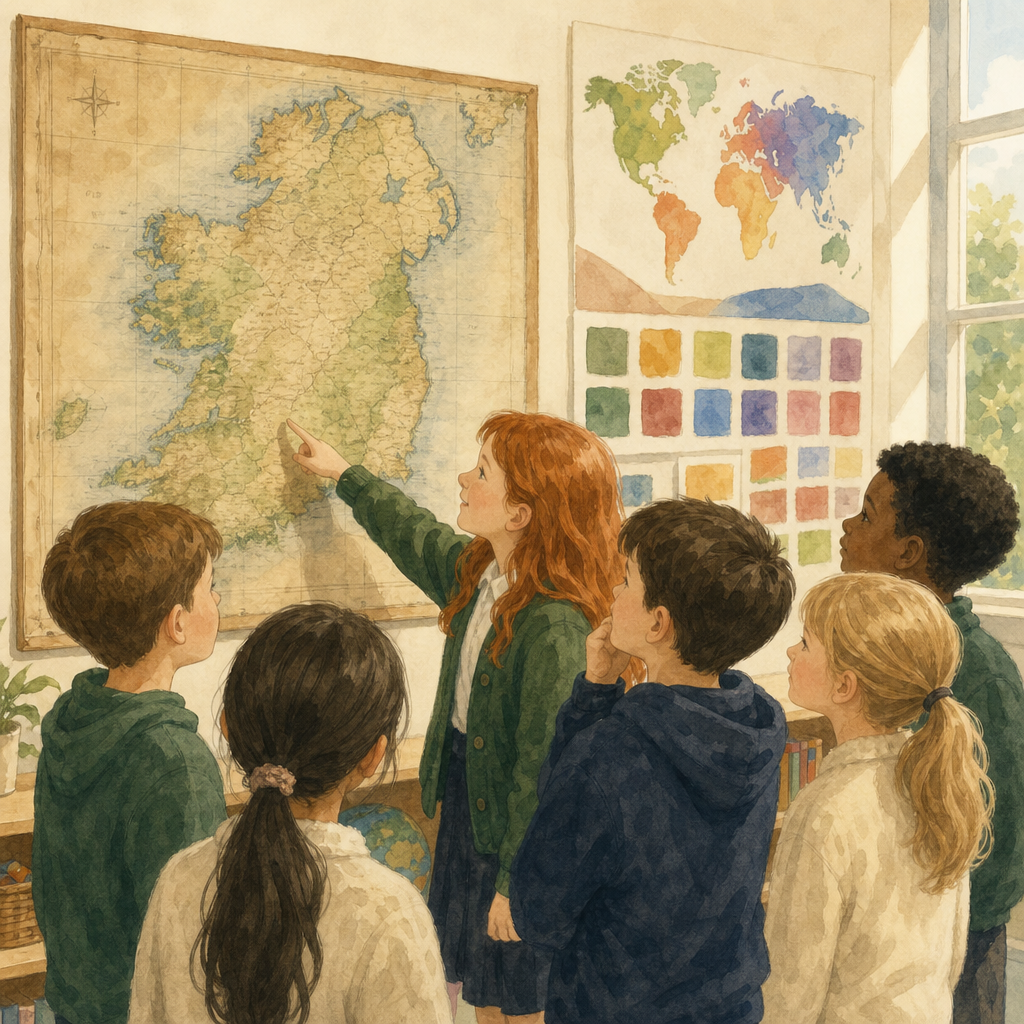
 Around 1800, Irish was still spoken at home by a very large number of people across much of this island, especially in the west and south. Within one lifetime, it had declined sharply in many places.
That is a huge change in a short time. What could make a language slip away that fast?
By the end of this lesson, you will:
- Spot Irish hiding in place names
- Hear that people still speak Irish today
- Think what you would want saved from a language
We will open places on the map together. When it is your turn you may tap; everyone else watch for the Irish bit inside the name and be ready to say what you noticed.
Even where daily Irish speaking faded, the names on the map often stayed. Notice what the land still remembers.
Now listen. Some clips have millions of speakers. Some have far fewer. You cannot tell by the sound alone.
After each clip, show a thumbs-up when you think you know the language, or point to a flag or language name on the board. Then we reveal together.
Irish is still spoken every day in Gaeltacht areas and by families and schools across the island. You may hear it as a living voice, not only a name on a map.
Open your copy. Write one thing you would want kept from a language you know: English, Irish, or another language at home.
It might be a song, a joke, a prayer, a family saying, or the sound of a voice you love. Write it in your own words. There is no single right answer.
If it helps, start your sentence like this: I would want to keep…
💬 Discussion time
Around two hundred years ago, Irish was still spoken at home by a very large number of people across much of this island. The names on the map often survived when everyday speaking faded in many places.
We will take one question at a time:
- When people stop speaking a language at home, what disappears first: songs, jokes, or everyday chat?
- Names on signs versus people still talking: which is keeping, and which is remembering?
- Looking at your copy, what would you most want still said out loud?
Unlock the full learning experience
You're previewing this lesson. Get full access to this lesson and hundreds more — each one ready to teach, with interactive activities, printable resources and pupil progress tracking built in.
This lesson is copyright of Coding Ireland 2017 - 2026. Unauthorised use, copying or distribution is not allowed.