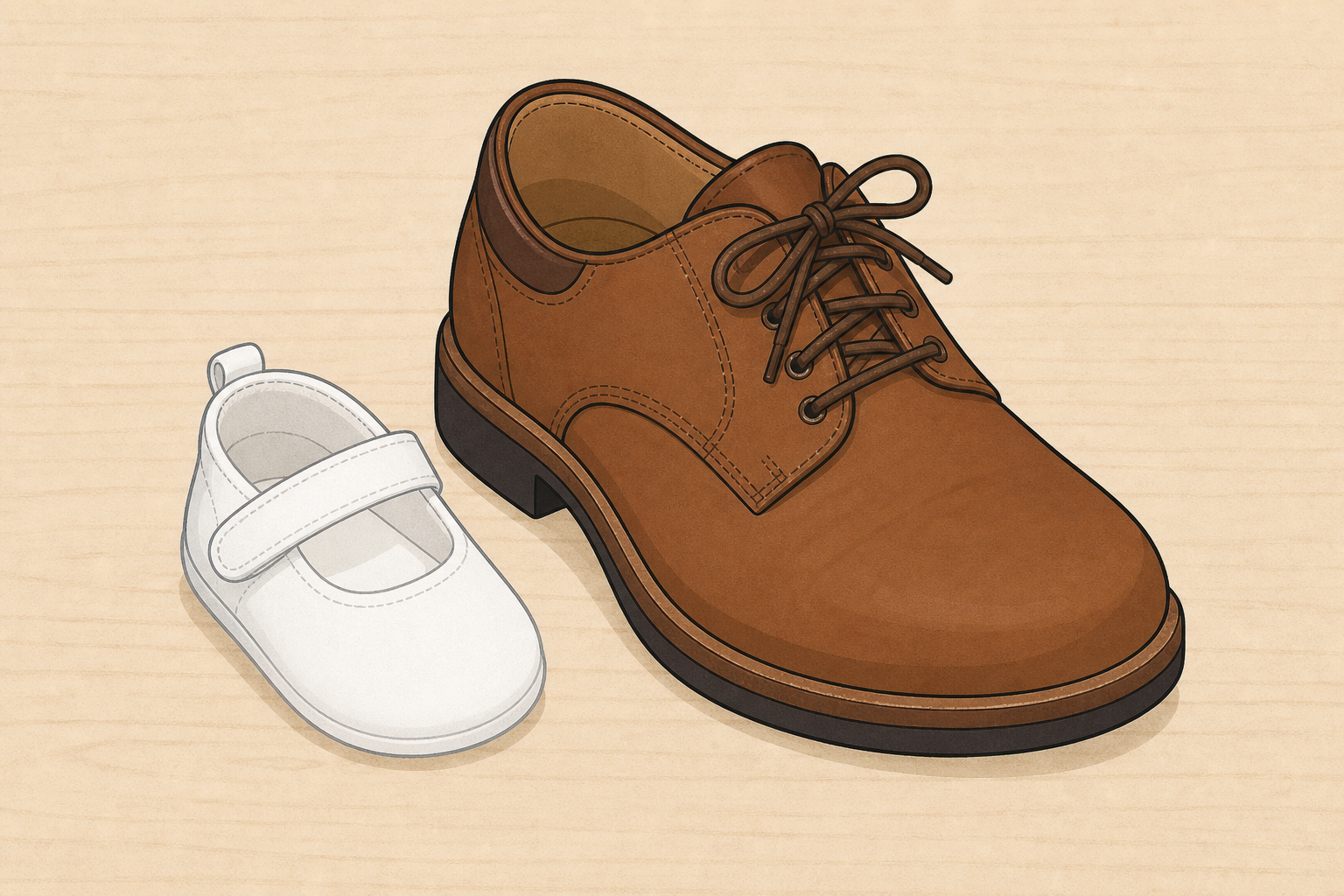
Look at this tiny baby shoe beside a big grown-up shoe. Who wore the little one? Who wears the big one now?
Today we put a life story in order.
Hold up a baby shoe (or a photo of a baby shoe) next to an adult shoe. Keep the hook light: one surprise pair and one question. Do not hand out the people cards yet.
Ask: Were you ever as small as that little shoe? Invite two or three quick answers. Guesses and memories are all welcome.
Before the lesson: print the provided picture card sets (people cards and action cards), one set per pair or small group. Print the spare age-stage picture pack as the default set for looking at how people change. Family photos from home are a welcome extra only, not required. Have the baby shoe and adult shoe ready.
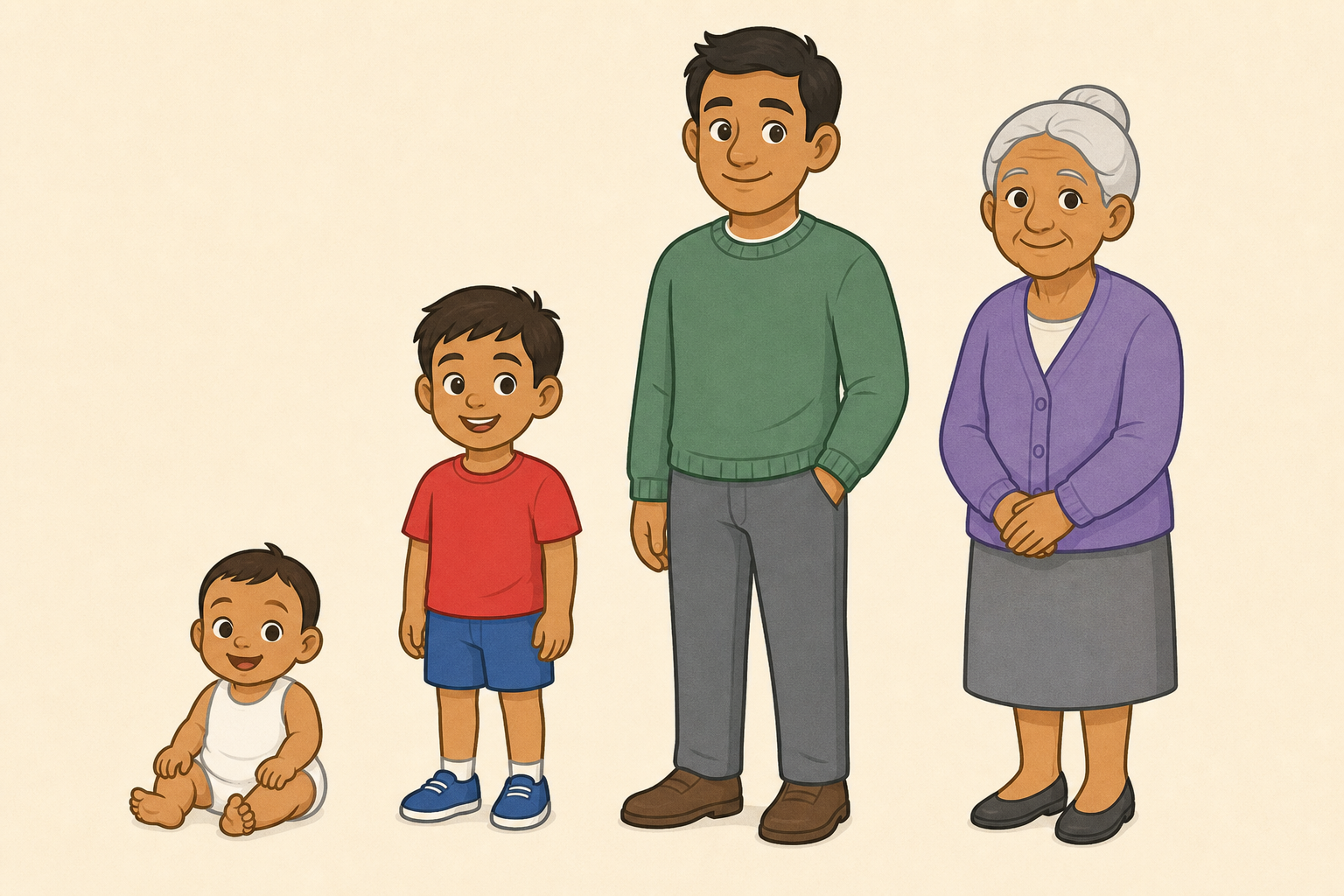
People grow and change. We say four words: baby, child, grown-up, older person.
Say the words with me, from the start of life to later on.
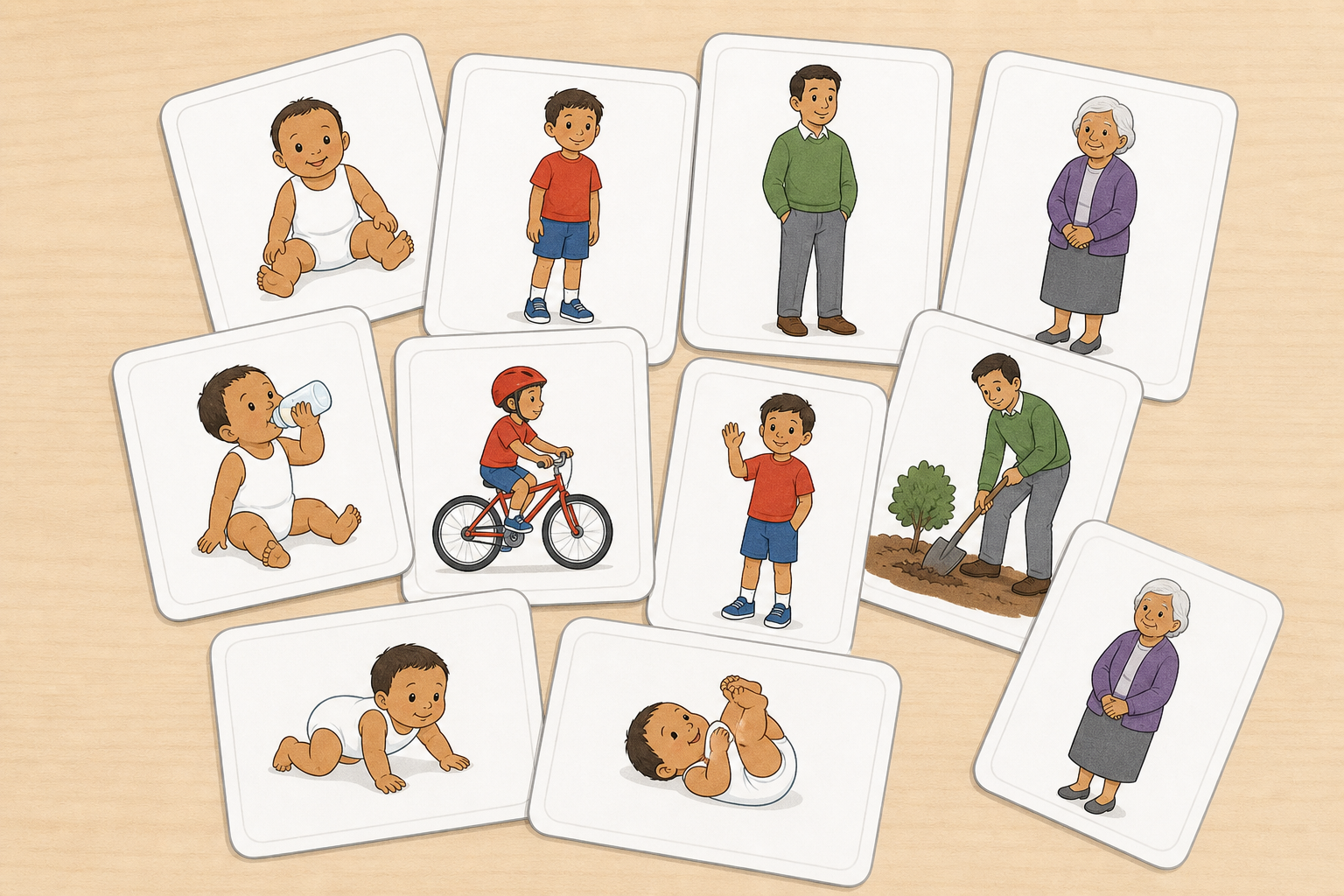
Show the four people picture cards one at a time, face up, then place them in a row (not yet treated as the final order). Name each one with a single short line and have the class echo. Do not put long definitions on the board.
Spoken lines (one card at a time):
Then chant the four names left to right with the class. Keep the board short; the full idea lives in the table below.
| Concept | Why it matters | Example |
|---|---|---|
| Life story — the way a person grows and changes from a baby to an older person | It helps us notice that people keep changing as the years go by, just as we have already changed | You once fitted in a baby buggy; now you walk into school on your own two feet |
| Baby — a very young person who is just starting life and needs lots of care | Babies need adults to feed them, hold them and keep them safe | A baby drinks milk and sleeps in a cot |
| Child — a young person who is growing, learning and playing | This is the stage you are in now, full of new skills every week | A child runs in the yard, draws and comes to school |
| Grown-up — an adult who can work and look after others | Grown-ups do many jobs that help families and the community | A grown-up may cook dinner, go to work or drive the car |
| Older person — an older person, often a grandparent, who has lived a long life (you may also hear the word elderly) | Older people share stories and care, and they still need kindness and help sometimes | A grandparent may tell a bedtime story or help mind the children |
Modelled cycle (say it aloud while you order one set):
Plant the helper idea once (with a simple nurse or helper picture if you have one): A nurse cares for people at every stage of life — babies, children, grown-ups and older people. One short sentence only; do not open a new topic.
Misconception to head off: some children may say a grown-up comes before a child, or mix older person with grown-up. Gently hold the four cards and retell the story slowly. Keep the talk warm and factual; do not frame ageing as scary or sad.
First, put the four people cards in a line: baby, child, grown-up, older person.
When I say go, put one action card under each person.
Give each pair (or three) one set of the provided people cards and one set of the provided action cards. Children may not read the words yet: you name each card aloud as you hand them out, and pairs work from the pictures plus your naming.
Keep the because sentence as your oral prompt while you circulate (I put this here because…), not as a board demand.
People cards
Card A — Baby: A tiny person just starting life. Needs lots of care.
Card B — Child: A young person like you. Growing, learning and playing.
Card C — Grown-up: An adult who can work and look after a family.
Card D — Older person: An older person, like a grandparent. Has lived a long life.
Action cards (these are the eight items on screen / in the set together with the people cards)
Card 1 — Drinks milk and needs to be held. (matches Baby)
Card 2 — Runs, plays and goes to school. (matches Child)
Card 3 — Goes to work and looks after a family. (matches Grown-up)
Card 4 — Tells stories and helps mind the children. (matches Older person)
Circulate and ask: Which card comes first? How do you know? What can this person do that the baby cannot? If a pair is stuck, retell one modelled line: baby first, then child, then grown-up, then older person.
Answer key (for you only): order = Baby → Child → Grown-up → Older person. Matches as above.
Optional alternate actions (accept if a pair can say why): grown-up might also be “reads a story”, “rides a bike”, or “cares for a pet”; older person might also be “cooks a favourite food”, “goes for a walk”, or “works in the garden”. Keep the four core matches as the main task.
Differentiation: some pairs only order the four people cards; ready pairs also match all four action cards and say a reason for each.
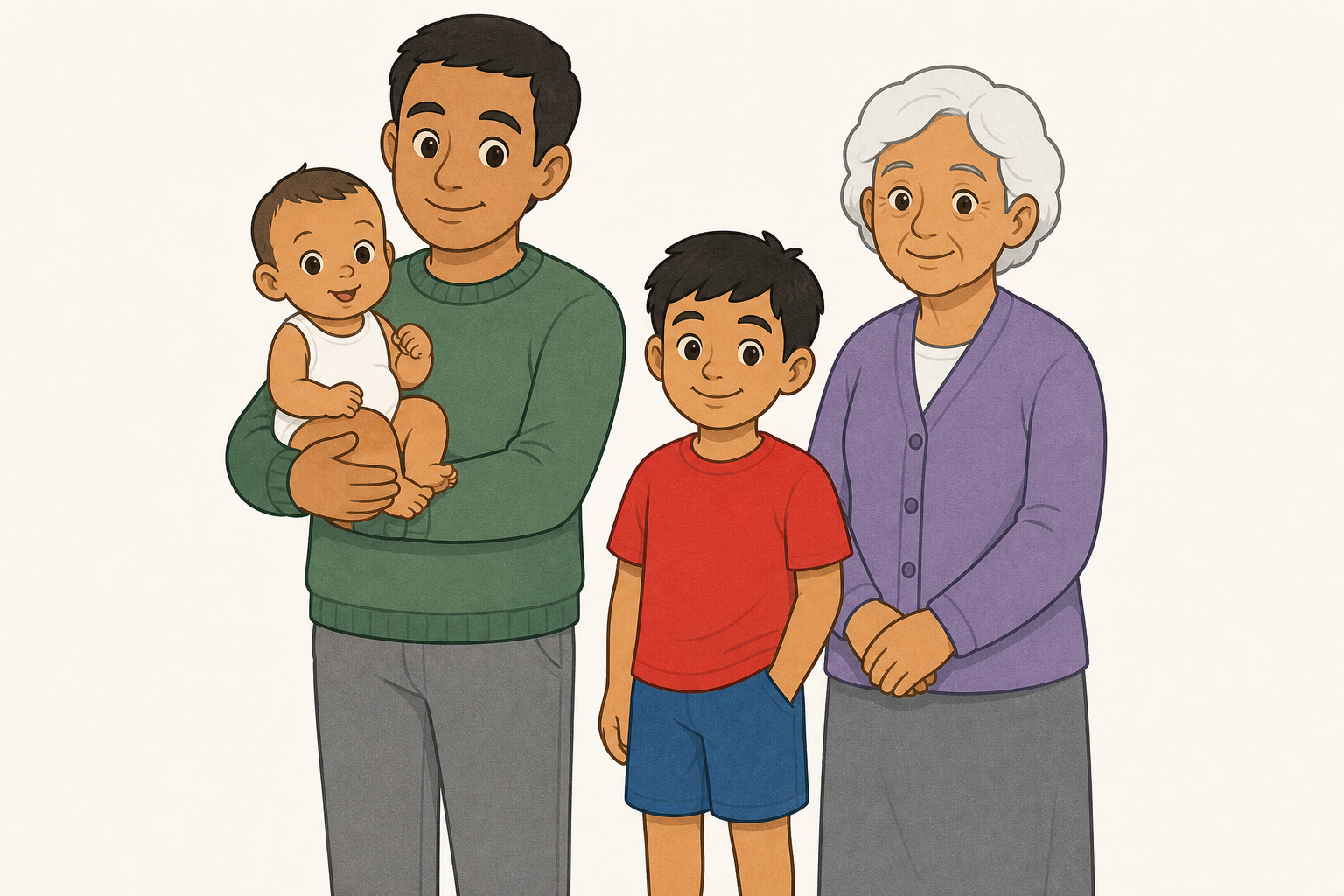
Look at a picture of people growing up. Who is the baby? Who is older?
Tell your partner one thing you notice.
Before any pictures appear, say to the whole class: Some of us have a photo from home, and some of us will use our class pictures. Both help us see how people grow.
Default materials are the spare age-stage picture cards (baby, child, grown-up, grandparent). Optional family photos children brought in are a welcome extra; handle them gently and kindly. Nobody needs a home photo to join in.
This step is talk only. Children do not draw or mark a diagram here. They look and tell a partner what they notice.
Prompts to ask as you move around:
Keep talk concrete: teeth, height, walking, talking, starting school. Celebrate change; do not dwell on loss or illness. If a child shares a sad family story, acknowledge kindly and steer back to the science of growing: people grow and change, and many people care for us along the way.
Look-fors: child points to baby vs older person; names one change (taller, can walk, can talk, goes to school).
On your Investigation Journal page, draw yourself growing up.
Draw you as a baby. Draw you as a child now. If you can, add you as a grown-up and as an older person.
Children draw on the paper Investigation Journal page. Tell them what to draw, not how the page is laid out: pictures of themselves in growing-up order.
Model in two layers on the board:
Quick stick figures are enough. Emergent labels are welcome (B for baby, or the full word if ready). Do not require writing.
Success look-fors (Stage 1): at least baby and child now attempted, with one clear difference (size, buggy vs standing). Grown-up and older person drawings are a welcome extension, not required for success.
Early finishers may add one thing each person can do beside a drawing, or draw one helper (nurse, parent, grandparent).
You're previewing this lesson. Get full access to this lesson and hundreds more — each one ready to teach, with interactive activities, printable resources and pupil progress tracking built in.