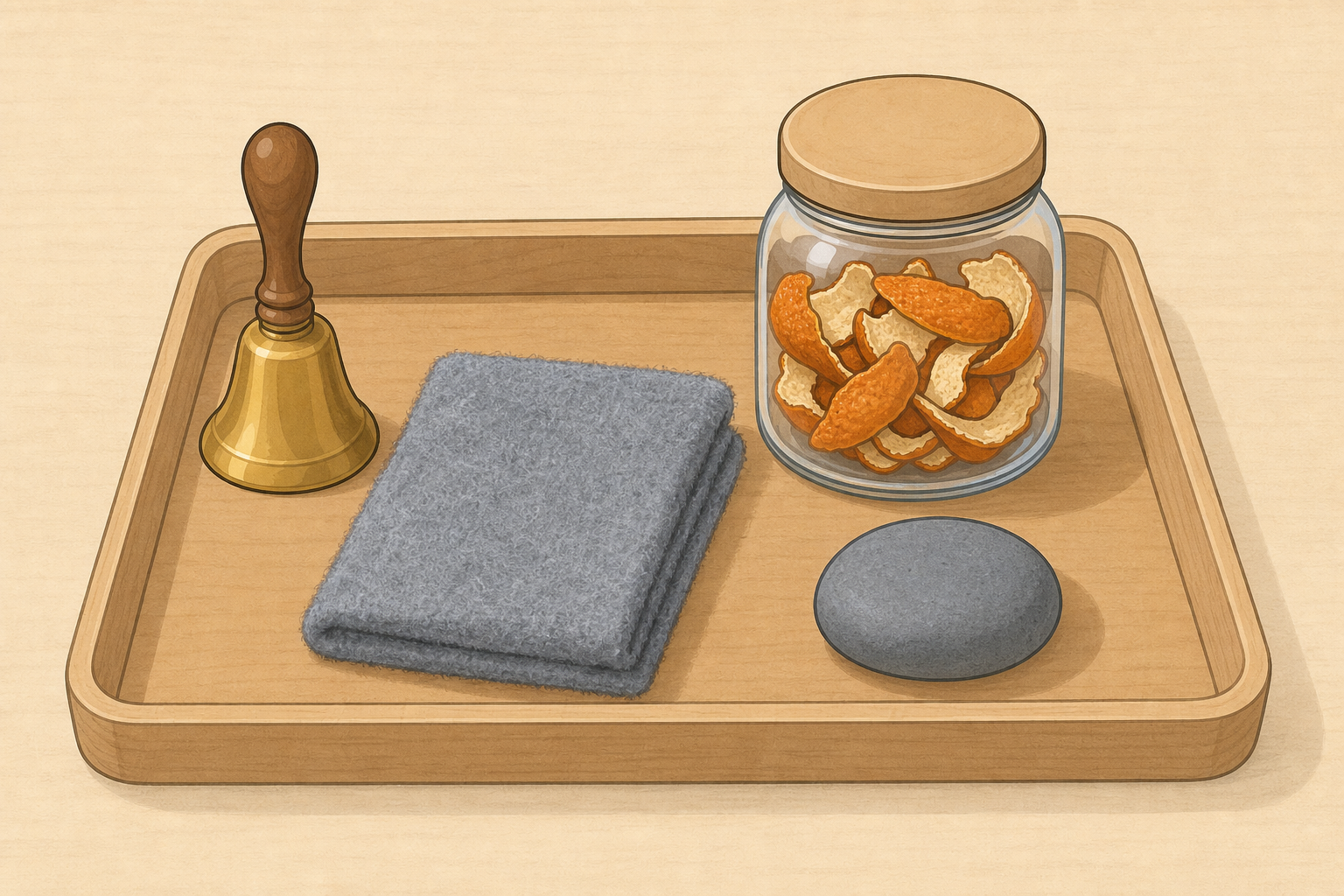
Close your eyes for a moment. What can you still notice?
Today we find out how our bodies help us explore the world, using five special senses.
Keep this beat light and curious. Invite the class to close their eyes for a few seconds, then open them. Ask: What could you still hear? What could you still feel? Do not name all five senses yet; let wonder lead.
Before the lesson: check the class allergy list and send a short note home if needed for the fruit taste. Set up three core carousel stations around the room, with the other two ready as stretch if time allows (see the carousel step). Print the Investigation Journal page. Open the diagram-labeller interactive on the IWB ready for later. Prepare three feely bags (or trays) so each carousel group has its own touch set.
STEM eyes: link to noticing in the classroom: Which sense do we use most when we look around this room?
Our body has special ways to find out about the world. We call these our senses.
Our eyes help us see: that sense is called sight. Our ears help us hear: that sense is called hearing.
Which sense would you use to find out if a ball is soft or hard?
We will meet three more senses next: smell, taste and touch.
Teach the five senses one at a time before the carousel. Keep the board short: show only the lead-in, the soft/hard ball question, and the tiny cue that three more senses are coming. Reveal each sense–body pair aloud while children point on their own bodies, rather than posting a full glossary wall.
Reveal order (point and say together):
Use the table below as your reference only; do not project the whole table.
| Concept | Why it matters | Example |
|---|---|---|
| Sense — a way our body finds out about the world around us | We use our senses every minute at school, at home and outdoors to stay safe and learn | Hearing the bell tells you it is time to line up |
| The five senses — sight, hearing, smell, taste and touch | Naming each sense helps us say clearly what we noticed in science | Sight sees colour; touch feels if something is rough or smooth |
| Sense and body part — each sense works with a body part (eyes, ears, nose, tongue, hands and skin) | Matching sense to body part shows we know how our body works | Eyes for sight, ears for hearing, nose for smell, tongue for taste, hands and skin for touch |
Worked example (model aloud with one object before the carousel): Hold up a pine cone or conker from the feely-bag tray. Think aloud: I wonder what this feels like without looking. I predict it will feel bumpy. I test by touching it with my eyes closed. I observed it feels rough and pointy. I think my sense of touch told me that — my hands found out, not my eyes. Hit all four beats so pupils hear a full notice cycle before they rotate.
Misconception to head off: some children think we only have one sense at a time. Gently show that we often use more than one together (we see and hear a bird).
Ask: Which sense would you use to know if soup was too hot before you tasted it? (sight of steam, smell, and careful touch of the bowl — not a wild first taste).
Look at the child on the board. We will match each sense to the body part that uses it.
Five labels: sight, hearing, smell, taste, touch. Call out where each one goes.
Drive the diagram-labeller on the IWB in explore mode. Pupils do not need devices. Invite volunteers to drag, or drag yourself from class calls.
What appears on screen: a child-body diagram and five sense labels — sight, hearing, smell, taste, touch. As each label lands, name the body part clearly: sight → eyes, hearing → ears, smell → nose, taste → tongue (inside the mouth), touch → hands and skin.
Say aloud for taste: Taste uses the tongue inside the mouth. That keeps the precise body part clear even though the label is the sense word.
Key questions: Which sense do we use to hear a bell? Which sense smells lunch? Which sense feels if a pebble is smooth?
Differentiation: less confident pupils point on their own body while a partner names the sense. Confident pupils can give a second example from the classroom for each sense.
We will visit sense stations around the room. The card at each station tells you which sense to use.
Try that sense, then say what you found out. Ask yourself: which sense am I using, and what did I notice?
Set up stations around the room with clear space between them. Place a simple name card at each (Touch, Hearing, Smell, Sight, Taste). Default plan for 1st Class: run three core stations (Touch, Sight, and either Smell or Taste after the allergy check). Keep Hearing and the spare station ready as stretch if groups finish early. Split the class into three small groups. Treat the 15 minutes as: brief teacher model, two solid rotations (about 3–4 minutes each), then whole-class handwash and reset. The third station is a bonus only if time appears — do not force a full three-stop circuit. Use a gentle chime or clap to signal move-on.
Hearing tip: if you include Hearing, place sound jars in a quieter corner away from chatter, or run a brief whole-class sound moment at the front so jar comparisons are not lost in room noise.
Briefly model one station action at the front (for example one feel in the feely bag with eyes closed, then name the sense and one finding). Point to the station card and say: The card tells you the sense. Try it. Then say what you found out. Then send groups off so every pupil knows the first move.
Stand where you can see all stations. At Taste, supervise closely. Remind: We use gentle hands. We do not taste anything except our own fruit cup. Smell pots are for sniffing only.
Key questions while circulating (anchor two findings per child): Which sense are you using? What did it tell you? Which body part did the work? Could another sense help too? Leave each child with at least two named sense-and-finding pairs they can reuse on the journal page.
What good looks like: a child names the sense, points to the body part, and says one clear finding (for example Touch — it felt bumpy).
If a station runs out of interest: invite a second object description, or ask them to compare two jars or two smells.
End-of-step reset (build into the 15 minutes): stop stations, wipe any fruit juice spills, pupils wash hands (especially after touch and taste). Then run a light whole-class oral harvest before journals: invite two or three children to name a sense and one finding so the whole class hears reusable language. Sit ready for the journal page.
On your Investigation Journal page, choose at least two stations you visited.
Draw or write the sense you used and one thing you found out. Pictures count — you do not need full sentences.
This is the paper recording beat, straight after handwash and the short whole-class oral harvest while findings are still fresh. Hand out the Investigation Journal page only after two or three volunteers have named a sense and one finding aloud, so every pupil has language to reuse even if circulation missed them.
Pupils draw or write simply: the sense, and what it found (for example Hearing — the rice jar was loud and rattly). Pictures and labels fully count.
Do not describe invented boxes or column names on the page. Say only what to record: which sense, and what they noticed.
Support: sentence starters said aloud — I used my sense of… I found out… Scribes or drawing are fine for emerging writers. Point back to the class harvest examples and any pairs you heard while circulating so nobody has to invent from a blank memory.
Challenge: add a third sense, or note when two senses worked together.
Circulate and listen for sense names matched to body parts. That is the learning check for this step.
You're previewing this lesson. Get full access to this lesson and hundreds more — each one ready to teach, with interactive activities, printable resources and pupil progress tracking built in.