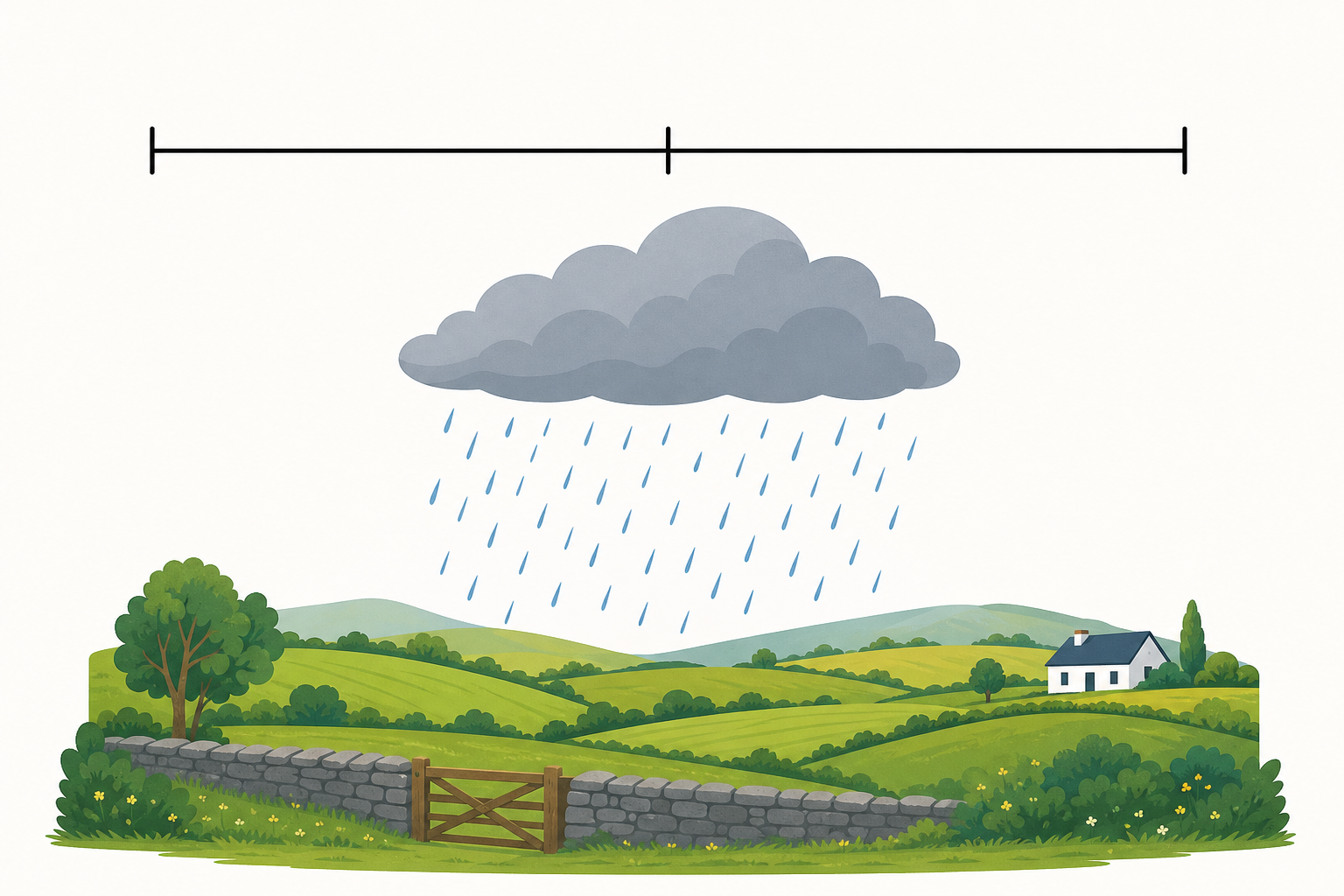
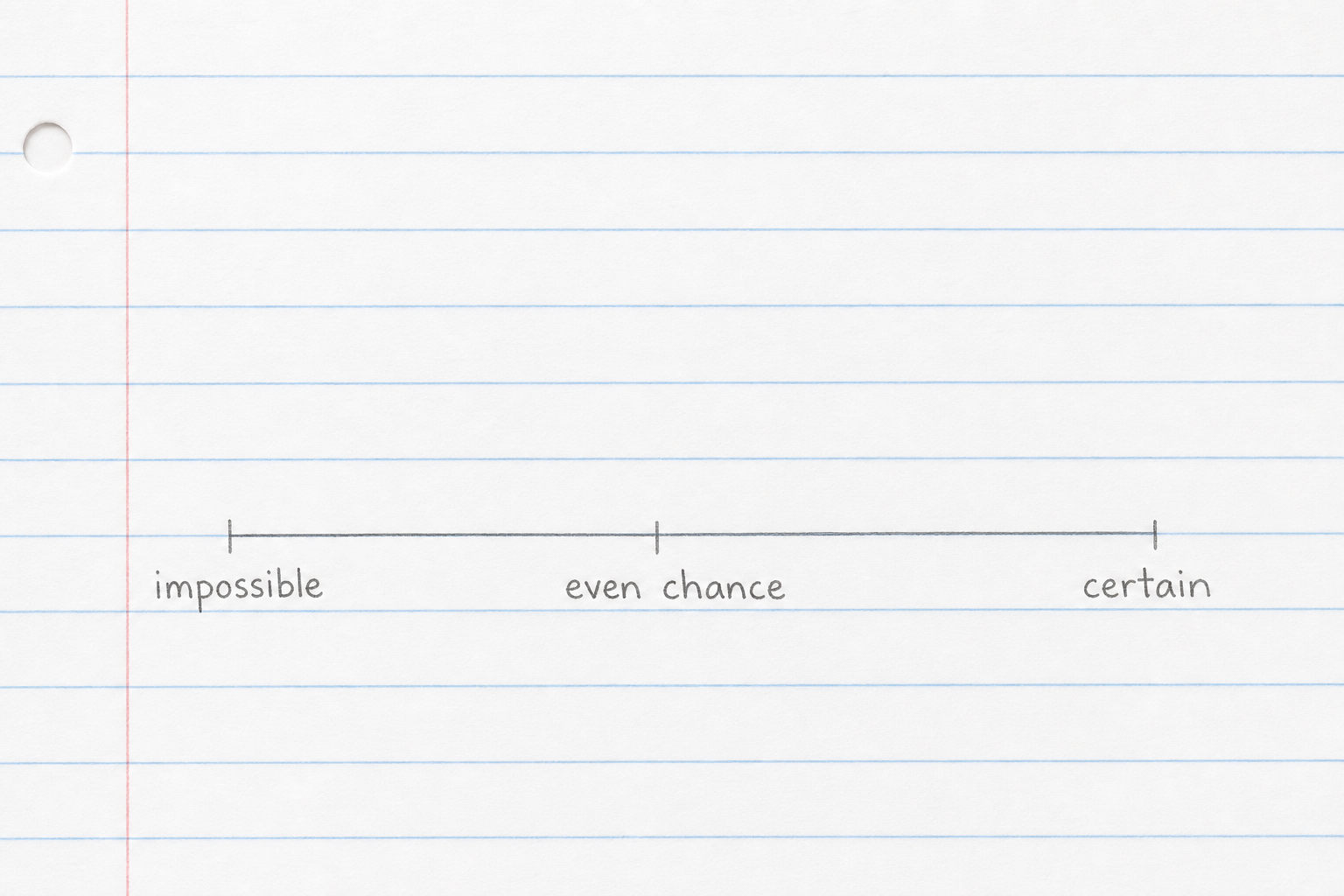
Here is a line. One end says impossible, the other end says certain, and the middle says even chance.
Think about this: "It will rain in Galway this week." Where on this line would you put it? Right at the end, near the middle, or somewhere in between?
Pose the question and take two or three hands-up answers, not open call-outs. There is no single right answer here yet — this hook is to get pupils pointing at spots on the line and starting to say why.
Listen for reasoning, not just a position — a pupil who says "near certain because it rains a lot here in winter" is doing the thinking the whole lesson builds on.
Watch four everyday events already placed on the likelihood line. Look at where each one sits and think about why it landed there.
One event sits at each end, one lands on the middle even-chance mark, and one lands in between. Watch how far from the middle each one goes, and think about why.
The cards show already placed. Point at each in turn, but do not read a script, and take two hands-up answers on why each one sits where it does before agreeing.
The coin on the middle is the reference mark for the rest of the lesson: everything else is judged against it. Ask "is this more likely or less likely than the coin?" before agreeing on any borderline event.
Today we place these events on the line together, one at a time:
Our judge stays on the middle: a coin landing heads is an even chance. Before each card goes down, we ask, is this event more likely or less likely than a coin landing heads?
Talk this one through together — pupils take turns at the board and the class agrees or corrects out loud.
Run the four cards in the order listed so the round builds: the school-day card is likely on most days (a genuine talking point); the toast is near even chance (a nice close call); the summer holidays sit at certain; and the roll-a-six card is clearly unlikely but not impossible.
In your maths copy, draw a likelihood line right across the page. Label the left end impossible, the middle even chance, and the right end certain.
Then mark these four events as points along your line:
Walk the room glancing at where each point lands and at the three labels — this is whole-class copybook practice, not marking. Look especially at the coin (should sit on the middle) and the bouncing ball (impossible end).
Now the harder work: some of these events are both likely, so we have to decide which one is more likely and which sits closer to certain.
Here are the four events to place:
For that last card, ask yourself: do we know how many red and how many green are in the jar? What would we need to know before we could place it?
This is the practice round — pupils take turns at the board, check each placement, and the class confirms before moving on. Keep the board work brisk rather than over-explaining.
You're previewing this lesson. Get full access to this lesson and hundreds more — each one ready to teach, with interactive activities, printable resources and pupil progress tracking built in.