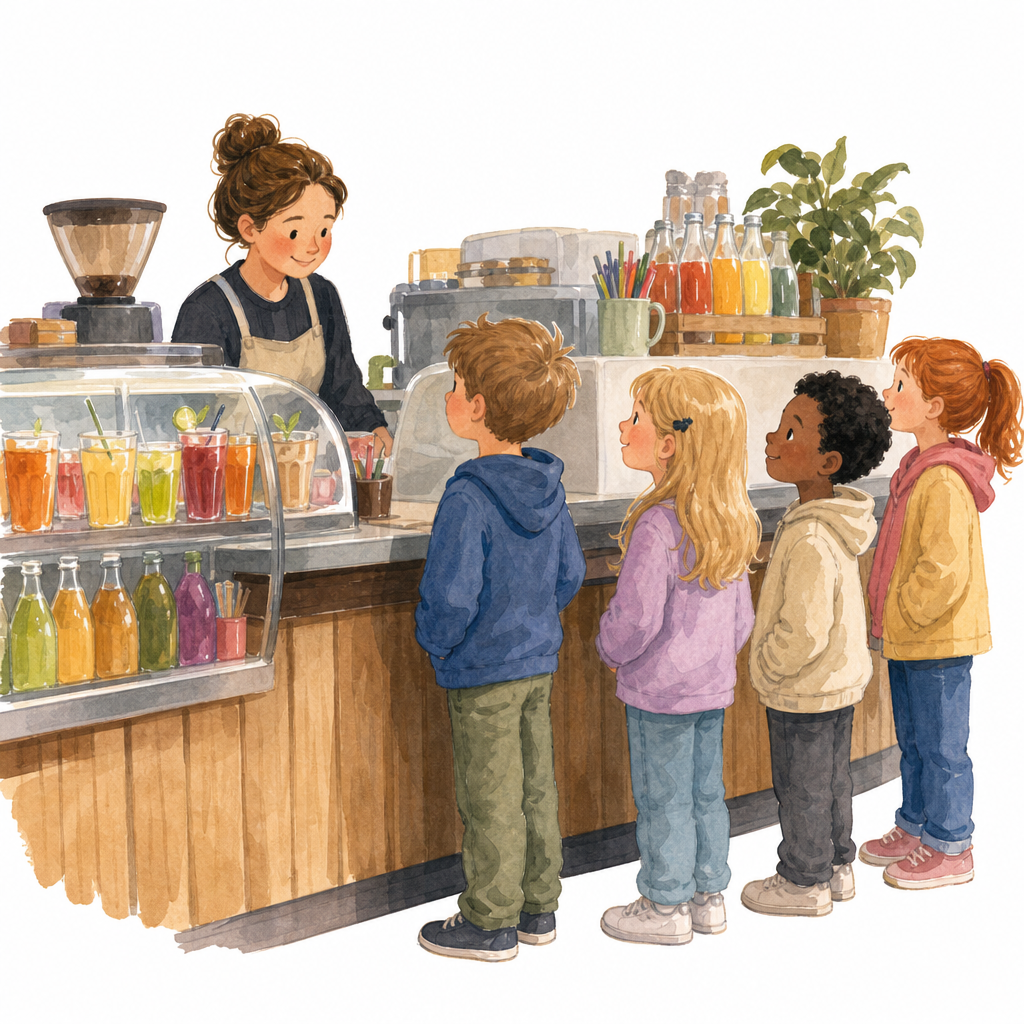
Imagine you walk up to the counter at a Bahnhofscafé in Munich after school. What two drinks would you order in English?
By the end of today you will be able to name eight drinks in German and ask for one out loud with a polite bitte.
Collect four or five English drink answers quickly so the class is thinking about ordering at a German café counter, not listing every soft drink they know. Do not teach any German yet; the flashcards in the next step introduce the eight words. Mention that German nouns always start with a capital letter, which pupils will see on every card. A quick spark: “In Munich the station café is busy after school — today you will order like a local.” Treat bitte today as a first friendly exposure inside the order frame only; the full polite-word set (Bitte, Danke and friends) is taught properly in the next lesson.
Here are today's eight drinks. Look at the picture and the English first. Listen to the German, then say it with the class. Listen for the article every time, and notice that every German noun starts with a capital letter.
Run this on the IWB with the whole class. First pass for each card: show the image and English, play the audio, then have the class repeat twice with the full article (once all together, once by table). Do not ask pupils to guess the German before they have heard it. On a quick second pass you may hide the German and invite volunteers to recall. Insist on the full phrase with the article: das Wasser (dahs VAH-ser), not bare Wasser. Point out the capital letter on each noun. A quick guide for you: das Wasser dahs VAH-ser, die Milch dee MILH (soft ch at the end, not English “sh”), der Saft dair ZAHFT, der Apfelsaft dair AP-fel-zahft, der Orangensaft dair oh-RAHN-zhen-zahft, der Tee dair TAY, der Kaffee dair KAH-fay (stress on the first syllable), die Limonade dee lee-moh-NAH-duh. Aside worth a smile: Limonade in German is usually fizzy lemon soda (more like Sprite), not homemade still lemonade. Cheer the first full-article chorus — “Super, das war das Wasser mit Artikel!”
Tick each drink on your bingo card as you hear it. First full line calls out!
How to Play Bingo:
Option 1: Students on Devices (Digital Version)
Option 2: Print Out the Bingo Cards
Open your copy and write the eight drinks with their articles, then circle the two you would order at the café.
Pause the board and keep the flashcards or a simple list of the eight drinks visible while they write. Everyone's pen should be moving for these three minutes. Check that articles are going in front of every word and that nouns are capitalised: a list of bare nouns will not carry the gender pairing. Do not collect the copies.
You are at the café counter. First we all practise the order phrase together. Then the wheel lands on a drink and that pupil asks for it aloud. Use the same frame every time:
Our order phrase (same for every drink):
Ein …, bitte. (A …, please.)
Word bank — read the line that matches the wheel:
Listen for a clear drink name and a polite bitte at the end.
Pretend you are the barista at the Bahnhofscafé counter — pupils look at you and order as if they are next in the queue. Keep one simple scaffold for every drink today: Ein + drink noun + bitte. Do not teach einen or eine in this lesson; the fixed frame lets every pupil succeed without choosing case endings. Bitte here is a first friendly exposure inside the order frame; the next lesson teaches the full polite-word set properly.
Before anyone spins (about 3 minutes): leave the word bank visible on the board. Model three orders with class echo twice each: Ein Wasser, bitte (ine VAH-ser BIT-tuh), Ein Saft, bitte (ine ZAHFT BIT-tuh), Ein Milch, bitte (ine MILH BIT-tuh). Then swap in two more from the bank (e.g. Ein Apfelsaft, bitte ine AP-fel-zahft BIT-tuh; Ein Tee, bitte ine TAY BIT-tuh) so the class has heard the frame with several drinks. Full pronunciation bank for you: Ein Wasser, bitte ine VAH-ser BIT-tuh; Ein Milch, bitte ine MILH BIT-tuh; Ein Saft, bitte ine ZAHFT BIT-tuh; Ein Apfelsaft, bitte ine AP-fel-zahft BIT-tuh; Ein Orangensaft, bitte ine oh-RAHN-zhen-zahft BIT-tuh; Ein Tee, bitte ine TAY BIT-tuh; Ein Kaffee, bitte ine KAH-fay BIT-tuh; Ein Limonade, bitte ine lee-moh-NAH-duh BIT-tuh.
Then spin: name a volunteer, they read-and-say the matching line from the word bank (not invent the ending), class echoes once, then spin again. Bias turns toward child-plausible orders (Wasser, Milch, Saft, Apfelsaft, Orangensaft, Tee, Limonade). If the wheel hits Kaffee, laugh and re-spin, or let them order it “for a grown-up at the table.” Aim for at least six different drinks ordered aloud. After each order, the class gives a quick “Prost!” or thumbs-up before the next spin.
You're previewing this lesson. Get full access to this lesson and hundreds more — each one ready to teach, with interactive activities, printable resources and pupil progress tracking built in.