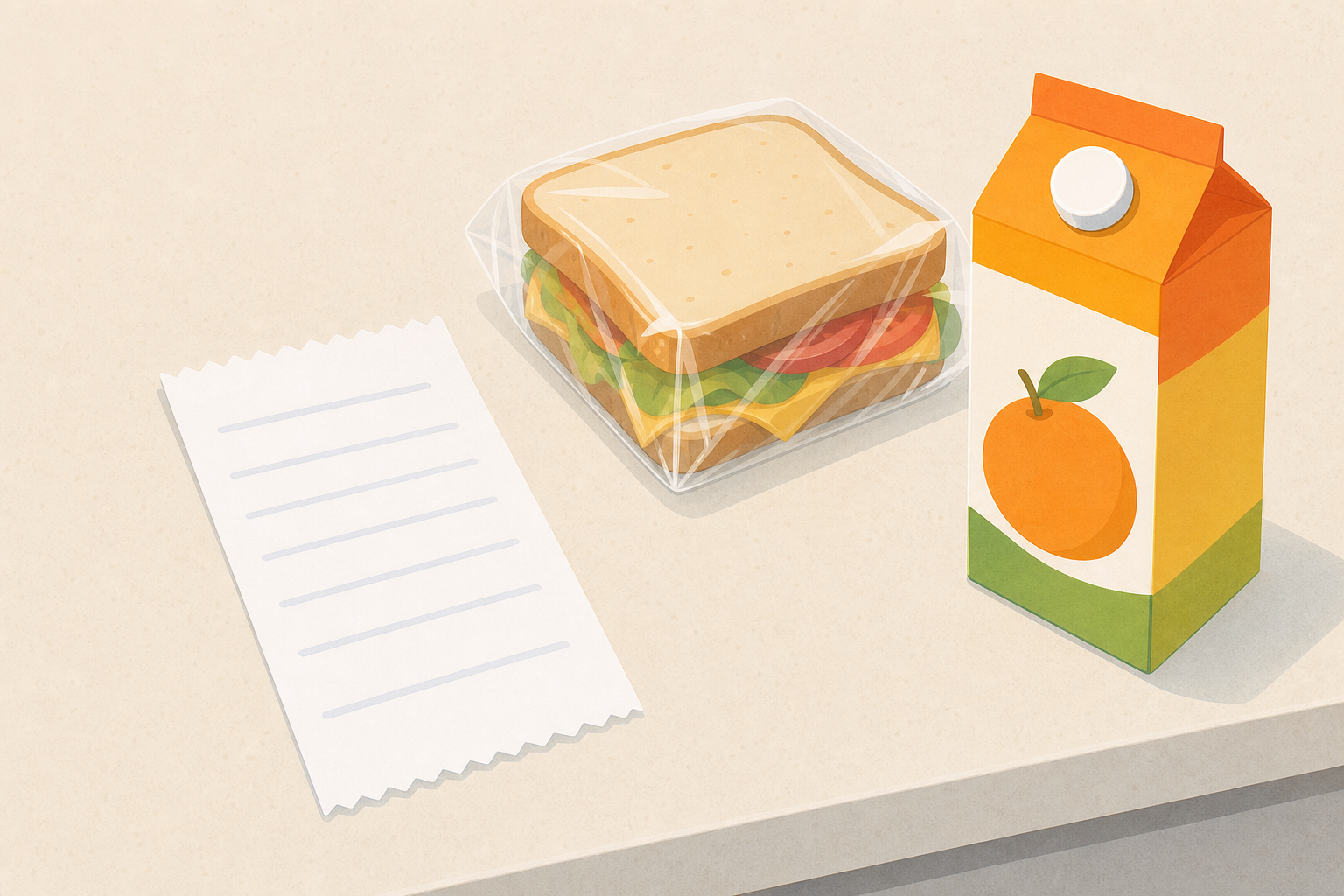
Here is the receipt. The total is €12.50. Look at the price printed for the juice: €7.5. Is that written correctly for money? What is missing?
Take two or three hands-up answers. Listen for a pupil naming the missing zero. Do not confirm the rule yet — hold it for Watch and Notice. If nobody spots it, ask "how many figures do we always write after the point when it is money?"
Watch three money ideas build in the coin tray, one at a time.
A zero that holds a place. In €7.50, the zero in the one-cent column keeps the 5 in the ten-cent place. Read it aloud.
Adding money. Here are the two amounts we will add: €12.50 and €8.75.
Now the total, €21.25. Watch what happens when a cent column goes past nine and we carry into the next column.
Sharing money. We split €27.60 equally among three, sharing the euros first, then the cent, to reach €9.20 each.
Open on €7.50 to settle the receipt from Getting Started. Point to the empty one-cent column: the zero is holding the place, not decoration. Say "seven euro, fifty cent — the zero tells us there are no one-cent coins." Keep this a quick read.
Now read €12.50 and €8.75 aloud with the class at a glance — these are the two amounts the sum tray will combine. Do not linger; they run straight into the sum.
On the sum, hold out for the regroup: "fifty and seventy-five make a hundred and twenty-five cent — that is more than a euro." Let the class say where the carried euro goes before you confirm.
On the share, this is the division model the Class Challenge needs. Say "twenty-seven euro among three is nine euro each; sixty cent among three is twenty cent each — so nine euro twenty." The last tray shows one person's share.
Today we build and combine money on the tray, one task at a time. Say each cent column aloud before we check it.
Talk this one through together — pupils take turns at the board building on the tray, and the class agrees or corrects out loud. The tray builds each amount or lot; the totalling and counting-up happen on the board, not inside the tray.
€3.05 is the wrinkle-catcher: the zero sits in the ten-cent column, not the one-cent column. Ask a pupil to point to which column is empty before reading it.
On €3.25 × 4, build one lot on the tray first and ask the class how many cent in that one lot (25c). Then ask how many lots we need (4). Turn-and-name a pupil to say four lots of 25c, and revoice: four 25c make 100c, which is €1.00 carried; four €3 make €12, so €13.00 altogether. Building the total step by step keeps the whole class with the multiplication rather than only the pupil at the board.
On the change from €20.00, count up from €13.45 to €20.00 on the board rather than subtracting digit by digit if pupils get stuck.
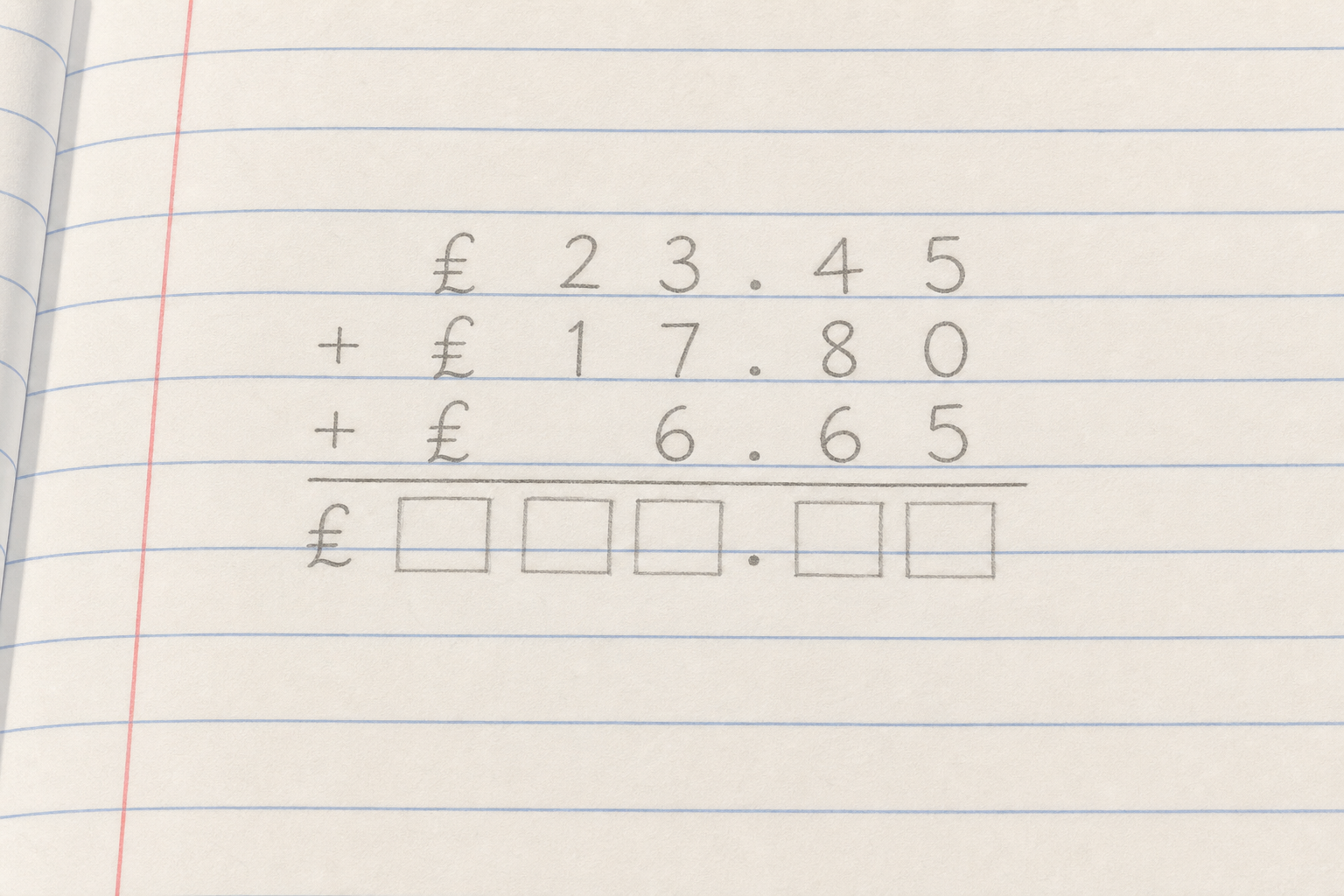
First we set two sums out together on the board so you can see how money is written in columns. Watch €12.50 + €8.75 with the decimal points one under the other, then worked down each column from the right. Next watch €27.60 ÷ 3 set out the same way: point under point, short division across the euros then the cent, and the answer written as €9.20. After that, set out each calculation below in your maths copy the same way. Write every answer in standard €X.XX form and circle the cent digits on every answer.
Before copy work, model two full columnar layouts on the board (no interactive on this step).
Addition first. Write €12.50 on the first line, + €8.75 under it, points in one vertical line, euro above euro and cent above cent. Work right to left with the class: 0 + 5 = 5; 5 + 7 = 12 (write 2, carry 1 into the euros); 2 + 8 + 1 = 11. Answer €21.25. Point out the trailing zero kept on €12.50 and that every money amount shows two figures after the point.
Division next (the missing skill). Write short division as 3 into €27.60, with the decimal point of the dividend fixed and the point in the quotient rising straight above it. Work left to right: 3 into 27 euro is 9 euro; point up; 3 into 6 tenths is 2; 3 into 0 hundredths is 0. Answer €9.20. Say the place-value check aloud: nine euro and twenty cent each. Slip to watch: pupils dropping the trailing zero and writing €9.2, or letting the point drift so cent land under euros.
Same alignment rule for the × and − lines: point under point, then work the digits. On ×, keep the point in €3.25 and place the 4 under the ones; on −, write €20.00 above €13.45 with points stacked.
Then pupils set out all four in their copies. Walk the room for two things: decimal points in one straight column, and trailing zeros kept on answers like €13.00 and €9.20. No individual marking, this is whole-class copybook practice, not assessment.
Now we solve real shopping problems together at the board. There are three core problems, each one a step further. First we total a small shopping list. Then we find change from a note. Then we split a bill fairly among three. If time allows, the strongest pupils reach an extension: work out the change from €20 after buying three items at €4.95 each.
Solve everyday euro problems by adding, sharing and finding change, keeping the decimal points aligned and the cent column correct.
Ways to start:
Stretch:
This is the practice round — pupils take turns at the board, check each answer, and the class confirms before moving on. Keep the board work brisk rather than over-explaining. The three core problems are what the class must complete in the slot; the change-from-€20 problem is an extension only if time allows.
The share of €27.60 rehearses the division we built in Watch and Notice: share the euros, then the cent. The change-from-€20 extension is the ceiling: pupils must first find €4.95 × 3 = €14.85, then €20.00 − €14.85 = €5.15. Push them to keep the trailing zero when they write €20.00 and to line up the points. Every pupil can start on the first problem; the strongest reach the two-step extension.
You're previewing this lesson. Get full access to this lesson and hundreds more — each one ready to teach, with interactive activities, printable resources and pupil progress tracking built in.