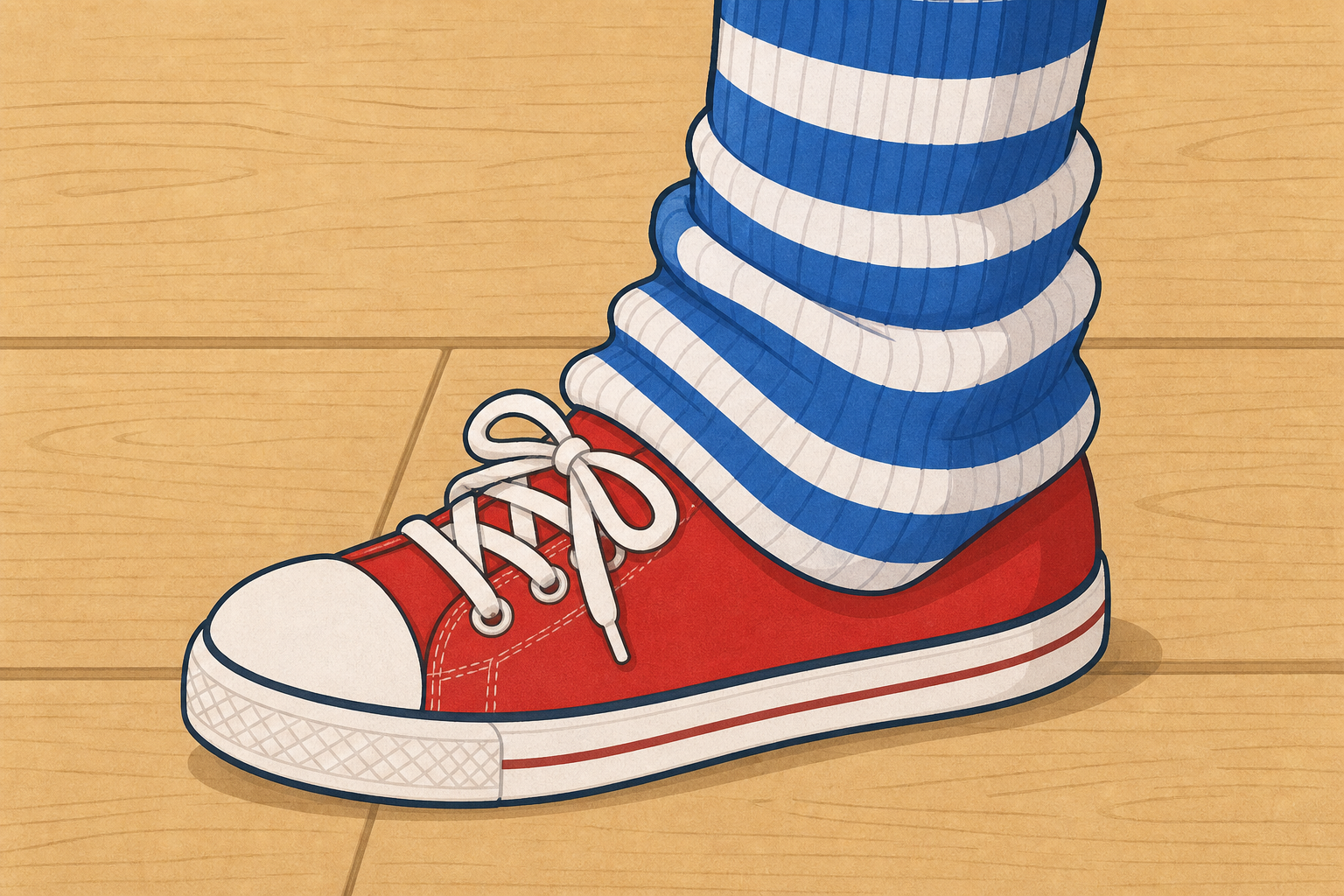
Someone got dressed in a very silly way this morning. Socks after shoes? That cannot be right!
Today we will spot the wrong step and put it right.
Keep this beat light and fun. Mime putting shoes on bare feet, then trying to shove socks over the shoes, and look stuck. Ask: What went wrong? Take two or three quick calls. Do not lay out the full card sequence yet; that comes next. Do not name bug yet unless a child offers a wrong-step idea; the word lands with the cards in the next steps.
Before the lesson: print the provided getting-dressed picture cards (one large front set). Clear a strip of floor so children can act the sequence. Have the cards ready face down until the demonstration. Extra small sets are optional only if you have adult support for groups.
Remember those stuck feet? A wrong step like that is called a bug.
Soon we will look at the picture cards and find the bug together.
| Concept | Why it matters | Example |
|---|---|---|
| Bug — a wrong step that makes a job go wrong | When one step is in the wrong place, the whole job can stop working | Shoes before socks: your feet get stuck and you cannot finish getting dressed |
Keep this beat tiny. One new word only: bug. Anchor it straight back to the stuck-feet mime from Getting Started. Do not define fix as a formal term and do not ask children to spot a bug yet; the wrong card line is not on the floor until the next step.
Prior learning (not new vocabulary): children already know jobs need steps in order from earlier work. Use that language lightly when you act and reorder, but do not teach it as a new key word today.
Everyday action word: when cards are swapped later, simply say we fix it or we put it right. Fix is ordinary classroom talk, not a second concept to learn.
Say the word simply: a bug is not a creepy-crawly here. It is a wrong step. Children may giggle; enjoy that, then point back to the stuck feet.
Misconception to head off: children may think a bug means they are bad at the job. Frame it as something people expect and put right. Everyone spots bugs.
Watch the picture cards on the floor. One step is in the wrong place. Which one looks wrong?
Full card set (picture-led printables): four large picture cards showing clothes or the dressing action. At most one simple word under each picture. Children should not need to read the cards.
Card A — trousers: picture of trousers (pull on trousers so legs are covered).
Card B — socks: picture of socks (pull soft socks onto bare feet).
Card C — shoes: picture of shoes (slip feet into shoes and fasten).
Card D — jumper: picture of a jumper (pull jumper over head and push arms through).
Correct order: A, B, C, D (trousers → socks → shoes → jumper).
Wrong order to show first: A, C, B, D (trousers → shoes → socks → jumper). The bug is shoes before socks.
I wonder: lay the four picture cards in the wrong order on the floor. I wonder if these steps will work for getting dressed.
I think: point along the line. I think one step is in the wrong place. Hands up if you can see which card looks wrong. Tally the class guesses on the board options.
I check: act the wrong order yourself, or with a willing child as the robot. Put trousers on. Try shoes on bare feet. Then try socks over the shoes. Look stuck. Reveal what happened. Name it now: That wrong step is our bug.
I put it right: ask the class which two cards to swap. Move C and B so the order is A, B, C, D. Act it again smoothly. We spotted the bug and we put it right. Socks come before shoes.
One breath technology link (optional, oral only): People who write steps for a toy robot have to get the order right too, or the helper gets stuck, just like our feet.
What to expect: most children will shout shoes or socks. Some may say the jumper is wrong; gently guide them back to the stuck feet. Keep the tone giggly, never shaming.
Your turn! Act the silly steps. Freeze when you spot the bug. Help put the cards right. Then act it the smooth way.
Default path is whole-class with one large picture-card set at the front. Run two or three short bursts with a quick regroup. Change the board prompt or your spoken cue at each burst so children know whether they are acting, spotting, or checking.
Board/spoken cue: Act the silly steps. Freeze at the bug.
Lay the cards in the wrong order again (A, C, B, D). Children stand in a space and act each card as you point. Freeze when the shoes-before-socks bug appears. Ask: Where is the bug? Invite one child to swap the two cards. Act the fixed order together.
Board/spoken cue: Watch our robots. Spot the bug and help put it right.
Invite one or two children to the front as robots. You (or another child) lay a secret wrong order by swapping any two cards. The robots act until the watching class spots the bug. Fold watchers in with questions: Do you think that will work? Which card should move? A helper swaps the cards. Try the smooth order. Swap roles once.
Optional only if you have extra illustrated sets and adult support: small groups of about four may use their own card sets the same way. Do not plan this as the default. If floor space or cards are tight, stay whole-class for the full activity.
Board/spoken cue: Check the order together.
Back on the carpet. Show the fixed line. Class checks: trousers, socks, shoes, jumper. Cheer the fix.
Guiding questions: Which step is wrong? What should come before shoes? How did we put it right?
Differentiation: for children who need more support, only swap socks and shoes and keep the other two cards fixed. For a stretch, invite helpers to invent a new silly bug (jumper before trousers) and put that right too.
Look-fors: children point to the out-of-order card; they suggest a swap; they can act the smooth order after the fix.
Talk together: What was our bug today? What did we swap? How did it feel when the steps worked?
A person who fixes bikes checks the steps and puts wrong ones right, just like we did with socks and shoes.
Keep this oral and display-only. Stay on concrete recall of today's cards first, then one familiar everyday fixer.
Draw out:
Familiar fixer anchor (one breath): name one role the class already knows, such as a person who fixes bikes, or someone who puts a toy back together. They check the steps and put a wrong one right, just like we did. Do not open with Who checks their steps? and do not add makers as a new word to learn. If you want a technology strand whisper, add: People who write steps for a toy robot have to get socks-before-shoes order right too, or the helper gets stuck.
Prompts if talk stalls: What was wrong in our line? Which two cards did we move? Show me a thumbs-up if the smooth order felt better.
You're previewing this lesson. Get full access to this lesson and hundreds more — each one ready to teach, with interactive activities, printable resources and pupil progress tracking built in.