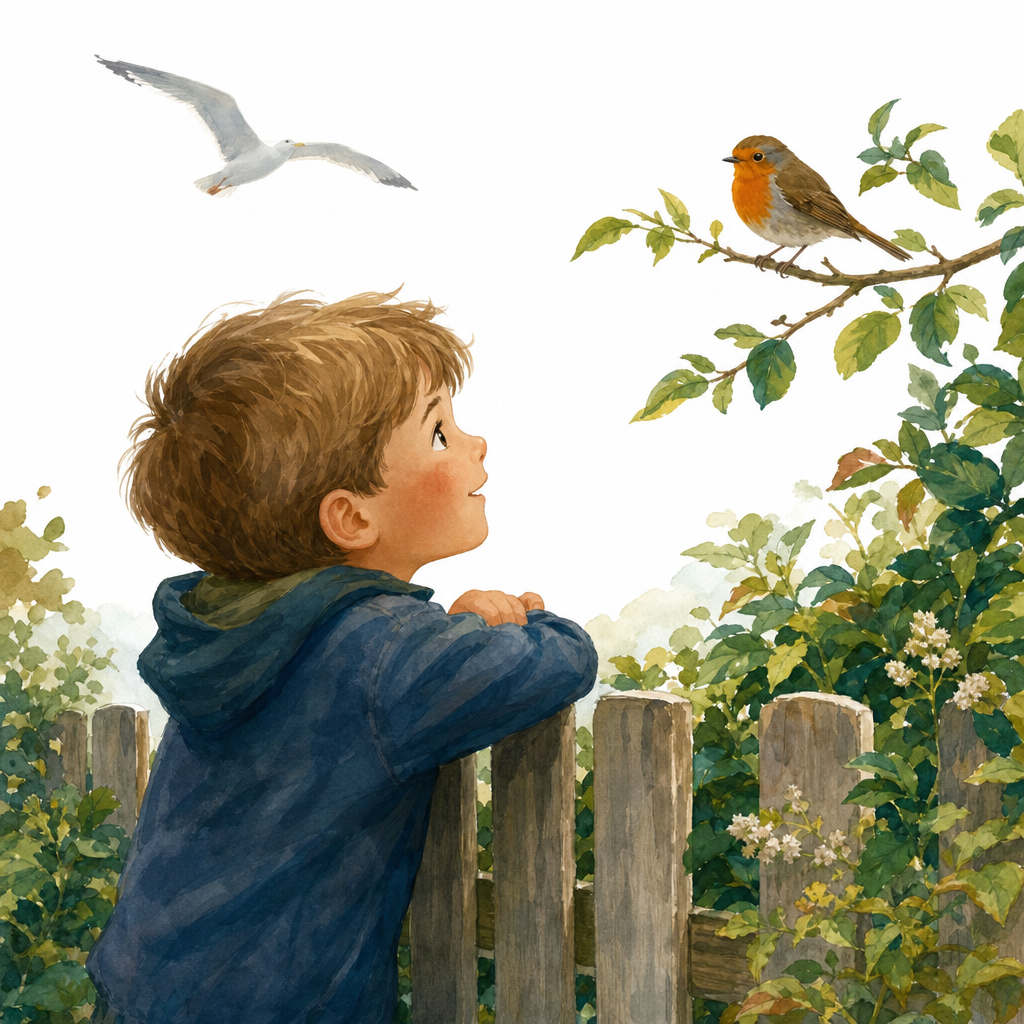
Which birds are here all year, and which only sometimes? Think of a robin in winter and a seagull by the sea in summer. Today we name eight birds in German and say when we might see some of them, using a small set of months and seasons.
Take a few quick answers about year-round versus seasonal birds, then move on. Do not teach the German words yet; the flashcards do that. If someone names a robin or seagull, nod and say those words are coming today. Keep the hook under five minutes so Present has its full ten.
Each card shows a bird. Listen to the German name with der, die or das, then repeat it with the class. After one full listen-and-repeat pass, volunteers can try the German before the card flips. Listen for the ö in Möwe and the soft ch in Rotkehlchen.
Run this as whole-class on the board. Pass 1 (listen and repeat): show image and German with the article, play audio or model yourself, class repeats chorally. Do not ask for English-to-German yet. Insist on the article every time: Adler alone is not enough; der Adler is the answer. After the first clean article-plus-bird answer, say something warm and quick: Genau — article and bird together, that is proper German.
Pass 2: volunteers see English (or image), say German with article, then flip to check.
Hard sounds on the board: Möwe = MUR-vuh (rounded lips for ö); Rotkehlchen = ROHT-kehl-khyen (soft ch as in ich); Krähe = KRAY-uh; Pinguin = pin-goo-EEN.
Mini month bank (teach now — pupils have not met months yet): write and chorus once: im Dezember (im day-TSEM-ber), im März (im MAIRTS), im April (im ah-PRIL), im Juni (im YOO-nee), im Winter (im VIN-ter), das ganze Jahr (dahs GAN-tsuh YAHR). Keep this strip visible for the rest of the lesson.
Sentence models (both same shape — nominative + kommt): say slowly and class repeats each twice: Das Rotkehlchen kommt im Dezember (dahs ROHT-kehl-khyen KOMT im day-TSEM-ber). Then: Die Möwe kommt im Juni (dee MUR-vuh KOMT im YOO-nee). Leave both lines pinned on the board.
Spotlight for sentences today: das Rotkehlchen, die Möwe, der Pinguin, der Spatz (use das ganze Jahr for the sparrow). The other four birds stay at name-and-article only on the wheel. Note: treat Rotkehlchen/Pinguin as strong season links; for Adler, Eule, Schwan, Krähe any sensible month or das ganze Jahr is fine.
Flip two cards at a time and find each German bird with its English meaning. Whisper the German as you turn each card, article included. This is a memory match, not a race.
Whole class on the IWB with volunteers, or pairs if devices are available. Audio plays on each flip, so pause and let the class echo any word that was missed twice. If a pair is stuck on die Möwe or das Rotkehlchen, stop and say it together before they continue. Keep the two model sentences and the month strip visible at the side of the board through this step. Recognition only here: no sentence writing yet. Oral bird-plus-month practice comes next on the wheel, then the copy moment.
Copy the two model sentences from the board, then write one more of your own using a spotlight bird and a month or season from the word bank.
Models on the board:
Spotlight birds: das Rotkehlchen, die Möwe, der Pinguin, der Spatz
Time words: im Dezember, im März, im April, im Juni, im Winter, das ganze Jahr
Keep der, die or das in front of every bird, and capital letters on every German noun.
This step comes after the wheel so every pupil has already heard and said the bird-plus-month pattern aloud. Pause other board clutter and leave both worked models large and visible: Das Rotkehlchen kommt im Dezember. and Die Möwe kommt im Juni. Everyone writes; this is the only three minutes where every pen should move. Expected outcome: two copied models plus one independent line (support: copy models only and gap-fill one month; extension: two independent lines). Walk the room and check for the article, the capital noun, and a time word from the bank on the board. Do not collect the copies. If a pupil is stuck, point at a spotlight bird they already said on the wheel rather than inventing new vocabulary.
First, chant two bird-plus-month lines with the class. Then spin the wheel. When it lands on a bird, say the German with its article. For the four spotlight birds, add when you might see it: Der/Die/Das ___ kommt im ___.
Before the first spin (about one minute): with models still visible, whole-class chant: Das Rotkehlchen kommt im Dezember and Die Möwe kommt im Juni. Optional third: Der Spatz kommt das ganze Jahr. Then one playful stretch: if the wheel gives you die Eule, give us a midnight month (e.g. im Dezember) for fun.
Support stem on screen: Der/Die/Das ___ kommt im ___. Month stays optional for weaker pupils; name-and-article is a full pass. Spotlight birds for the full sentence: Rotkehlchen, Möwe, Pinguin, Spatz. Other four: article + noun only unless a confident pupil volunteers a month.
Spin, name a pupil, allow a five-second whisper rehearsal with a neighbour, then the named pupil answers. Stay at the board; nominate around the room. Use a thumb-signal or whisper the first sound if someone freezes — do not circulate mid-spin. Keep the pace brisk so several children get a turn. If the same bird comes up twice, ask for a different month the second time.
Quick Stimmt das? listen (2–3 items, different demand from naming): you say a line; class shows thumbs up/down. Example: Die Möwe kommt im Dezember — stimmt das? (usually no). Der Spatz kommt das ganze Jahr — stimmt das? (yes). Rebuild one wrong line together.
Pronunciation reminders: Möwe needs rounded ö (MUR-vuh); Rotkehlchen soft ch; Pinguin stress on the last beat (pin-goo-EEN).
This oral production beat comes before the copy moment so every pupil has heard and said the pattern before pens move.
You're previewing this lesson. Get full access to this lesson and hundreds more — each one ready to teach, with interactive activities, printable resources and pupil progress tracking built in.